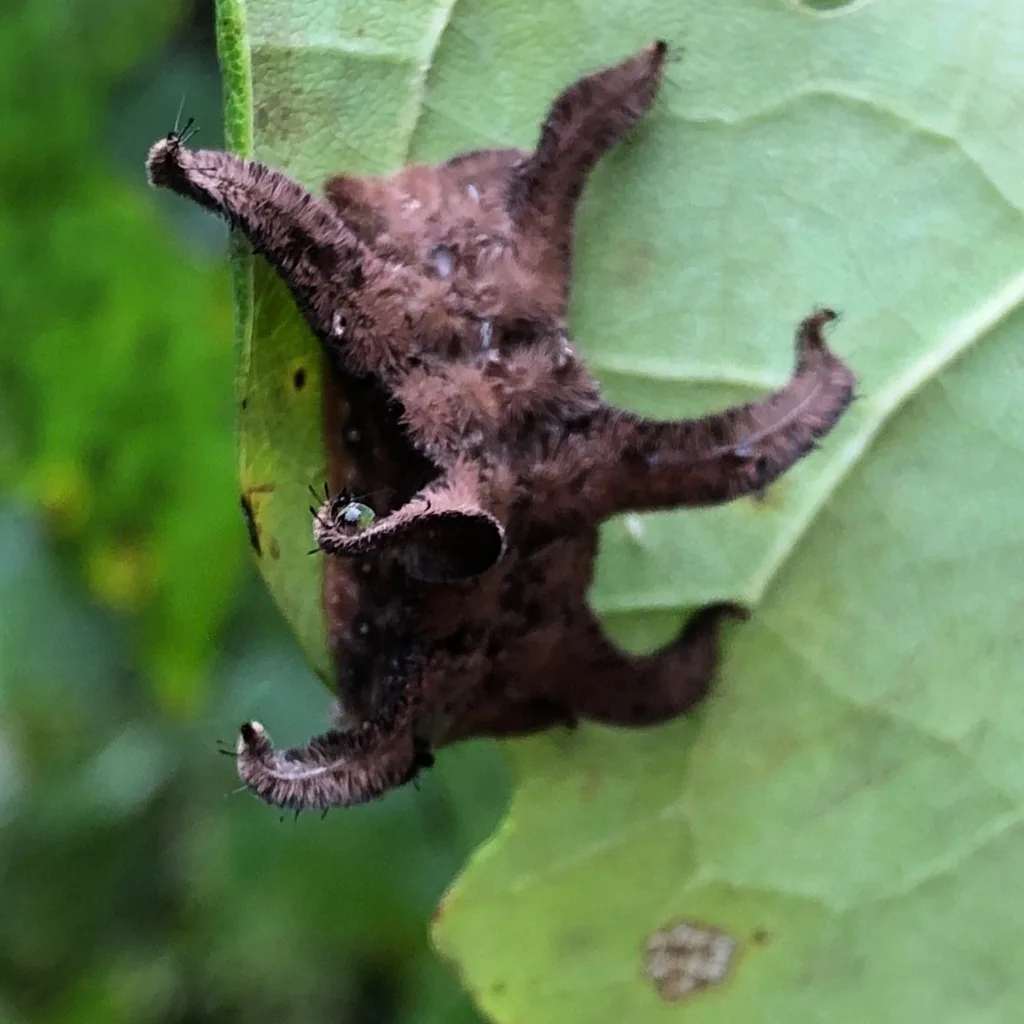
How to identify it
Look-alikes
| Look-alike | How to tell them apart |
|---|---|
| Saddleback caterpillar | Another slug caterpillar, green in the middle with a purple-centered saddle.[1] |
Where it lives
UK Extension lists it among the more commonly encountered stinging caterpillars in Kentucky.[1]
Biology and life cycle
Slug caterpillars creep over leaves like slugs, with the head and legs hidden from above.[1]
It's usually seen feeding on the undersides of leaves on lower branches.[1]
Damage and signs
- It feeds on oak, chestnut, dogwood, sassafras, ash and other trees and shrubs.[1]
Health risk
Its hollow stinging hairs release venom into the skin, causing anything from mild itching to pain, swelling and blistering.[1]
Control
Prevention
Don't brush it off or slap it with a bare hand; remove it carefully with a stick.[1]
Traps and physical control
For a single caterpillar, clip the leaf or stem and move it; preventive sprays aren't recommended.[1]
Common questions
Sources
- University of Kentucky Entomology (ENTFACT), “Stinging Caterpillars (ENTFACT-003).” entomology.mgcafe.uky.edu/ef003 (accessed 2026-10-06)
- iNaturalist, “Phobetron pithecium taxon page (order and family).” www.inaturalist.org/taxa/122254 (accessed 2026-10-06)