On this page
How to identify it
- In early May, leaves opening from attacked buds are riddled with small shot holes. Later, sections of leaves are folded or rolled by tying veins or leaf edges together, and finally two or more leaves are tied together with silk.[1][3][2]
- Young caterpillars are yellowish brown with a shiny black head. Full-grown caterpillars are about 1/2 inch long, off-white to greenish yellow or light green, with a light brown to brownish-black head and dark legs near the front.[3][2]
- Mature caterpillars hang from oaks on silk threads as they drop to the ground to pupate.[3][1][2]
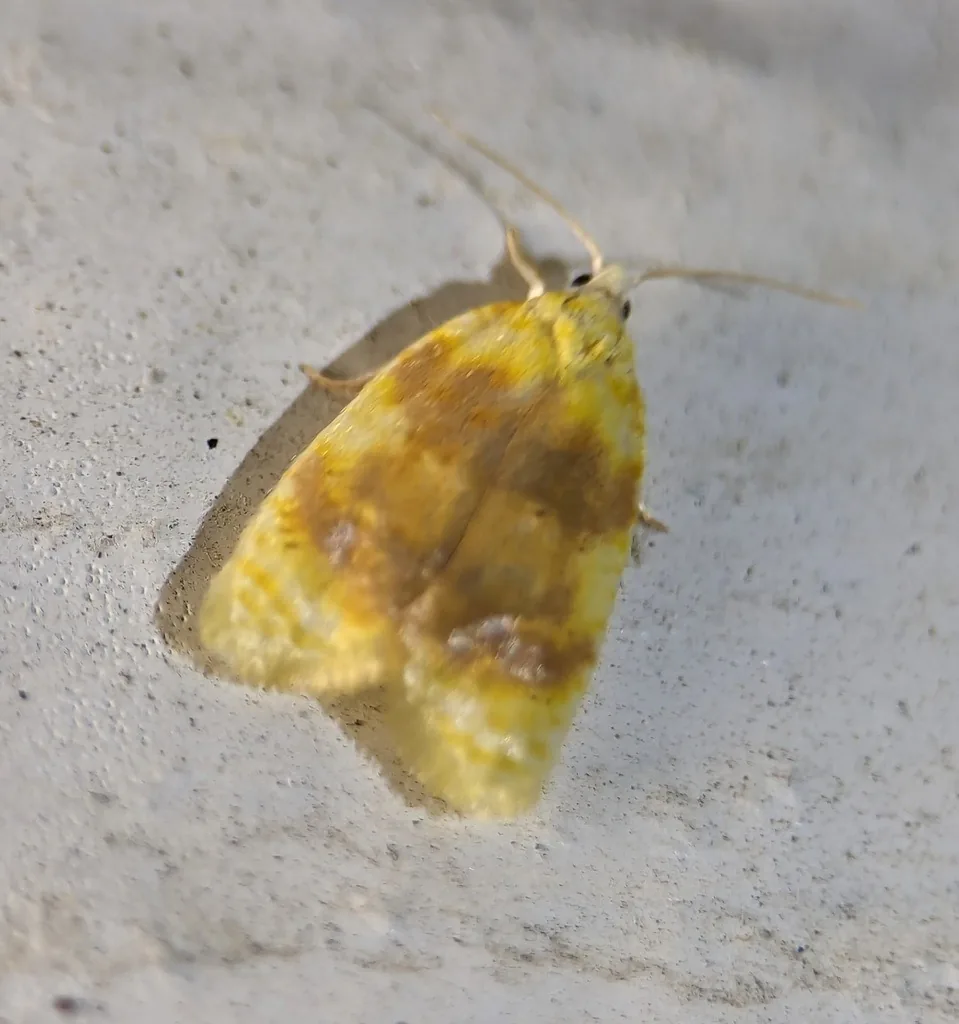
- The moth is small, with a wingspan of about 1/2 inch, and sulphur yellow with brown markings. In late June and July it can be seen flitting around oak crowns.[3][1][2]
Look-alikes
| Look-alike | How to tell them apart |
|---|---|
| Oak leafroller (Archips semiferana) | Another leafrolling caterpillar of oaks that is often found together with the oak leafshredder.[2] |
| Winter moth | Its early-spring caterpillars also leave holes in oak leaves that open from damaged buds, a similar kind of damage.[2] |
Where it lives
It is native to eastern North America and attacks oaks throughout the northeastern United States and eastern Canada, mainly in mature red oak stands. Heavy infestations have been reported from Maine, New York, New Jersey, Connecticut, Pennsylvania and West Virginia.[1][3][2]
Biology and life cycle
Red oak is the main host, and UMass lists scarlet oak as a preferred host too.[1][2][3]
It spends the winter as eggs, laid one at a time in rough bark or cracks on two- and three-year-old twigs, often around the nodes.[1][3]
Eggs hatch from mid-April to early May. The earliest caterpillars can get into buds even before they open, and much of the defoliation comes from this bud feeding. They then move to the expanding leaves, mining them at first and later feeding in folded or tied shelters and eventually in the open.[2][3][1]
When full grown, the caterpillars spin down on silk to the ground and pupate in the leaf litter. Moths fly from late June into July and lay the eggs that overwinter.[3][1][2]
Outbreaks don't happen every year and may come in cycles of several years. It is rare to see more than two years in a row of heavy defoliation before a population collapses. A small parasitic wasp in the genus Dimmockia is reported as a parasitoid.[2][3]
Damage and signs
- Infested oaks look ragged, sparse and distorted, with rolled and browned leaves and thin crowns. In an outbreak, every bud on a tree may be killed.[3][1][2]
- Most trees grow new leaves, but the second set is usually yellower and somewhat stunted. Trees can generally survive two, possibly three, years of defoliation in a row before twigs and branches start dying; severe infestations cause growth loss, and several years of defoliation can kill trees.[3][1]
- Large outbreaks have caused real losses: in 1966, about 10,000 acres of oak on West Virginia's Monongahela National Forest suffered heavy mortality.[2]
- For homeowners, the biggest annoyance is often the caterpillars spinning down on silk onto patios and the family barbecue.[3]
Health risk
The sources describe the caterpillars dropping on silk threads as a nuisance around homes; they mention no harm to people.[3][2][1]
Control
Prevention
Watch for damage in late April and early May. Yellow moths around oak crowns in summer signal an infestation the following spring, and pheromone traps can be used to monitor the moths.[2][1]
Help defoliated trees recover: water them well after defoliation and keep them vigorous. Fertilizing may help, but only early in the season following defoliation.[2][3]
Biological control
Bacillus thuringiensis subspecies kurstaki, a biological insecticide, is among the products UMass Extension lists for this caterpillar.[2]
Pesticides
Individual shade or ornamental oaks can be protected by spraying when the buds begin to break; the Maine Forest Service names carbaryl or cyfluthrin. One spray may also control sawflies and spongy (gypsy) moth feeding at the same time. UMass also lists spinosad, and horticultural oil against the eggs. Don't apply concentrated mistblower sprays to tender new foliage, and apply products after bloom to protect pollinators.[3][2]
Common questions
- Why are my oak's new leaves full of small holes in spring?
- If the leaves are on red oak and also tied or rolled with silk, oak leafshredder caterpillars are a likely cause: they mine the buds, so leaves open already riddled with holes.[1][3][2]
- What are the little caterpillars hanging on threads from my oak tree?
- In late spring these are often mature oak leaf tier caterpillars, about 1/2 inch long, dropping on silk to pupate in the leaf litter.[3]
Sources
- Natural Resources Canada, Canadian Forest Service, “Oak leafshredder, Trees, insects and diseases of Canada's forests.” tidcf.nrcan.gc.ca/en/insects/factsheet/12040 (accessed 2026-11-09)
- UMass Extension, University of Massachusetts Amherst, “Landscape, Nursery and Urban Forestry Insect & Mite Guide: Acleris (Croesia) semipurpurana (oak leaftier).” www.umass.edu/agriculture-food-environment/landscape/publications-resources/insect-mite-guide/acleris-croesia-semipurpurana (accessed 2026-11-09)
- Maine Forest Service, Maine Department of Agriculture, Conservation and Forestry, “Oak Leaf Tier, Forest Pest Index.” www.maine.gov/dacf/mfs/forest_health/insects/oak_leaf_tier.htm (accessed 2026-11-09)
- iNaturalist, “Acleris semipurpurana taxon page (order and family).” www.inaturalist.org/taxa/319692 (accessed 2026-11-09)