On this page
How to identify it
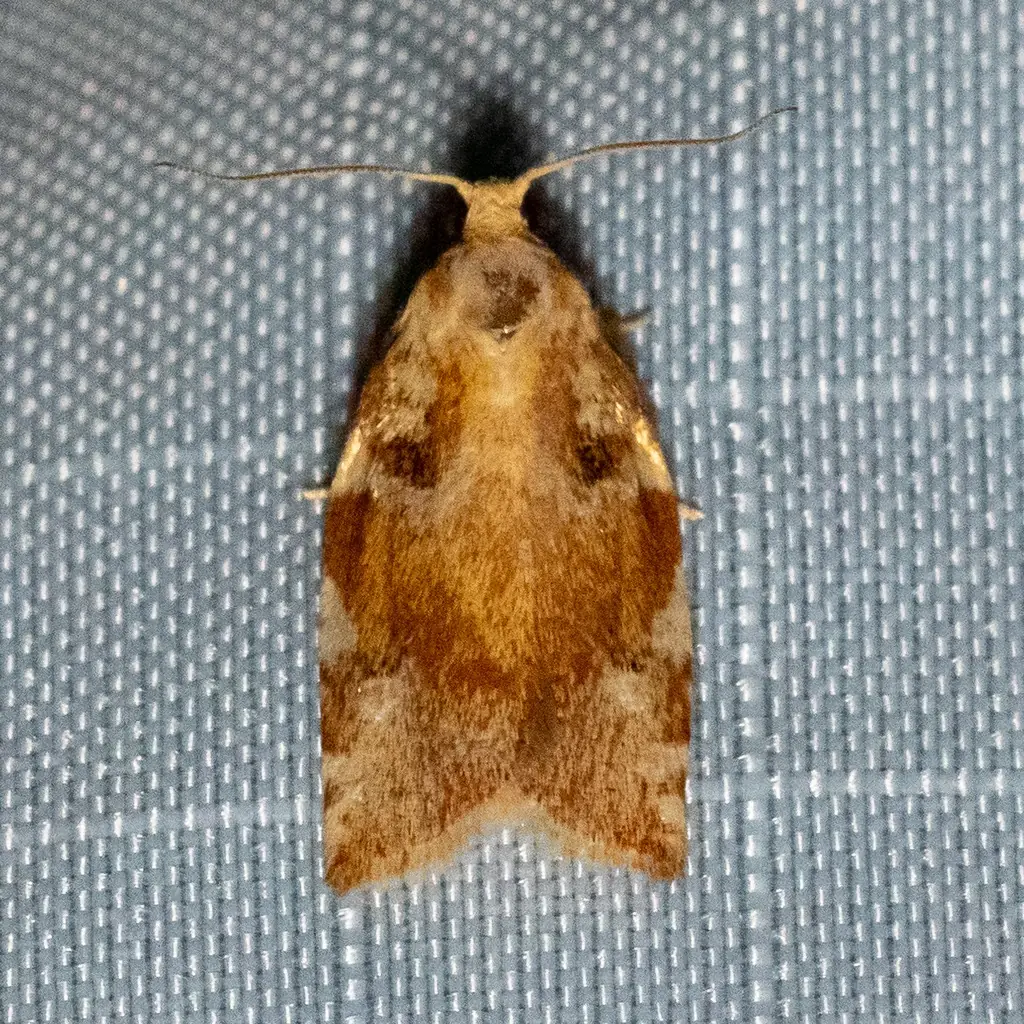
- The adult is a small moth about 1/2 inch long with mottled brown wings marked with dark brown.[2]
- Larvae are creamy white to greenish caterpillars with dark black or brown head capsules, reaching about 3/4 inch; they pass through five instars and spin down on silk threads from leaves, branches or the trunk when dislodged.[2][1]
- Eggs are laid in an oval mass of rounded eggs near twig crotches or on twig tips and leaf buds, covered with scales from the female's abdomen; they are the overwintering stage.[1][2]
- Feeding sign progresses from clusters of newly emerging leaves webbed together with the upper surfaces skeletonized, to shredded foliage with only the major veins intact, to single leaves or lobes rolled lengthwise or sideways.[1]
Look-alikes
| Look-alike | How to tell them apart |
|---|---|
| Oak leafshredder (oak leaftier) | Northern oaks host a group of leafrollers, tiers and shredders that are hard to tell apart in the field, and the oak leafroller may be found on the same tree as the oak leaftier.[1] |
| Sparganothis pettitana | An associated leafroller in Texas oak outbreaks whose moth has lemon-yellow wings and is 1/2 to 3/4 inch long, versus the mottled brown oak leafroller moth; both have one generation and the same spring timing.[2] |
| Cankerworms (inchworms) | Spring and fall cankerworms, often called inchworms, also dangle from oaks on silk threads in spring; they are not leaf-rolling caterpillars.[2] |
| Uglynest caterpillar | Another Archips, but its larvae feed and pupate in frass-filled silk nests on cherry along hedgerows and roads rather than rolling and shredding oak leaves.[4] |
Where it lives
A native insect of eastern oak forests, recorded on oak and witch-hazel by the USDA Forest Service and on red oaks, scarlet oak, apple, pear and hazel by UMass; it occurs throughout Texas and is most destructive in the Hill Country and South Texas, with damaging populations reported from Fredericksburg, Kerrville, Boerne, New Braunfels, San Antonio, Floresville and Goliad.[3][1][2]
Biology and life cycle
There is one generation a year. Adult moths are active in July in Massachusetts and from about the first of May in Texas; females lay their egg masses on twigs, and the eggs stay in place about 10 months, hatching close to red oak budbreak (mid-March in Texas).[1][2]
Young caterpillars feed in small groups by webbing together newly emerging leaves and skeletonizing the upper surfaces inside the web. As they grow they web and roll new leaves and feed between the veins, and the oldest larvae become solitary, rolling single leaves or lobes.[1]
Caterpillar feeding is finished by late April in Texas and by the end of June in the Northeast. Pupation takes place in rolled, still-green leaves, on twig tips, in bark crevices or on vegetation below the tree, and in Texas the moths that emerge in May lay eggs on oak, hackberry, pecan and walnut.[2][1]
Egg parasitoids in the genus Trichogrammatomyia and the pupal parasitoids Itoplectis conquisitor and Phaeogenes gilvilabris attack the oak leafroller, and Texas A&M notes that parasitic wasps are its best natural control, with mockingbirds also feeding on the dangling caterpillars.[1][2]
Damage and signs
- Oak foliage becomes tattered or shredded with only the major leaf veins left, and the oak leafroller is capable of defoliating its host. Historically large outbreaks of this native insect have occurred, with caterpillars distributed by the wind, but its natural enemies typically keep populations below damaging levels and outbreaks are cyclic rather than yearly.[1][2]
- Defoliation during the growing season stresses a tree: it stops manufacturing sugars, draws on reserve food to releaf, and becomes more susceptible to diseases and wood-boring insects. Trees completely defoliated year after year, especially under drought, can die.[2]
- In the Texas Hill Country the caterpillars are also a nuisance, dangling by the hundreds from trees, branches and nearby objects by mid-April.[2]
Health risk
Texas A&M states that the caterpillars are harmless to people and animals; walking through the dangling caterpillars is a nuisance, and broad-brimmed hats and long sleeves help avoid contact.[2]
Control
Prevention
Watch for clusters of webbed leaves as oak foliage opens in spring, and check valuable landscape trees with a history of infestation closely from mid- to late March in Texas.[1][2]
For most Hill Country oaks insecticides are not feasible and the best course is often to do nothing; populations are cyclic and post oaks have survived periodic defoliation without intervention. Keep trees vigorous, water during drought, and fertilize and water trees that have been severely defoliated.[2][1]
Biological control
Parasitic wasps attacking eggs and pupae, along with birds such as mockingbirds, are the main natural controls and usually keep the leafroller below damaging levels, though they are seldom enough to stop an outbreak once it starts.[1][2]
Pesticides
Where a valuable tree shows heavy feeding, Texas A&M lists sprays of carbaryl or Bacillus thuringiensis var. kurstaki, or other products labeled for caterpillars or oakworms on ornamental trees. UMass also lists spinosad, azadirachtin or neem oil, horticultural oil against the eggs, and pyrethroids such as bifenthrin, permethrin and lambda-cyhalothrin, with applications made after bloom to protect pollinators.[2][1]
Common questions
- What are the caterpillars hanging from my oaks on threads?
- In spring they are often oak leafrollers (or the associated Sparganothis pettitana and cankerworms); the leafroller caterpillars drop on silk when disturbed and are harmless to people and pets.[2]
- Will the oak leafroller kill my tree?
- Usually not: natural enemies normally keep it below damaging levels and outbreaks are cyclic. A healthy tree releafs, but repeated complete defoliation, especially with drought, stresses trees, invites borers and can kill them.[1][2]
- When does the oak leafroller feed?
- From budbreak until the caterpillars finish, which is late April in Texas and the end of June in the Northeast; the eggs then sit on the twigs for about 10 months, so there is one generation a year.[2][1]
Sources
- UMass Extension Landscape, Nursery and Urban Forestry Program, University of Massachusetts Amherst, “Archips semiferana (Oak Leafroller), Insect and Mite Guide.” www.umass.edu/agriculture-food-environment/landscape/publications-resources/insect-mite-guide/archips-semiferana (accessed 2026-11-10)
- Texas A&M AgriLife Extension Service (Texas Cooperative Extension), “Oak Leaf Roller and Springtime Defoliation of Live Oak Trees, E-206 (B. M. Drees, March 2004).” extensionentomology.tamu.edu/wp-content/uploads/2025/03/Oak-Leaf-Roller-and-Springtime-Defoliation-of-Live-Oak-Trees.pdf (accessed 2026-11-10)
- USDA Forest Service, “Eastern Forest Insects, Miscellaneous Publication 1175 (W. L. Baker, 1972; scanned copy).” archive.org/details/easternforestins1175bake (accessed 2026-11-10)
- USDA Forest Service, “Western Forest Insects, Miscellaneous Publication 1339 (R. L. Furniss and V. M. Carolin, November 1977; scanned copy).” archive.org/details/CAT78702369 (accessed 2026-11-10)
- iNaturalist, “Archips semiferanus taxon page (order and family).” www.inaturalist.org/taxa/465083 (accessed 2026-11-10)