On this page
How to identify it
- Look for two to four cupped leaves at the end of a branch tied together with silk into a pouch or purse in mid-May; the tied leaves stop expanding and wrinkle, may turn dark green and can look like a gall. An attacked plant typically carries ten to twenty of these leaf sets.[2][3][1]
- Inside is a single slender caterpillar, green and partly transparent with a shiny black head capsule and a black plate behind the head, up to about half an inch long, along with dark green frass pellets.[1][2][3]
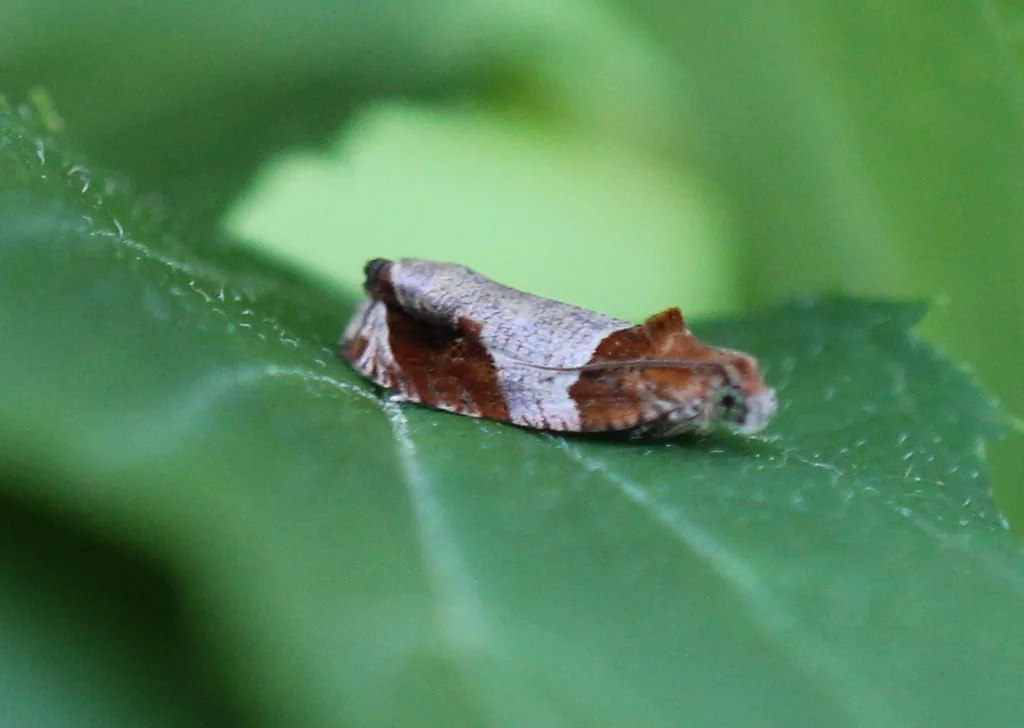
- The adult is a small brown and white moth whose white pattern resembles bird droppings, a camouflage against birds; it flies in spring.[1][2][3]
Look-alikes
| Look-alike | How to tell them apart |
|---|---|
| Gold-striped leaftier | A green leaf-tying caterpillar that lives inside a single folded leaf of birch, ash, maple, oak and other hardwoods; the hydrangea leaftier is recorded only from hydrangeas and pouches the terminal leaves.[4][1] |
Where it lives
Common throughout eastern North America from Maine to North Carolina, and noticeable in central Illinois and other parts of that state. UMass lists it on smooth hydrangea (Hydrangea arborescens) and other Hydrangea species in Massachusetts.[2][3][1]
Biology and life cycle
The moth emerges in spring and lays its eggs on the branch tips of hydrangeas. The hatching caterpillars cement the newly expanding terminal leaves together with silk and feed inside on the enclosed flower bud and the surrounding leaf tissue.[2][3][1]
After a few weeks of feeding, at about half an inch long, the caterpillar is thought to drop to the soil and pupate, spending the winter there and emerging as a moth the next spring. UMass notes that in Ohio pupal skins have been seen hanging out of the leaf pouches in early to mid June, so some pupation may happen inside the purse.[2][3][1]
There is only one generation a year, so no new pouches form after the spring flush; the ones already made stay visible for the rest of the season.[2][1]
Smooth hydrangea and its cultivars may be attacked more than other hydrangea species.[1]
Damage and signs
- The caterpillar eats the flower bud enclosed in the pouch and part of the surrounding leaves, so a heavily hit shrub can carry fewer blooms, but the damage to the plant's overall health is minor.[3][2][1]
- The cupped, tied leaves at the stem tips are the real complaint: they are obvious, fail to expand and remain all season. Occasional localized problem populations have been reported.[1][2]
Health risk
None of the sources mentions any effect on people; UVM even suggests opening a pouch with children to show them the caterpillar.[2][1]
Control
Prevention
UVM and UMass say no pesticides are warranted for this minor pest, and contact insecticides would not reach a caterpillar sealed inside its pouch anyway.[2][1]
Traps and physical control
Pull the tied leaves apart and crush the caterpillar inside, or pinch or remove the leaf pouches in spring before the insect pupates; this is the standard recommendation from all three universities.[1][2][3]
Pesticides
If treatment is wanted, Illinois Extension says a single forceful spray of Bacillus thuringiensis kurstaki or a labeled pyrethroid directed into the cupped leaves is effective.[3]
Common questions
- What are the cupped, stuck-together leaves on my hydrangea?
- Pouches made by the hydrangea leaftier caterpillar, which ties two to four terminal leaves with silk and feeds on the flower bud inside. Open one and you will find a half-inch green caterpillar with a black head.[2][3][1]
- Will the leaftier hurt my hydrangea?
- Not seriously. It is a minor pest that causes no real damage to the shrub's health, though you may lose some blossoms and the tied leaves stay unsightly all season.[2][3]
- Should I spray for hydrangea leaftier?
- Usually not. Pinching or removing the pouches works, and a caterpillar sealed in leaves is protected from contact sprays. Illinois notes that a forceful Bt or pyrethroid spray into the pouches is effective if you insist.[2][1][3]
Sources
- UMass Extension Landscape, Nursery and Urban Forestry Program, University of Massachusetts Amherst, “Olethreutes ferriferana, Hydrangea Leaftier, Insect & Mite Guide (Professional Guide for IPM in Trees and Shrubs).” www.umass.edu/agriculture-food-environment/landscape/publications-resources/insect-mite-guide/olethreutes-ferriferana (accessed 2026-11-10)
- University of Vermont Extension, “The Hydrangea Leaftier (Ann Hazelrigg, Extension Plant Pathologist, May 30, 2024).” www.uvm.edu/news/extension/hydrangea-leaftier (accessed 2026-11-10)
- University of Illinois Extension, “Hydrangea leaftier (Phil Nixon, Flowers, Fruits, and Frass blog, May 30, 2014).” extension.illinois.edu/blogs/flowers-fruits-and-frass/2014-05-30-hydrangea-leaftier-phil-nixon (accessed 2026-11-10)
- USDA Forest Service, “Eastern Forest Insects, Miscellaneous Publication 1175 (W. L. Baker, 1972; scanned copy).” archive.org/details/easternforestins1175bake (accessed 2026-11-10)
- iNaturalist, “Olethreutes ferriferana taxon page (order and family).” www.inaturalist.org/taxa/322025 (accessed 2026-11-10)