On this page
How to identify it
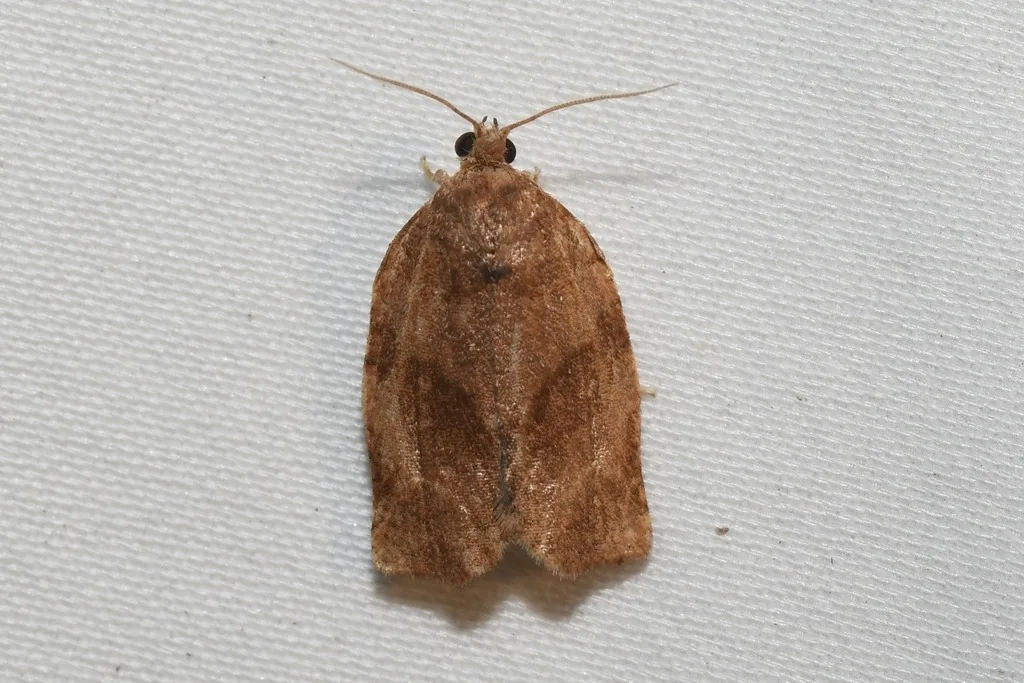
- Moths are about 1/3 to 1/2 inch long with a wingspan of about 3/4 to 1 inch; the forewings are tan to light reddish brown, crossed by three oblique chocolate-brown bands.[1][2][3]
- Caterpillars are green to greenish yellow with a brown to black head and grow to 3/4 to 1 inch; when exposed they wriggle and drop on a silk thread.[2][3]
- Eggs are laid in greenish-yellow overlapping masses on the upper sides of leaves.[1][2]
Look-alikes
| Look-alike | How to tell them apart |
|---|---|
| Redbanded leafroller | A smaller leafroller with similar overlapping egg masses.[2] |
| Fruittree leafroller and other leafrollers | Several leafrollers attack fruit trees; Utah State notes the obliquebanded leafroller is the most common in Utah.[3] |
Where it lives
Native and widely distributed across temperate North America, including Pennsylvania, North Carolina and Utah.[1][2][3]
Biology and life cycle
It overwinters as small larvae on the tree, in bark crevices or under bud scales, and resumes feeding at bud break.[1][3]
There are two generations a year; moths emerge in late May or early June and females can lay up to 900 eggs, which hatch in 10 to 12 days.[1]
Second-generation larvae feed mainly on leaves in late summer and fall before going dormant.[1]
Damage and signs
Health risk
Control
Prevention
Pheromone traps show when moths are flying; most backyard trees don't need treatment.[1][3]
Traps and physical control
Check shoot tips for rolled leaves from mid-May, and squash larvae or cut out infested shoots.[3]
Pesticides
If needed, time sprays to bloom through petal fall for overwintered larvae, or to June and July when summer eggs have hatched.[1][3]
Common questions
- What is rolling and webbing the leaves on my apple tree?
- Often a leafroller such as the obliquebanded leafroller.[1][3]
- Do I need to spray?
- Usually not on backyard trees; hand-picking or pruning infested shoots often suffices.[3]
- When are the caterpillars active?
- From bud break through June, with a second generation in late summer.[1][3]
Sources
- Penn State Extension, “Tree Fruit Insect Pest - Obliquebanded Leafroller (updated February 25, 2026).” extension.psu.edu/tree-fruit-insect-pest-obliquebanded-leafroller/ (accessed 2026-10-16)
- NC State Extension, “Obliquebanded Leafroller (PDIC Factsheet).” content.ces.ncsu.edu/obliquebanded-leafroller (accessed 2026-10-16)
- Utah State University Extension (Integrated Pest Management), “Fruit Leafrollers (fruit pest fact sheet).” extension.usu.edu/planthealth/ipm/notes_ag/fruit-fruit-leafrollers.php (accessed 2026-10-16)
- iNaturalist, “Choristoneura rosaceana taxon page (order and family).” www.inaturalist.org/taxa/143728 (accessed 2026-10-06)