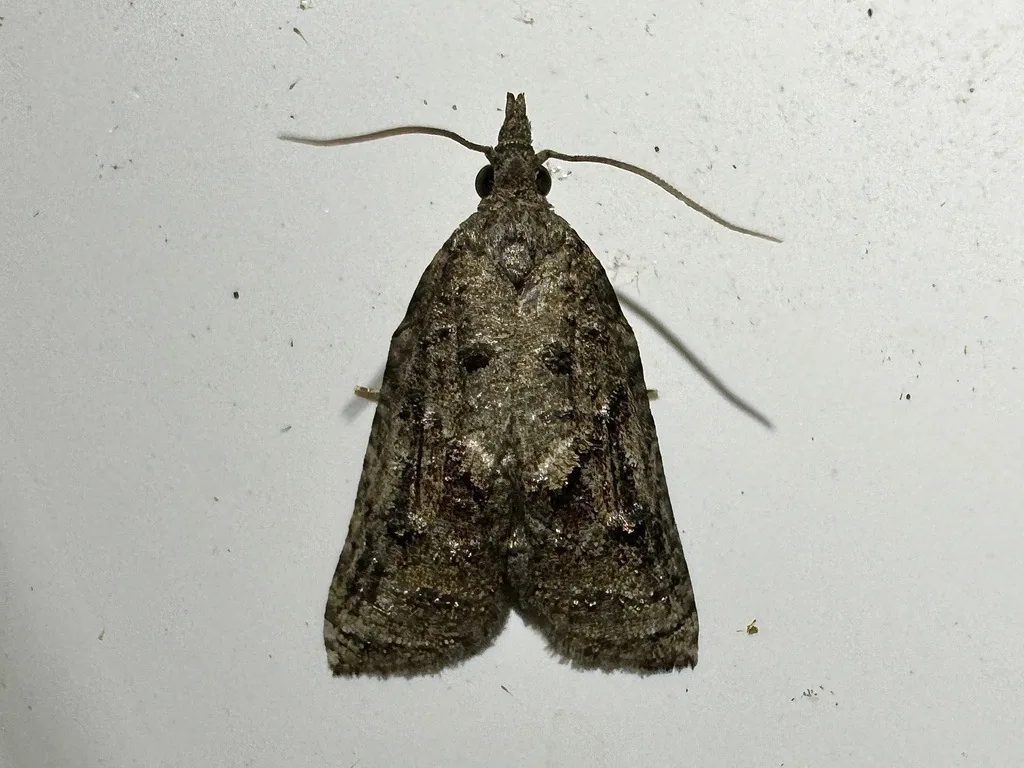
How to identify it
- Moths are about 1/2 inch long, grayish at the wing base and darkening to brown at the tips, with two or three tufts of raised scales on the wings.[1]
- Larvae are light brown to grayish tan with a chestnut-brown head, a darker shield behind the head and a dark stripe down the back.[1]
- Eggs are laid in oval, apple-green masses of up to 150 or more, usually along a vein on the upper leaf surface.[1]
Look-alikes
| Look-alike | How to tell them apart |
|---|---|
| Redbanded leafroller | Its larva has a pale green body and a yellowish-green head.[1] |
| Obliquebanded leafroller | Its larva is yellowish green with a brown to black head.[1] |
Where it lives
Penn State Extension covers it in Pennsylvania apple orchards; larvae also overwinter under cherry, peach and pear trees and in woods.[1]
Biology and life cycle
There are two generations a year, and partly grown larvae overwinter in leaves and rotting fruit on the ground.[1]
In spring they finish feeding on root suckers or weeds such as dandelion, dock and wild strawberry, and moths emerge around the beginning of May.[1]
Egg laying starts in early June; young larvae spread by crawling or floating on the wind, and the second brood starts laying about early August.[1]
Damage and signs
- Rolled leaves matter little; the trouble starts when a larva ties a leaf to an apple and feeds on the fruit.[1]
- Damage shows as tiny holes, irregular scarring or galleries on the skin, or rot around the stem; larvae sometimes feed unseen in the seed cavity.[1]
- Most fruit damage comes from the second brood, though in some years the first brood does more.[1]
Health risk
It feeds on plants; Penn State Extension mentions no risk to people.[1]
Control
Prevention
Orchards track moth flights with sex pheromone traps hung 5 to 6 feet up in the outer canopy by apple bloom.[1]
Pesticides
Sprays aimed at codling moth now give long-lasting control of this moth too, which is why it has become a minor pest.[1]
If damage was too high the previous season, Penn State times sprays around third cover or in the first two weeks of September.[1]
Common questions
- What makes small holes and scars on apples under a stuck-on leaf?
- Tufted apple bud moth larvae tie leaves to apples and feed on the skin underneath.[1]
- How do I tell tufted apple bud moth larvae from other leafrollers?
- Look for a light brown to grayish-tan body, a chestnut-brown head and a dark stripe down the back.[1]
Sources
- Penn State Extension, “Tree Fruit Insect Pest: Tufted Apple Bud Moth.” extension.psu.edu/tree-fruit-insect-pest-tufted-apple-bud-moth (accessed 2026-10-06)
- iNaturalist, “Platynota idaeusalis taxon page (order and family).” www.inaturalist.org/taxa/146797 (accessed 2026-10-06)