On this page
How to identify it
- Caterpillars are green with a shiny black head, which helps tell them from other leafrollers, and they feed inside leaves they roll or web together.[1][2][3]
- Egg masses are flat, irregular patches of 30 to 100 eggs cemented over with a secretion on twigs and small branches; they turn white by spring.[1][2][3]
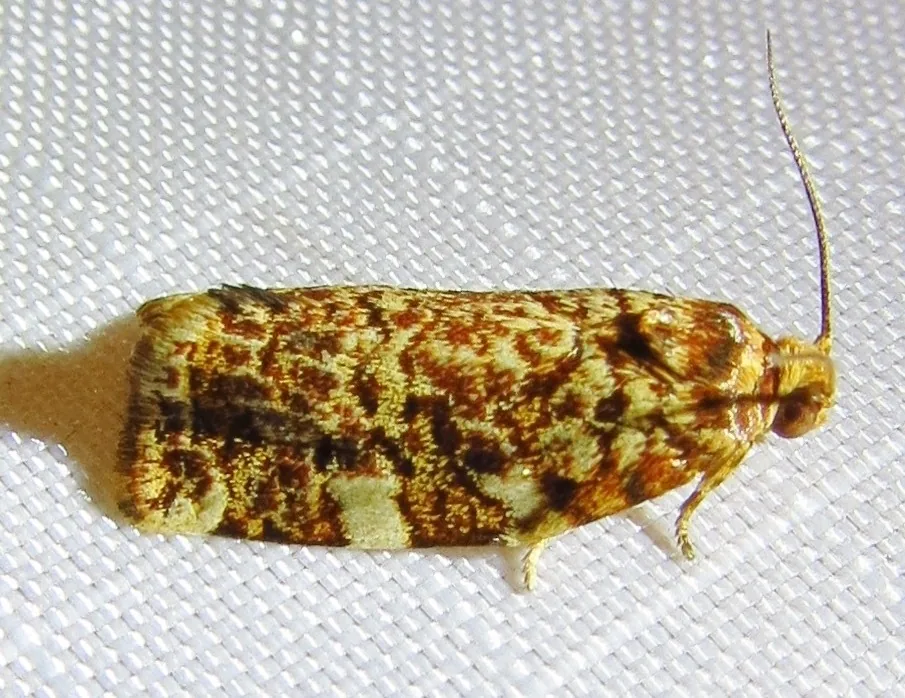
- Adult moths are about 1/2 inch long with rusty brown wings marked with white and gold.[2]
Look-alikes
| Look-alike | How to tell them apart |
|---|---|
| Obliquebanded leafroller | Its young larvae also look green with a black head, but it has two generations a year, so its second brood causes damage later in summer.[1] |
Where it lives
It attacks ornamentals and fruit trees throughout California, from warm inland valleys to the coast, and also occurs in Connecticut apple orchards, though infestations there have been uncommon for decades.[1][3]
Biology and life cycle
It has one generation a year and spends the winter as eggs on bark, which hatch in spring, around bloom.[1][3]
In Connecticut the caterpillars feed from late April to mid-June, pupate in late June and lay new egg masses starting in early July.[3]
Besides leaves, larvae also feed on flower buds, blossoms and young fruit.[2]
Damage and signs
Health risk
It feeds only on plants; UC IPM and the Connecticut station mention no risk to people.[1][3]
Control
Biological control
General predators such as lacewing and lady beetle larvae, plus parasites, usually keep numbers low.[2]
Pesticides
A thorough dormant oil spray covering the egg masses gives good control; Bt works best on caterpillars under 1/2 inch and usually needs more than one spray. Treat only when large numbers of egg masses or young larvae show up, because by the time trees are badly defoliated the caterpillars are almost done.[2][1]
Common questions
- What are the green caterpillars rolling up leaves on my oak in spring?
- Often fruittree leafrollers, the most common leafroller in California landscapes; they feed inside rolled or webbed leaves.[1]
- When should I treat fruittree leafrollers?
- In the dormant season with oil on the egg masses, or with Bt while caterpillars are small; late sprays after heavy defoliation do little good.[2][1]
Sources
- University of California Statewide IPM Program, “Leafrollers on Ornamental and Fruit Trees (Pest Notes 7473).” ipm.ucanr.edu/home-and-landscape/leafrollers-on-ornamental-and-fruit-trees/ (accessed 2026-10-19)
- University of California Statewide IPM Program, “Fruittree Leafroller (UC IPM Pest Management Guidelines: Apple).” ipm.ucanr.edu/agriculture/apple/fruittree-leafroller/ (accessed 2026-10-19)
- Connecticut Agricultural Experiment Station, “Plant Pest Handbook: Apple (Malus).” portal.ct.gov/caes/plant-pest-handbook/ppha/apple-malus (accessed 2026-10-19)
- iNaturalist, “Archips argyrospila taxon page (order and family).” www.inaturalist.org/taxa/214078 (accessed 2026-10-06)