On this page
How to identify it
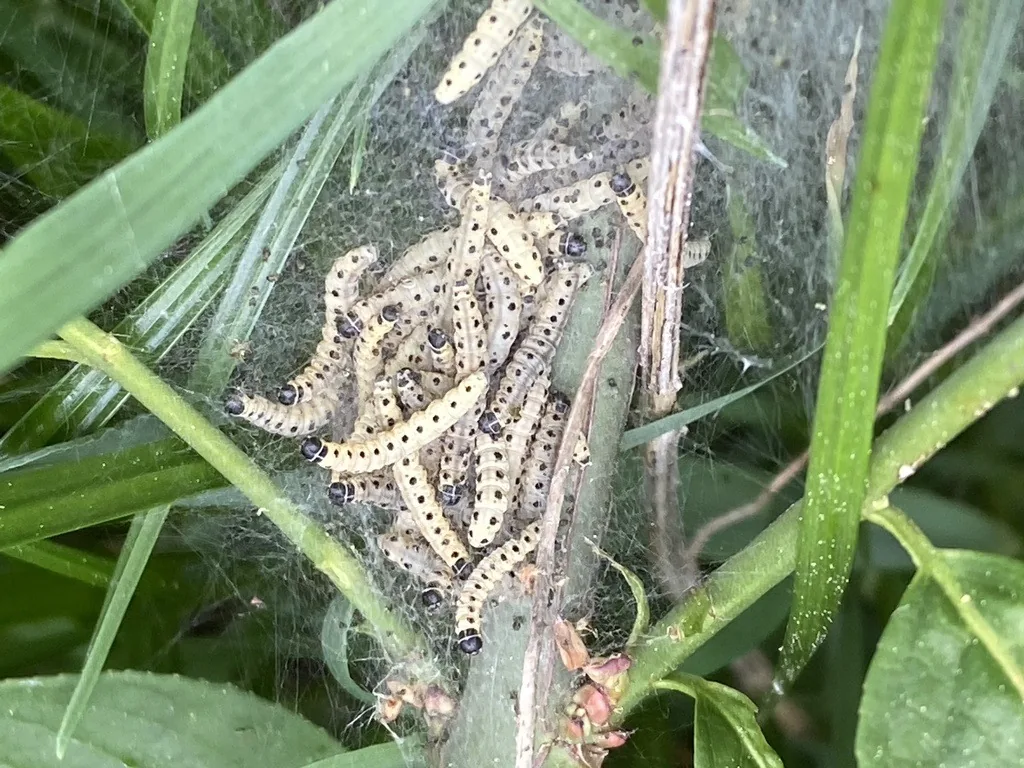
- Caterpillars are cream-colored with dark heads and rows of black spots along the sides, about 3/4 inch long when grown.[2]
- Adults are small white moths, about 1 inch across, covered with black spots.[2]
- The heavy silk webbing over the plant, and sometimes the ground below, is the most noticeable sign.[1][2]
Look-alikes
| Look-alike | How to tell them apart |
|---|---|
| Apple ermine moth | A related ermine moth whose caterpillars web apple foliage instead.[1] |
Where it lives
First detected in Ontario in 1967 and now relatively widespread in the US, reported in Wisconsin, Illinois, Michigan, Iowa and Massachusetts.[1][2]
Biology and life cycle
Moths lay eggs in July on twigs and covers them with a hard coating; caterpillars hatch, feed briefly and overwinter under the egg mass.[1][2]
Caterpillars feed in groups on new foliage in spring, are most noticeable in May and June, then pupate; moths emerge in July.[1][2]
Damage and signs
Health risk
Control
Prevention
Consider not planting Euonymus, many of which are invasive.[1]
Traps and physical control
Scout new foliage in spring and remove webbed nests while they are small.[1]
Common questions
Sources
- UMass Extension Landscape, Nursery and Urban Forestry Program (Landscape Insect & Mite Guide), “Yponomeuta cagnagella (Euonymus Caterpillar).” www.umass.edu/agriculture-food-environment/landscape/publications-resources/insect-mite-guide/yponomeuta-cagnagella (accessed 2026-10-16)
- Iowa State University Extension and Outreach (Horticulture and Home Pest News), “Euonymus Caterpillars Munch Through Windbreak (2012).” yardandgarden.extension.iastate.edu/article/2012/6-13/euonymuscaterpillar.html (accessed 2026-10-16)
- iNaturalist, “Yponomeuta cagnagella taxon page (order and family).” www.inaturalist.org/taxa/319551 (accessed 2026-10-06)