How to identify it
- Adults are long, narrow moths up to 0.4 inch long, with white wings dotted with small black spots and long antennae that sweep back.[1]
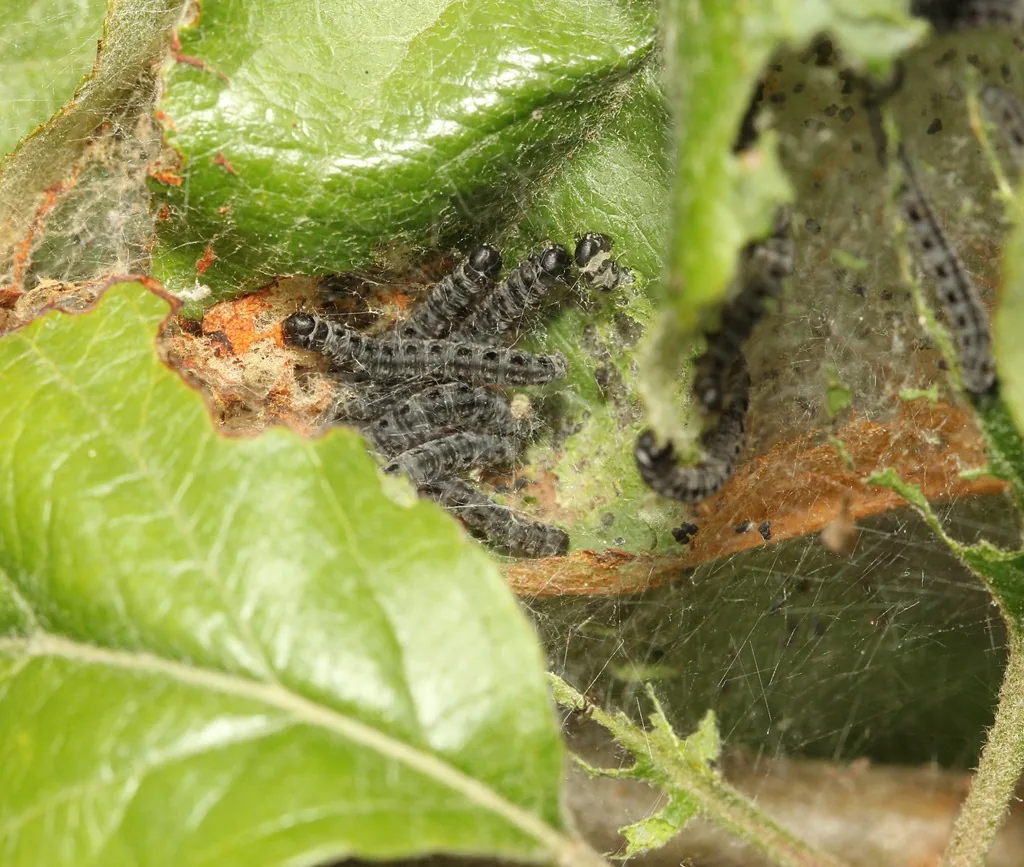
- Larvae are greenish-yellow caterpillars about 1/2 inch long with two rows of black spots.[1]
- They pupate in clusters of spindle-shaped white cocoons inside the webbing.[1]
Look-alikes
| Look-alike | How to tell them apart |
|---|---|
| Fall webworm | Fall webworm tents are much larger than apple ermine moth nests.[1] |
| Tent caterpillars | Their tents are also much larger than apple ermine moth nests.[1] |
Where it lives
Native to Eurasia, it's established in the Pacific Northwest.[1]
Biology and life cycle
Young larvae overwinter under their egg masses on the bark; females lay 10 to 80 eggs per cluster in overlapping rows like shingles.[1]
Larvae mine leaves at budbreak, then tie leaves into nests up to 3 inches across, several caterpillars to a nest.[1]
They pupate in clusters around June, and adults emerge from late June on, laying eggs into fall; there's one generation a year.[1]
Damage and signs
- Larvae eat foliage inside their webs, mainly on unmanaged trees; orchards with few insecticide sprays could also be damaged.[1]
Health risk
It feeds on plants; the PNW Insect Management Handbook mentions no risk to people.[1]
Control
Traps and physical control
Pick off or prune out egg masses on the bark in fall, prune out and destroy nests in May, and remove pupating clusters when you see them.[1]
Pesticides
The handbook lists zeta-cypermethrin for home use and notes it's highly toxic to bees.[1]
Common questions
Sources
- Pacific Northwest Pest Management Handbooks (OSU, WSU, University of Idaho), “Apple: Apple ermine moth (Insect Management Handbook).” pnwhandbooks.org/insect/tree-fruit/apple/apple-apple-ermine-moth (accessed 2026-10-06)
- iNaturalist, “Yponomeuta malinellus taxon page (order and family).” www.inaturalist.org/taxa/324938 (accessed 2026-10-06)