On this page
How to identify it
- The caterpillar is pale green with two faint whitish bands running the length of the body, a large head and a body that tapers toward the rear. It lives inside a leaf folded and held with silk, with a silk shelter on either side of the leaf.[1][2]
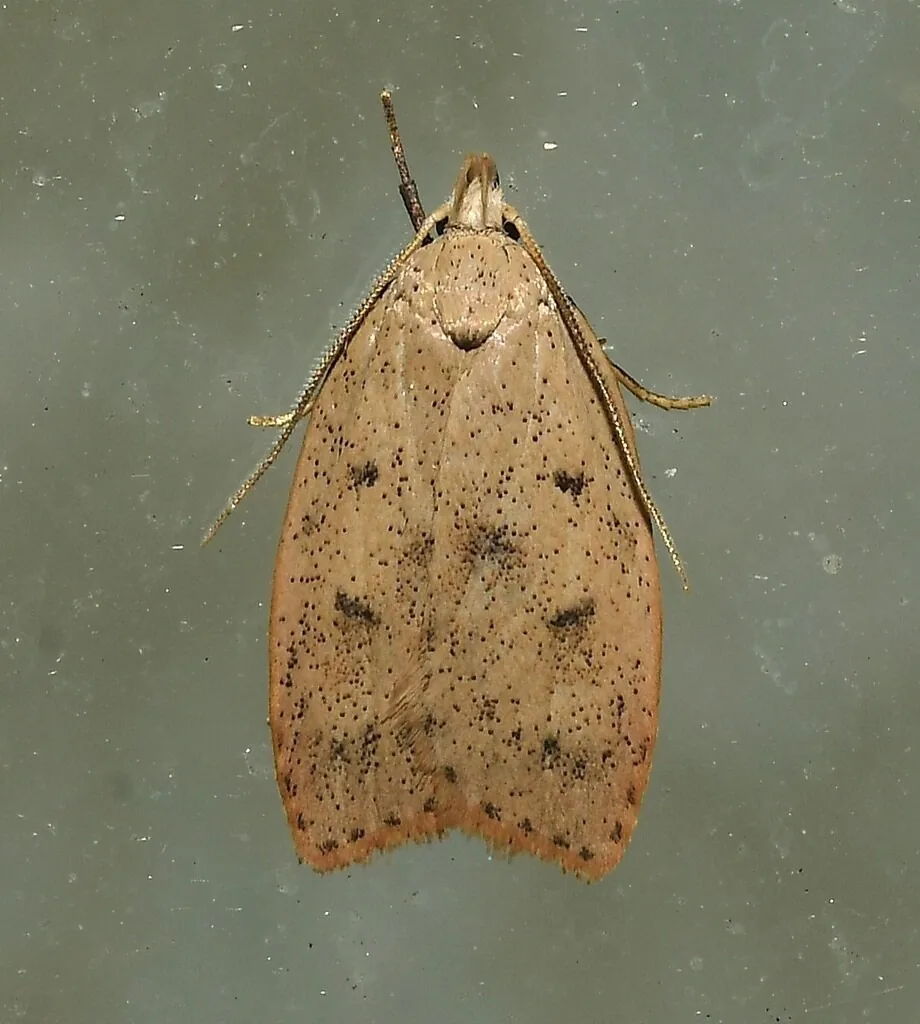
- The adult is light ochreous (a pale yellow-brown) with a wingspread of 18 to 20 mm. The forewing is dusted with black and marked with two black discal dots, a black spot in the fold, a broken line parallel to the outer margin and a row of black dots along the wing edge.[2]
- On blueberries the damage is a folded or tied leaf with yellow or brown frass inside, sometimes with skeletonized leaf tissue or holes chewed in flower buds and fruit.[1]
Look-alikes
| Look-alike | How to tell them apart |
|---|---|
| Blueberry leaftier | Shares highbush blueberry with the gold-striped leaftier, but its caterpillars are cream colored with black heads when young and cinnamon-headed later, burrow into closed flower buds and finish by June; the gold-striped leaftier is pale green and feeds into late summer.[1] |
| Obliquebanded leafroller | The most widespread blueberry leaf tier in North Carolina, with dull green young larvae, a solid black head and later a cinnamon-brown head; it ties terminal leaves together and can have one to three generations a year, while the gold-striped leaftier has one.[1] |
Where it lives
Rather common in the Northeastern States and southeastern Canada on a wide range of hardwoods. In North Carolina it has been noted mainly in the mountains and piedmont, with one record from Camden County in the coastal plain.[2][1]
Biology and life cycle
The caterpillar spins silk shelters on either side of a leaf and feeds inside the folded leaf; as it grows it leaves the shelter at night to feed.[1][2]
There is a single generation a year. In August or September the caterpillar pupates inside a downward-folded leaf for about three weeks and the moth emerges in the fall. Adults have been found in the North Carolina mountains and piedmont as late as December, which suggests the insect overwinters as a moth or as eggs, though its overwintering is not well known.[1]
In North Carolina, caterpillars of the three blueberry leaf tiers begin appearing between April and May.[1]
Hosts recorded by the Forest Service are birch, ash, maple, oak, honey locust, mountain ash, hickory, elm and wild cherry; NC State adds highbush blueberry, with cherry and apple as alternative hosts of the leaf-tier group.[2][1]
Damage and signs
- Leaf tiers skeletonize leaves and can chew holes in fruits and flower buds, leaving yellow or brown frass in the tied or folded leaf. In North Carolina blueberries they are common but rarely cause severe damage.[1]
Health risk
Neither source mentions any effect on people; this is a leaf-feeding caterpillar of trees and blueberry bushes.[1][2]
Control
Prevention
Scout blueberries from April for tightly rolled or folded leaves and feeding on new growth and terminal clusters, and look for patches and rows of light-colored eggs. Sprays are rarely necessary and are worth considering only with many larvae or egg masses early in spring or obvious damage.[1]
Sanitation
Remove rolled leaves and the leaf litter under the plants during fall pruning to take away overwintering sites and reduce the spring population.[1]
Biological control
Spiders, brown lacewing larvae, assassin bugs and birds eat leaf-tier eggs and larvae, and braconid and ichneumonid wasps and tachinid flies parasitize them; avoiding broad-spectrum insecticides keeps these natural enemies working.[1]
Pesticides
Bacillus thuringiensis works on newly hatched larvae under half an inch long, and spinosad is labeled for leafrollers in blueberries; both are available to conventional and organic growers, but spinosad is harmful to bees and should not be used during bloom.[1]
Common questions
- What is the green caterpillar folded inside my blueberry leaf?
- If it is pale green with two faint whitish stripes and hides in a silk-lined leaf fold, it is likely the gold-striped leaftier, one of three leaf-tying caterpillars NC State records on highbush blueberry.[1]
- Does the gold-striped leaftier attack trees too?
- Yes. The Forest Service lists it as rather common on birch, ash, maple, oak, honey locust, mountain ash, hickory, elm and wild cherry in the Northeast and southeastern Canada.[2]
- Do I need to spray?
- Rarely. Leaf tiers seldom cause severe damage in North Carolina blueberries, and natural enemies help; fall removal of rolled leaves and litter is the first step, with Bt or spinosad reserved for heavy early-season infestations.[1]
Sources
- NC State Extension, North Carolina State University, “Leaf Tier Caterpillars in Blueberries (Leo Kerner and Lorena Lopez; published Jan. 4, 2026).” content.ces.ncsu.edu/leaftier-and-leaf-roller-caterpillars-in-blueberries (accessed 2026-11-10)
- USDA Forest Service, “Eastern Forest Insects, Miscellaneous Publication 1175 (W. L. Baker, 1972; scanned copy).” archive.org/details/easternforestins1175bake (accessed 2026-11-10)
- iNaturalist, “Machimia tentoriferella taxon page (order and family).” www.inaturalist.org/taxa/81689 (accessed 2026-11-10)