On this page
How to identify it
- Young caterpillars (first to third instars) are cream colored with a black head and dark thorax; the fourth and final instar is yellowish with a cinnamon-brown head and thorax. Early larvae look much like early obliquebanded leafroller larvae.[1][2]
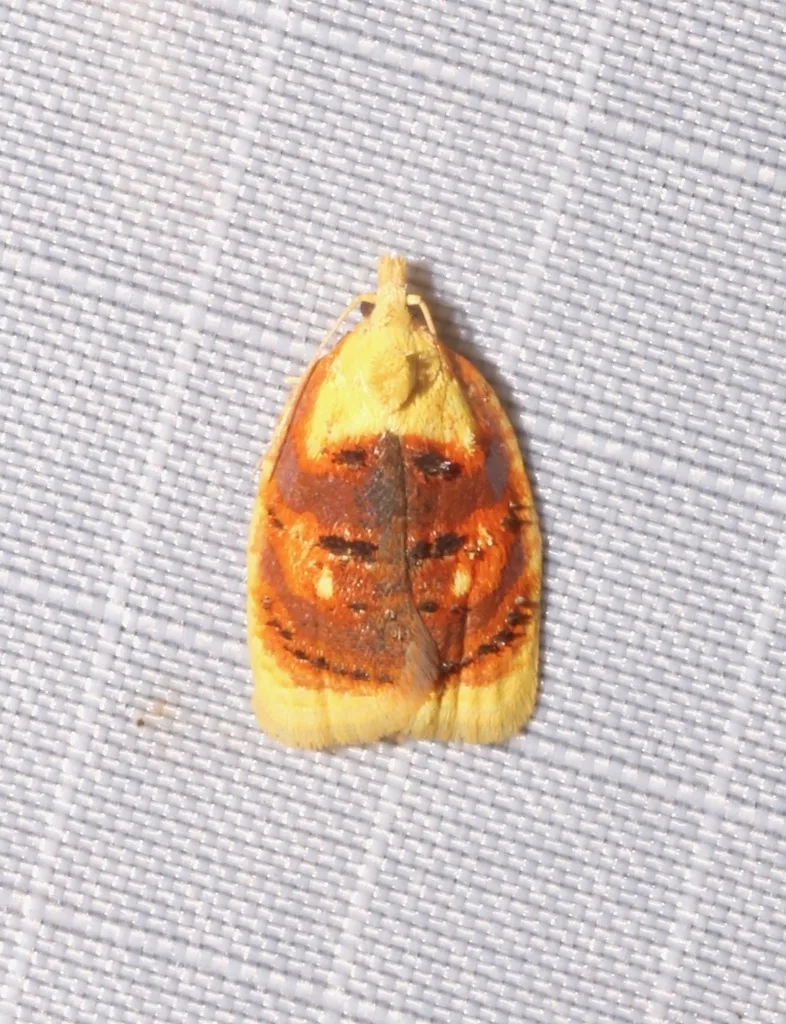
- The adult is a small moth about 6 mm long with a wingspan of 1.4 to 1.6 cm; the thorax and wing margins are yellow, the center of each forewing is reddish brown with a small kidney-shaped yellow spot, and the gray hindwings have a white fringe.[1]
- Signs are closed flower buds with yellow frass from a boring larva in spring, followed by young leaves fastened together with silk into shelters near the shoot tips. Pupae are dark brown, 5 to 7 mm, usually inside the shelters.[2][1]
Look-alikes
| Look-alike | How to tell them apart |
|---|---|
| Obliquebanded leafroller | The most widespread blueberry leaf tier in North Carolina; its young larvae are dull green with a solid black head, it lays its eggs in overlapping masses on leaves in spring rather than overwintering as eggs in the litter, and it can have one to three generations a year.[2] |
| Gold-striped leaftier | Pale green with two faint whitish lengthwise bands, feeding in a single folded leaf into late summer, whereas the blueberry leaftier is cream colored with a black head and is finished by June.[2] |
Where it lives
Found in low numbers throughout the blueberry-growing area of Nova Scotia, with past damage concentrated in Cumberland County. In North Carolina it is the least observed of the blueberry leaf tiers, recorded only in Haywood, Madison, Buncombe, Yancey, Brunswick and Carteret counties.[1][2]
Biology and life cycle
Eggs are laid singly on the leaf litter around the base of blueberry plants in late July and early August and overwinter there; NC State notes they must experience a freeze to complete development. Hatching runs over about three weeks from late April and early May.[1][2]
Newly hatched larvae climb the stems and burrow into closed flower buds, leaving yellow frass. Second and third instars feed on expanding leaf buds and young leaves, fastening leaves together with silk into protective shelters; older larvae move about and feed on flowers as well as leaves.[1][2]
Pupation takes place during the first three weeks of June, usually inside the leaf shelters, and the moths fly from late June through July. The eggs they lay in late July and August are the overwintering stage and do not hatch until the following spring.[1][2]
Damage and signs
- First-instar feeding inside developing flower buds is the most serious damage and can affect up to 20 percent of buds. Older larvae feed on leaves and flowers, and in severe outbreaks defoliation can be close to 100 percent.[1]
- In North Carolina highbush plantings, leaf tiers are common but rarely cause severe damage; they skeletonize leaves and chew holes in fruit and flower buds, leaving frass in the tied leaves.[2]
Health risk
Neither source mentions any effect on people; the insect only damages blueberry plants.[1][2]
Control
Prevention
Commercial lowbush growers in Nova Scotia monitor the moths with pheromone-baited green Unitraps set by the third week of June, 40 m apart and 25 m in from the field edge (three traps for fields under 10 acres, more for larger fields), checked every two to three weeks until mid-August; a season average of 750 moths per trap is the threshold for spraying the larvae next spring. In North Carolina, scouting from April for rolled leaves and bud damage is enough, with pheromone traps only where a severe infestation is suspected.[1][2]
Sanitation
Remove rolled leaves and the leaf litter under the plants during fall pruning; the eggs overwinter in that litter.[2][1]
Biological control
Spiders, brown lacewing larvae, assassin bugs and birds eat leaf-tier eggs and larvae, and braconid and ichneumonid wasps and tachinid flies parasitize them; avoiding broad-spectrum insecticides protects these natural enemies.[2]
Pesticides
Nova Scotia recommends deltamethrin timed to when flower buds begin to swell and show green, which corresponds to about 10 percent egg hatch, so the larvae are killed before they bore into the buds. NC State says sprays for leaf tiers are rarely necessary; Bacillus thuringiensis works on newly hatched larvae and spinosad is labeled for leafrollers in blueberries but should not be used during bloom because it harms bees.[1][2]
Common questions
- How do blueberry leaftiers damage the crop?
- The newly hatched larvae bore into flower buds, which is the most serious injury and can hit up to 20 percent of buds; older larvae web and eat leaves and flowers, and severe outbreaks can defoliate plants.[1]
- When does the blueberry leaftier hatch?
- Over about three weeks from late April into early May, from eggs that overwintered in the leaf litter under the plants.[1][2]
- Is it a problem in highbush blueberries?
- In North Carolina it is the least common of three leaf tiers on highbush blueberry, and leaf tiers there rarely cause severe damage.[2]
Sources
- Nova Scotia Department of Agriculture and Marketing (fact sheet by L. Crozier; PDF hosted by Dalhousie University's Wild Blueberry site), “The Blueberry Leaftier (Lorne Crozier, January 1996), Lowbush Blueberry Fact Sheet.” cdn.dal.ca/content/dam/dalhousie/images/sites/wild-blueberry/pdfs/Blueberry_Leaftier.pdf (accessed 2026-11-10)
- NC State Extension, North Carolina State University, “Leaf Tier Caterpillars in Blueberries (Leo Kerner and Lorena Lopez; published Jan. 4, 2026).” content.ces.ncsu.edu/leaftier-and-leaf-roller-caterpillars-in-blueberries (accessed 2026-11-10)
- iNaturalist, “Acleris curvalana taxon page (order and family).” www.inaturalist.org/taxa/174131 (accessed 2026-11-10)