On this page
How to identify it
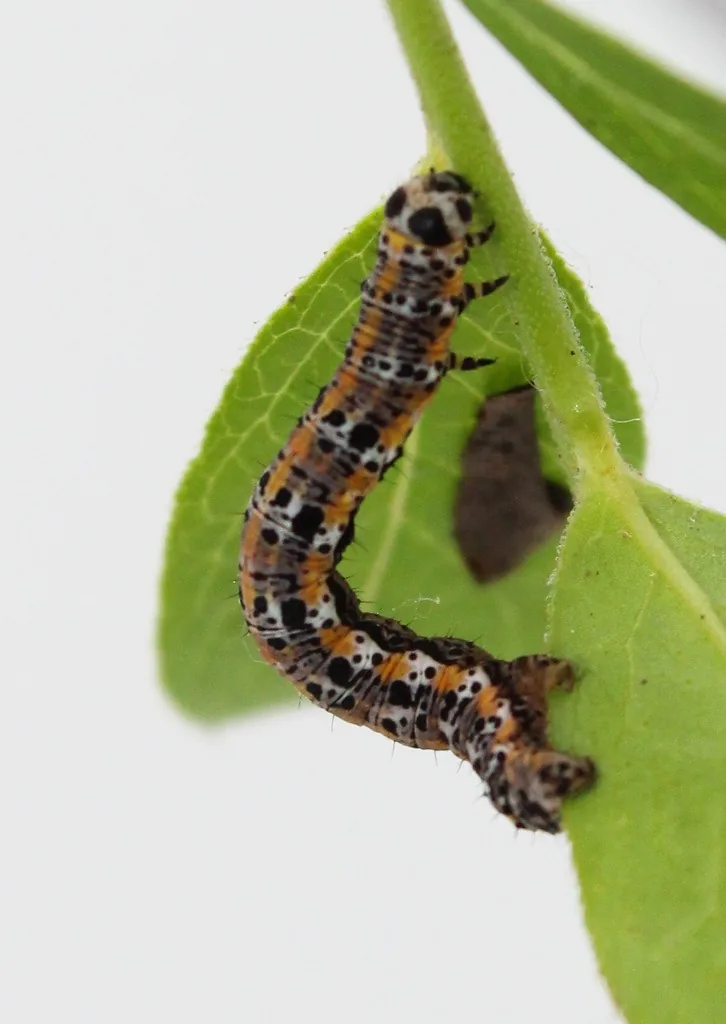
- Older caterpillars are yellow-orange with a row of black spots along the body that can run together into a stripe; the Forest Service describes an intricate yellow or orange and black pattern with a stripe down the back, a second stripe through the spiracles broken by white patches, a thin white stripe between them, and a shiny black head crossed by up to five white lines. Young larvae are tan or grey with black spots. They grow from 3 to 20 mm, under 3 cm at maturity.[1][2]
- Like other inchworms they walk with a looping gait and have only three pairs of true legs at the front and two pairs of prolegs near the back.[1]
- Adults have grey-brown wings spanning about 23 to 29 mm; males are mostly uniform in color while females carry some darker spots.[1]
Look-alikes
| Look-alike | How to tell them apart |
|---|---|
| Brown spanworm (cranberry spanworm) | A chocolate-colored inchworm of bogs and heathlands with a pale, wavy flange along its sides and a paler tan-to-white underside, also found on blueberry and a pest of cranberry; the blueberry spanworm is instead patterned in yellow-orange and black.[2] |
Where it lives
Open woodlands, heaths, balds, barrens and bogs from Ontario and Quebec south to New Jersey and West Virginia, and the lowbush blueberry barrens of New England and Nova Scotia, where it is the principal spanworm species in commercial fields.[2][1]
Biology and life cycle
The insect overwinters as eggs laid on leaves or on the ground in the litter around the base of the blueberry plants. The eggs hatch in mid to late May, about when new sprouts begin to grow.[1][2]
Caterpillars feed mostly at night on leaves and buds and by day many drop to the ground and hide in the leaf litter. They feed until late June or early July, then pupate in the soil; in Connecticut mature caterpillars are found from late May into June.[1][2]
Adult moths begin to emerge in late July and lay eggs that do not hatch until the following spring. There is one generation a year.[1][2]
The bright coloration appears to be a warning pattern, like that of the related currant spanworm, although blueberry and cranberry are not generally regarded as toxic plants.[2]
Damage and signs
- Larvae eat the foliage and flower buds of lowbush blueberry. In severe outbreaks plants may be completely defoliated, and in sprout fields the new growth can be eaten back so that patches appear to have no shoots at all.[1]
- Several related Itame species also feed on blueberry; the Nova Scotia sheet treats them as similar and counts them together when sampling.[1]
Health risk
Neither source mentions any effect on people; this is a crop pest of blueberry and cranberry.[1][2]
Control
Prevention
Sample fields with a 30 cm sweep net weekly in May and June (sprout fields as soon as shoots appear), taking at least three samples of 25 sweeps per field of 5 hectares or less plus one more per additional 5 hectares. The Nova Scotia action threshold is 12 spanworms per 25 sweeps in crop fields and 7 in sprout fields, counting every spanworm species present.[1]
Sanitation
Burning fields as the pruning method destroys the overwintering eggs in the litter and reduces spanworm numbers; outbreaks increased after growers switched to mowing.[1]
Biological control
Several species of parasitic wasps attack the blueberry spanworm and keep populations in check in most years, though numbers fluctuate from year to year.[1]
Pesticides
If sweep counts exceed the action threshold, an insecticide treatment is needed; the Nova Scotia sheet refers growers to the provincial Lowbush Blueberry Protection Guide for products and rates.[1]
Common questions
- What is the orange caterpillar with black spots on my blueberries?
- A blueberry spanworm, an inchworm that feeds at night on lowbush blueberry leaves and buds in late May and June and hides in the litter by day.[1][2]
- Why did spanworms get worse after we stopped burning?
- Burning as a pruning method destroyed the eggs that overwinter in the leaf litter; mowing leaves them alive, and outbreaks have increased as a result.[1]
- When should a blueberry field be treated?
- Nova Scotia's threshold is 12 spanworms per 25 sweeps in a crop field or 7 in a sprout field, sampled weekly in May and June.[1]
Sources
- Nova Scotia Department of Agriculture and Marketing (fact sheet by L. Crozier; PDF hosted by Dalhousie University's Wild Blueberry site), “The Blueberry Spanworm (Lorne Crozier, January 1995), Lowbush Blueberry Fact Sheet.” cdn.dal.ca/content/dam/dalhousie/images/sites/wild-blueberry/pdfs/Blueberry_Spanworm.pdf (accessed 2026-11-10)
- USDA Forest Service, Forest Health Technology Enterprise Team, “Geometroid Caterpillars of Northeastern and Appalachian Forests, FHTET-2001-10 (D. L. Wagner, D. C. Ferguson, T. L. McCabe and R. C. Reardon, September 2001; scanned copy).” archive.org/details/geometroidcaterp00wagn (accessed 2026-11-10)
- iNaturalist, “Macaria argillacearia taxon page (order and family).” www.inaturalist.org/taxa/791091 (accessed 2026-11-10)