On this page
How to identify it
- A slender, smooth, hairless looper with only two pairs of legs at the hind end; young larvae are uniform pale yellow to light green with light-white lines along the back, and mature larvae are green with several white lines and a narrow yellow stripe along each side, with a herringbone pattern on top of the head. They never get very large, stopping at about an inch (17 to 24 mm).[1][2][3]
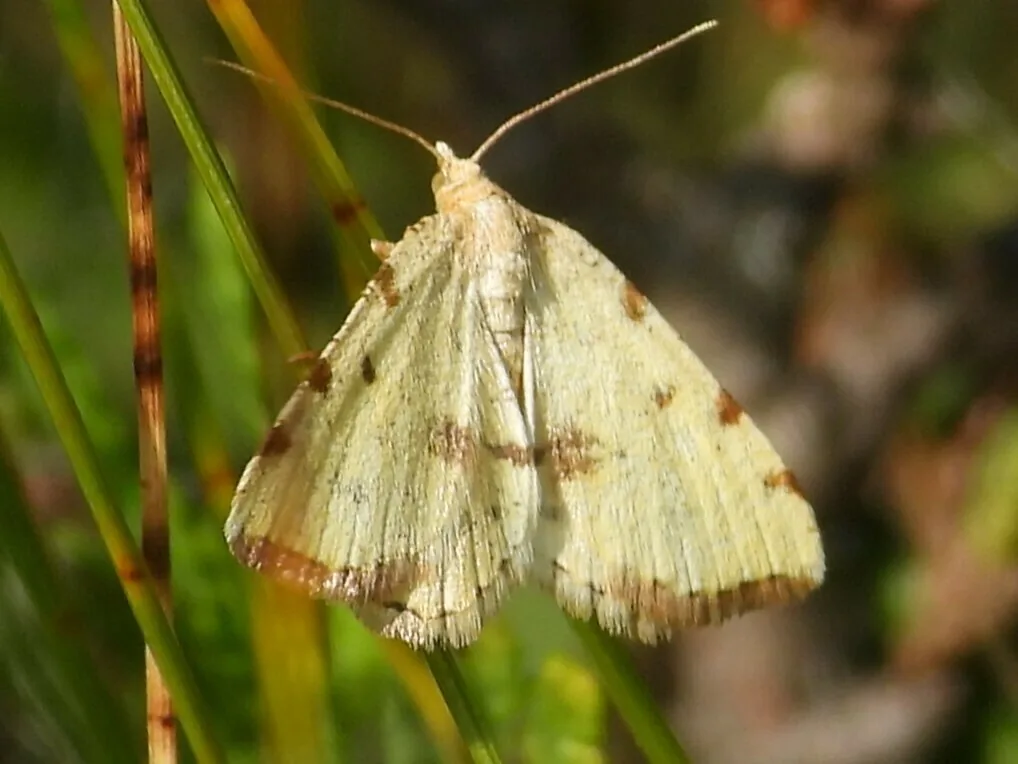
- The male moth is pale tannish to grayish with two or three dark spots on gray forewings, slightly feathery antennae and a wingspan of about an inch (21 to 23 mm); the female is sulphur-yellow with bright yellow forewings carrying three brown markings, hair-like antennae and a span of about 7/8 inch. Older moths lose wing scales and look paler.[1][3]
- Eggs are white to light green, 0.7 to 0.8 mm, elliptical with a rough surface, scattered singly in the leaf litter; pupae are 10 to 15 mm, pale yellow turning brown.[3]
- Disturbed larvae stay motionless to blend with the background, and feeding larvae do not web the uprights together.[1][3]
Look-alikes
| Look-alike | How to tell them apart |
|---|---|
| Brown spanworm | The other main cranberry spanworm; its larvae are brown and hatch in mid-June, weeks after green spanworm, and its moths are brown and smaller than the green spanworm's.[1][2][3] |
| Blackheaded fireworm | A cranberry leafroller that webs uprights together as it feeds; green spanworm is an open feeder that never webs foliage.[3] |
| False armyworm | Its very young larvae loop like a spanworm and can look like green spanworms, but they have three or four pairs of hind legs even when tiny and five when larger; UMass recommends a 10x lens.[2] |
Where it lives
A pest of cranberry in Massachusetts, where UMass has tracked it for decades, and one of the more common spanworms in Wisconsin cranberry beds; Rutgers includes the spanworms in New Jersey scouting thresholds. Besides cranberry, Wisconsin lists sweet gale as a host.[1][3][4]
Biology and life cycle
There is one generation a year and the egg is the overwintering stage. Females scatter eggs singly in the trash litter under the vines beginning in June, about 125 per female; flooding appears to have no effect on the eggs, which survive even late-held water.[1][3]
Hatch begins in April in Massachusetts and continues over an extended period; the 1999 UMass sheet put it at mid-May to June 1 and Wisconsin at mid-May to early June, and UMass has since observed the species shifting earlier. There are five instars.[1][2][3]
Larvae held in the lab finished feeding by the end of May and pupated for about 10 days, with moths flying by June 8; Wisconsin reports pupation from the end of June with some larvae feeding into July and adults emerging 10 to 15 days after pupation. Moth flight on Massachusetts bogs runs through the second and third weeks of June, with short, jumpy flights just above the canopy; males emerge first and are more active, while females often rest among the vines.[1][3]
No synthetic pheromone lure is available for trapping, and no research has been done on its natural enemies, though as a native insect it most likely has a complex of them.[3]
Damage and signs
- Larvae feed on leaves and developing buds and sever the stem at the blossom junction, nipping off flower buds and blossoms, which can cause severe crop reduction; dense infestations defoliate vines and reduce fruit set.[1][2][3]
- When extremely abundant they can brown a small area of bog. There is no webbing associated with the larvae.[2][1]
Health risk
None of the sources mentions any effect on people; this is a smooth, hairless caterpillar that feeds on cranberry.[1][3]
Control
Sanitation
Sanding buries the overwintering eggs in the trash layer and reduces the population because larvae fail to emerge; a heavy, uniform layer of sand is the cultural control UMass and Wisconsin both list.[1][2][3]
Traps and physical control
Spring sweeping is critical: expect green spanworm in early-season sweeps starting in May. The long-standing Massachusetts threshold is an average of 18 small larvae per set of 25 sweeps, which UMass says may be lowered a bit for full-grown larvae; Rutgers uses the same 18-per-set action threshold for brown and green spanworms, one set per acre.[1][4][3]
Biological control
Bacillus thuringiensis products are effective against spanworms while the larvae are young; Bt is a stomach poison with short residual activity, so coverage must be thorough and a second application after 5 to 10 days may be needed if larvae keep hatching.[2][3]
Pesticides
UMass lists Avaunt, Delegate and Intrepid as effective, favoring Intrepid because it conserves the natural enemies that parasitize Sparganothis fruitworm and works best on small larvae; Wisconsin notes most broad-spectrum insecticides control spanworms and that the selective materials tebufenozide and spinosad are registered. Apply while larvae are young.[1][3]
Common questions
- When should I sweep for green spanworm?
- Start in May. UMass has watched the species shift earlier, with hatch beginning in April and larvae finishing by the end of May, so management should not be delayed into June.[1]
- How do I tell green spanworm from brown spanworm?
- Green spanworm larvae are green with white lines and a yellow side stripe and hatch weeks earlier; brown spanworm larvae are brown and hatch in mid-June. The green spanworm female moth is sulphur-yellow with brown spots and larger than the brown spanworm moth.[1][2][3]
- Does flooding kill the eggs?
- No. The eggs overwinter in the trash litter and survive flooding even when the water is held late in spring; sanding, not flooding, is the cultural control.[1][3]
Sources
- UMass Amherst Cranberry Station, Center for Agriculture, Food, and the Environment, “Green Cranberry Spanworm in MA Cranberry (M. M. Sylvia and A. L. Averill, March 2023) (UMass Cranberry Station fact sheet).” www.umass.edu/agriculture-food-environment/cranberry/fact-sheets/green-cranberry-spanworm-in-ma-cranberry-march-2023 (accessed 2026-11-10)
- UMass Amherst Cranberry Station, Center for Agriculture, Food, and the Environment, “Confusing Spring Caterpillars in Cranberry (1999) (UMass Cranberry Station fact sheet).” www.umass.edu/agriculture-food-environment/cranberry/fact-sheets/confusing-spring-caterpilars-in-cranberry-1999 (accessed 2026-11-10)
- University of Wisconsin-Madison, “Green Cranberry Spanworm (D. L. Mahr, November 2005; revised from the University of Wisconsin Cranberry Crop Management software).” wpcdn.web.wsu.edu/wp-wsucahnrs/uploads/sites/2166/2025/05/Green-Cranberry-Spanworm.pdf (accessed 2026-11-10). PDF copy hosted by Washington State University CAHNRS
- Rutgers Cooperative Extension Plant & Pest Advisory (Rutgers New Jersey Agricultural Experiment Station), “Cranberry Early-Season Insect Pests, May 2026 (C. Rodriguez-Saona), Plant & Pest Advisory.” plant-pest-advisory.rutgers.edu/cranberry-early-season-insect-pests-may-2026/ (accessed 2026-11-10)
- iNaturalist, “Macaria sulphurea taxon page (order and family).” www.inaturalist.org/taxa/791095 (accessed 2026-11-10)