On this page
How to identify it
- Early hatched larvae are greenish with portions of the body tinged pinkish, reddish or purplish; larger larvae are usually completely pinkish-reddish with a white stripe along the side, a distinctive purplish color among the cranberry caterpillars, and may be over 1.5 inches (38 mm) when mature.[1]
- Small caterpillars crawl by looping until they are over 0.4 inch (9 mm) long, which makes them easy to mistake for spanworms; count the legs with a lens, because the blossomworm has five pairs of hind legs where spanworms have only two.[1]
- Like the other cranberry cutworms it does not web the vines; young larvae feed openly by day, while larger ones feed at night and hide during the day.[1]
Look-alikes
| Look-alike | How to tell them apart |
|---|---|
| False armyworm (Xylena nupera) | The other large cranberry cutworm counted alongside the blossomworm; its larger larvae are lime green to black with white lines and a yellow side stripe, not pinkish-purple.[1] |
| Green cranberry spanworm and brown spanworm | Spanworms are slender, hairless loopers with only two pairs of hind legs; the blossomworm loops only while very small and soon shows five pairs of hind legs and a stout body.[1] |
| Humped green fruitworm (copper underwing) | An apple-green caterpillar with a hump at the rear that is counted with the cutworms in sweep nets; the blossomworm is pinkish-red to purplish.[1] |
Where it lives
A pest of cranberry bogs in Massachusetts, where UMass ranks it among the most damaging spring caterpillars, and in New Jersey, where it is described as a major pest of cranberries and Rutgers includes it in its early-season scouting list.[1][3][2]
Biology and life cycle
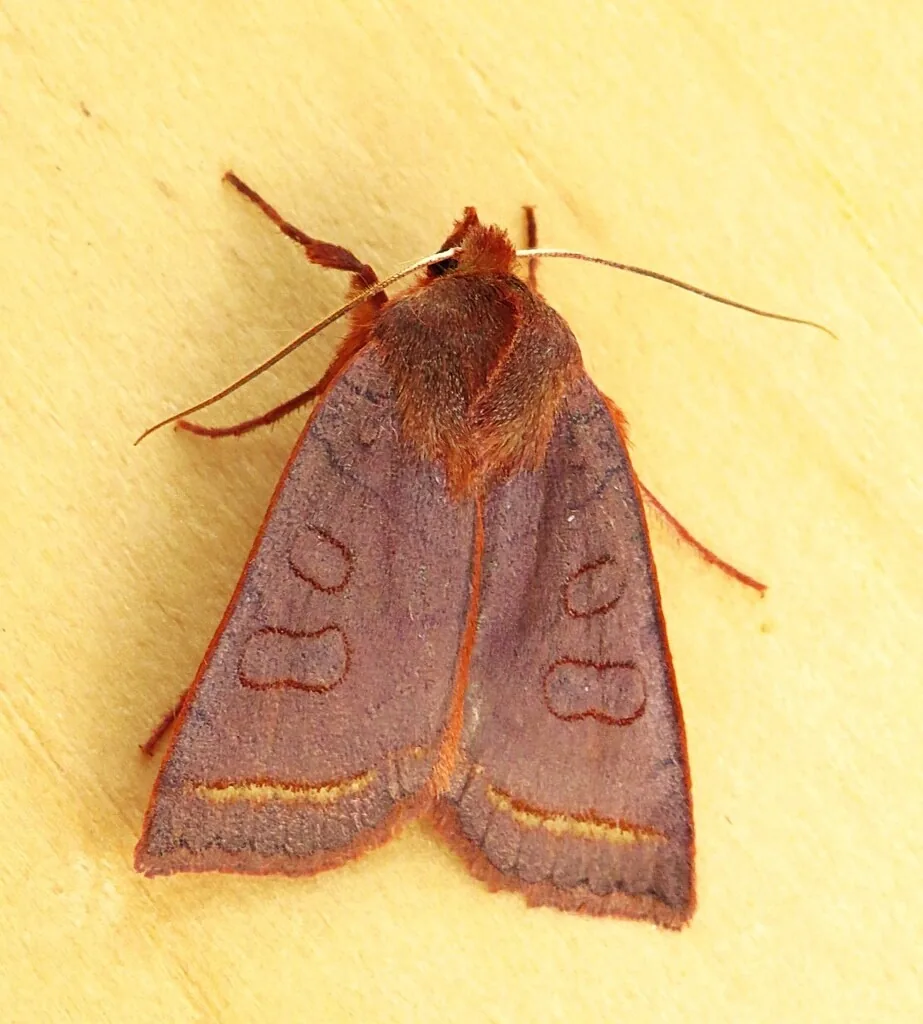
The moths fly during the cranberry harvest, from the end of August to the end of October in New Jersey, and lay eggs in the beds in October. The eggs overwinter and hatch over a period of several weeks the following May; early instars are found in the first week of May in New Jersey.[1][2]
Young caterpillars feed on leaves and terminal buds starting in May. The larvae pass through six instars, and when they are about half grown they become night active, so they stop showing up in daytime sweep-net samples. They complete development by June or July, then spend a long pre-pupal stage until the end of August and a pupal stage until October.[1][2]
The female sex pheromone has been identified as a 65:2:33 blend of (Z)-9-hexadecenyl acetate, (Z)-9-tetradecenyl acetate and tetradecyl acetate; a synthetic blend at 300 to 1,000 micrograms on a rubber septum attracted more males than lower doses, and the short-chain aliphatic acids also present in the gland did not improve trap catch.[3]
Damage and signs
- Young cutworm caterpillars can do great harm by eating out the hearts of the terminal buds before new growth starts, then feed more and more voraciously on leaves, buds and flowers as they mature.[1]
- Older blossomworm caterpillars cut off flower pods and blossoms, which is the damage that gives the insect its name; Rutgers describes the older instars as very voracious and capable of destroying 100 blossoms within a three-week period.[1][2]
Health risk
Neither source mentions any effect on people; the cranberry blossomworm is a crop pest of cranberry.[1][3]
Control
Prevention
Late water, a spring flood held on the bog, is a very effective tool for managing false armyworm and cranberry blossomworm.[1]
Traps and physical control
Sweep-net the bog early in the season, before the larvae are large and before they turn night active. UMass's guideline for the cutworm complex (blossomworm, false armyworm and other cutworms, with humped green fruitworm and spongy moth counts added) is to consider management when counts average more than 4 to 5 larvae per 25 sweeps; Rutgers uses a combined action threshold of 4.5 caterpillars per set of 25 sweeps, one set per acre. Once the later instars turn nocturnal, Rutgers recommends night sweeping between 9 pm and 1 am.[1][2]
The female sex pheromone has been identified, and a synthetic blend on rubber septa attracted male moths to traps in field tests.[3]
Biological control
Bacillus thuringiensis (B.t.) products are effective against cutworms while they are small; larger caterpillars are much harder to control by any type of spray, so treat early.[1]
Pesticides
When counts exceed the threshold, Rutgers recommends reduced-risk materials: the insect growth regulator methoxyfenozide (Intrepid), the spinosyn spinetoram (Delegate) or a diamide insecticide (Altacor, Exirel or Verdepryn), rotating modes of action to delay resistance.[2]
Common questions
- What does a cranberry blossomworm look like?
- A stout cutworm-type caterpillar that is greenish with pink, red or purple tinges when small and completely pinkish-reddish with a white side stripe when large, reaching over 1.5 inches; it has five pairs of hind legs, unlike the two-legged spanworms.[1]
- When does it hatch and feed?
- Eggs laid in October overwinter on the bog and hatch over several weeks in May; larvae eat leaves and terminal buds, then cut flower pods and blossoms, and become night feeders once half grown. The moths fly during harvest, from late August to late October.[1][2]
- Why does UMass stress early sweeping for this pest?
- Small larvae are the ones B.t. and other sprays control well, and half-grown larvae feed at night and no longer turn up in daytime sweeps, so the window for detecting and treating them is short.[1]
Sources
- UMass Amherst Cranberry Station, Center for Agriculture, Food, and the Environment, “Confusing Spring Caterpillars in Cranberry (1999) (UMass Cranberry Station fact sheet).” www.umass.edu/agriculture-food-environment/cranberry/fact-sheets/confusing-spring-caterpilars-in-cranberry-1999 (accessed 2026-11-10)
- Rutgers Cooperative Extension Plant & Pest Advisory (Rutgers New Jersey Agricultural Experiment Station), “Cranberry Early-Season Insect Pests, May 2026 (C. Rodriguez-Saona), Plant & Pest Advisory.” plant-pest-advisory.rutgers.edu/cranberry-early-season-insect-pests-may-2026/ (accessed 2026-11-10)
- Journal of Chemical Ecology (via NCBI PubMed), “Sex pheromone of the cranberry blossom worm, Epiglaea apiata (A. Zhang and S. Polavarapu, 2003) (abstract).” pubmed.ncbi.nlm.nih.gov/14584682/ (accessed 2026-11-10)
- iNaturalist, “Epiglaea apiata taxon page (order and family).” www.inaturalist.org/taxa/63751 (accessed 2026-11-10)