On this page
How to identify it
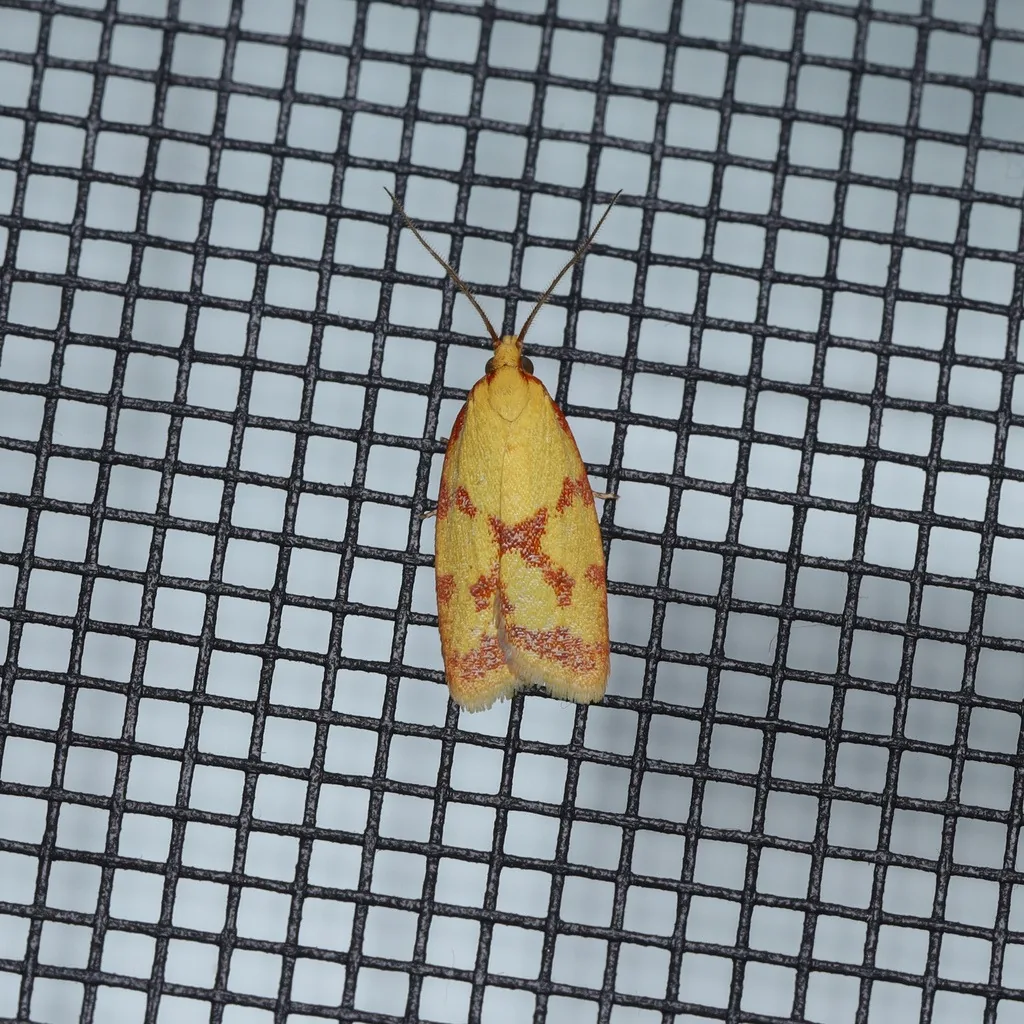
- The moth is small, with a wingspan of about 20 mm (a forewing about 6.5 to 10 mm long). The forewings are bright yellow to brownish yellow with orange to purplish markings, and the hindwings are light gray to grayish brown.[2][1]
- Most moths have two marks along the front edge of the forewing and a V-shaped band across it, so the folded wings show an X when the moth is at rest. The pattern varies: some moths are nearly unmarked and others are covered in fine netted lines.[2][1]
- Grown caterpillars are roughly 10 to 17 mm long (the two sources give 10-12 and 13-17 mm). The body is pale olive green-brown to yellowish or grayish green with small, noticeable pale spots and only a few fine hairs, and the head is yellow to reddish brown.[1][2]
- Newly hatched caterpillars are 1 to 2 mm long and light green with a black head. Eggs are laid in greenish yellow masses of about 20 to 50 on the upper side of leaves, where they are hard to see against the green.[1][2]
Look-alikes
| Look-alike | How to tell them apart |
|---|---|
| Cranberry fruitworm | Both caterpillars feed inside cranberries, but sparganothis larvae push their droppings out of the berry, unlike cranberry fruitworm, so fruit they have mined stays free of frass.[1] |
Where it lives
USDA's tortricid guide describes it as widespread in eastern North America, with records from the Pacific Northwest. It is a native insect and a cranberry pest on the East Coast and in Wisconsin.[2][1]
Biology and life cycle
There are two generations a year. Young caterpillars spend the winter in leaf debris on the ground, and on cranberry beds they ride out the winter flood: they can tolerate flooding longer than the cranberry plants can.[2][1]
On cranberry beds the caterpillars become active when new growth starts, around mid-May, and feed on foliage and blossoms through June and July. They pupate for 7 to 12 days, and the first moths emerge throughout July.[1]
Females lay eggs within two days of emerging, and the eggs hatch in 9 to 12 days. This summer brood feeds on leaves and directly on the fruit, pupates in August inside a berry or on a webbed upright after 50 to 60 days, and produces moths from late August through September. Their offspring settle in for the winter by mid- to late September.[1]
Moths fly from mid-June into July and again from August into September.[2]
The caterpillars eat many kinds of plants. Besides cranberry and highbush and southern highbush blueberries, recorded hosts include apple, strawberry, grape, corn, alfalfa, clover, mint, several pines, white spruce, balsam fir and arborvitae, and weeds such as goldenrod, aster and yellow loosestrife.[2][1]
Damage and signs
- In spring the caterpillars web the underside of a leaf or stem and keep adding leaves to the webbing as they grow. They feed on the developing blossoms and skeletonize the leaves, which turn brown.[1]
- The summer brood does the most harm because it feeds directly on the fruit: each caterpillar mines 3 to 5 berries and scars the surface of several others.[1]
- Damage on the East Coast has been severe in some cases, and the pest has become a significant problem in Wisconsin; on some farms it is more serious than blackheaded fireworm.[1]
Health risk
Neither the University of Wisconsin profile nor the USDA fact sheet mentions any risk to people; both treat it only as a plant pest.[1][2]
Control
Prevention
Remove known weed hosts such as yellow loosestrife, goldenrod and aster.[1]
Monitor the moths with pheromone traps placed by May 21; first catches usually come in the last week of May or the first week of June. A sweep net confirms that larvae or adults are present, but no economic thresholds have been set.[1]
Pheromone mating disruption has been developed for this pest and for blackheaded fireworm. At the time of the University of Wisconsin profile, pheromone dispensers were registered and available and acceptable for certified organic production, while the sprayable pheromone had gone out of production.[1]
Biological control
Native predators and parasites attack it, especially Trichogramma egg parasites and the tachinid fly Erynnia tortricis, and biological control is likely better in beds where broad-spectrum insecticide use has been cut back.[1]
Pesticides
Resistance to certain organophosphates has developed on the East Coast, so spray only when needed, spot-treat only beds with damaging populations, and rotate insecticides. The 2005 University of Wisconsin profile lists organophosphates, carbaryl, insect growth regulators and spinosad as effective; there was no data showing Bacillus thuringiensis works against it, though it may give some control of young larvae.[1]
Common questions
- What does sparganothis fruitworm damage look like in cranberries?
- In spring, look for webbed leaves and stems with browned, skeletonized leaves; in summer, look for mined and scarred berries. Each caterpillar mines several berries but pushes its droppings outside them.[1]
- Does sparganothis fruitworm feed on blueberries?
- Yes. Highbush and southern highbush blueberries are among its recorded host plants, along with cranberry.[1][2]
- Is it the same insect as the false yellowheaded fireworm?
- Yes. False yellowheaded fireworm is another common name for sparganothis fruitworm.[1]
Sources
- University of Wisconsin-Madison, “Sparganothis Fruitworm (D. L. Mahr, November 2005; revised from the University of Wisconsin Cranberry Crop Management software).” wpcdn.web.wsu.edu/wp-wsucahnrs/uploads/sites/2166/2025/05/Sparganothis-Fruitworm.pdf (accessed 2026-11-08). PDF copy hosted by Washington State University CAHNRS
- USDA APHIS PPQ Center for Plant Health Science and Technology, with Colorado State University, “Sparganothis sulfureana fact sheet, Tortricids of Agricultural Importance (T. M. Gilligan and M. E. Epstein; last updated August 2014).” idtools.org/id/leps/tortai/Sparganothis_sulfureana.htm (accessed 2026-11-08)
- iNaturalist, “Sparganothis sulfureana taxon page (order and family).” www.inaturalist.org/taxa/81683 (accessed 2026-11-08)