On this page
How to identify it
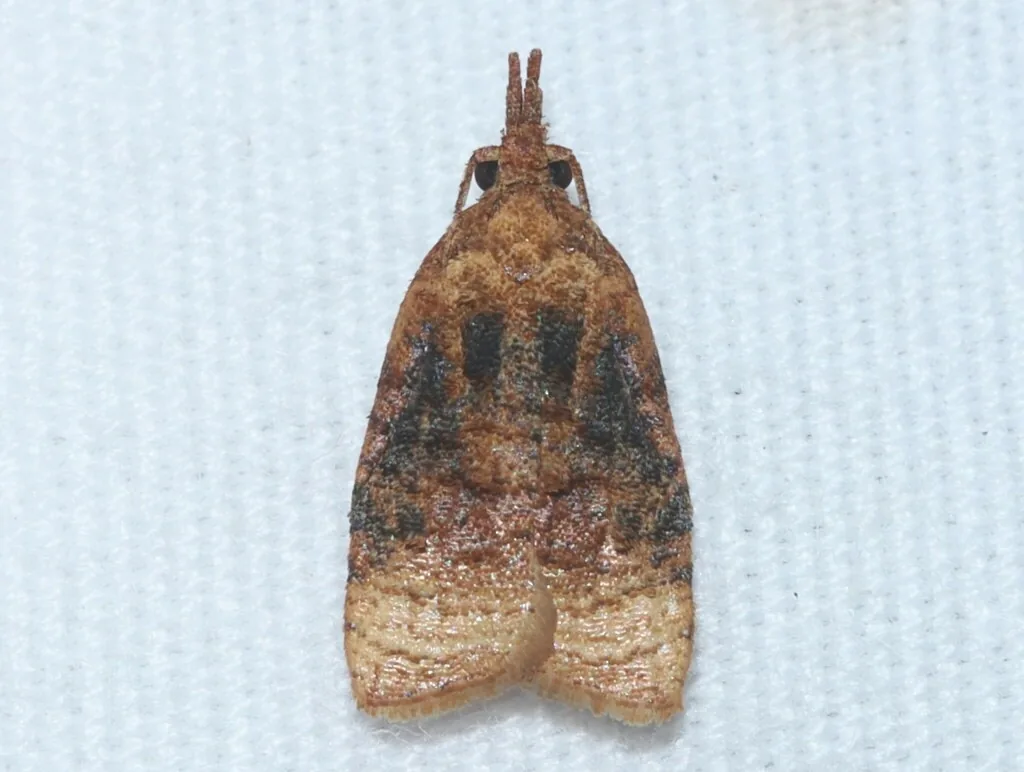
- The adult is a reddish to orange-brown moth about 1/2 inch long, triangular at rest, with mouthparts that stick out in front of the head and a wingspan of about 1/2 to 3/4 inch. A U-shaped line crosses the middle of the wings.[1][2]
- Males and females look different. The male's forewing is dark purplish brown near the body and yellowish to orange-brown toward the tip; the female's is brown to orange-brown with darker brown to purplish markings. The orange tone separates it from most other Platynota moths, but a dissection is needed to confirm the species.[2]
- Full-grown larvae are about 1/2 to 3/4 inch long. The USDA fact sheet describes them as green to pale green with a brownish-yellow head and neck shield; NC State describes them as light brown to tan.[2][1]
Look-alikes
| Look-alike | How to tell them apart |
|---|---|
| Tufted apple bud moth | Its damage looks the same as tufted apple bud moth damage in apples, and both lay their eggs in masses on the leaves.[1] |
| Sparganothis fruitworm | Larvae of the two look alike and often turn up in the same habitats in the eastern United States.[2] |
Where it lives
It is widely distributed in the eastern United States and much of the central states. Records from the western U.S. are questionable.[2][1]
Biology and life cycle
There are two generations a year over much of its range, with a partial third in the South. Adults fly in May and June and again from July through September.[2]
Females lay eggs in masses of about 50 on the upper surface of leaves. The larvae live in shelters of tied or folded leaves and pupate in webbed leaves.[2][1]
Partly grown larvae of the last generation spend the winter on the orchard floor and resume feeding in spring. In North Carolina, adults emerge in late April and lay eggs from late May to June; most first-generation larvae feed on leaves, while second-generation larvae may attack fruit from August to September.[1][2]
Reported hosts include apple, strawberry, peach and rose, and cotton and citrus are other important hosts. New apple sucker growth and broadleaf weeds are important food sources in spring.[2][1]
Damage and signs
- Larvae skeletonize the underside of leaves near the midrib and fold and web the leaf together. They also web leaves together with blossoms and young fruit.[1][2]
- On apples they feed on the fruit surface under a web or a leaf webbed to the fruit, and they also attack the cavities at the stem and calyx ends and the spots where two fruit touch.[1]
Health risk
Neither source mentions any harm to people; both treat it only as a leaf- and fruit-feeding caterpillar.[1][2]
Control
Prevention
In North Carolina, NC State Extension doubts that special precautions are needed unless an orchard has a history of damage from this leafroller.[1]
Sanitation
Keep the orchard floor clean. New sucker growth and broadleaf weeds feed the larvae in spring, so removing them helps keep numbers down.[1]
Common questions
- What is rolling up the leaves and scarring my apples?
- Several leafrollers do this. Variegated leafroller larvae web leaves together and feed on the fruit surface under a web or leaf, and the damage looks the same as that of the tufted apple bud moth.[1]
- Is the variegated leafroller a serious pest?
- Usually not in North Carolina orchards, where NC State says it is usually not a major pest, though it has been reported damaging strawberry, peach and rose elsewhere.[1][2]
Sources
- NC State Extension, “Variegated Leafroller (Entomology Insect Notes).” content.ces.ncsu.edu/variegated-leafroller (accessed 2026-11-09)
- USDA APHIS PPQ Center for Plant Health Science and Technology, with Colorado State University, “Platynota flavedana fact sheet, Tortricids of Agricultural Importance (T. M. Gilligan and M. E. Epstein; last updated August 2014).” idtools.org/id/leps/tortai/Platynota_flavedana.htm (accessed 2026-11-09)
- iNaturalist, “Platynota flavedana taxon page (order and family).” www.inaturalist.org/taxa/208090 (accessed 2026-11-09)