On this page
How to identify it
- Look for cranberry uprights webbed together with a caterpillar feeding inside the webbing, and patches of foliage turned brown as if burned by the first-generation larvae.[1]
- Eggs are laid in masses, on weeds growing in the bog rather than on the cranberry vines; viable eggs darken from yellow-orange to black as they develop and hatch in about 10 to 12 days.[1][3]
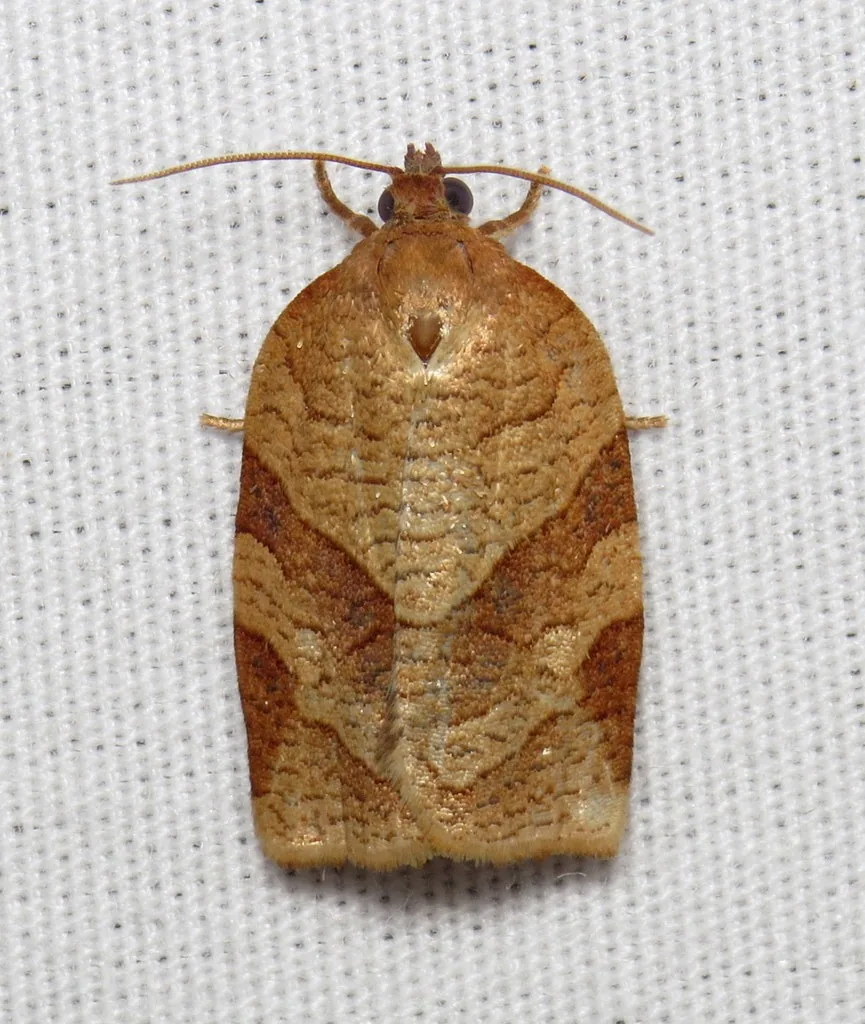
- Adult moths appear in two flights in New Jersey: the first in the first week of June and the second in early August.[1]
Look-alikes
| Look-alike | How to tell them apart |
|---|---|
| Sparganothis fruitworm | The other key tortricid of cranberry, a serious pest in most cranberry-growing states; it also has two generations and webs and feeds on uprights and fruit, but lays its egg clusters on cranberry leaves rather than on weeds, and its eggs turn from light green-yellow to dark green-black instead of yellow-orange to black.[3][1] |
| Blackheaded fireworm | A smaller cranberry leafroller whose eggs overwinter on the bed and hatch by mid-May; its second generation feeds during bloom, and Rutgers sets a much lower action threshold for it (1.5 per sweep set).[1] |
Where it lives
Native to the United States and a key pest of cranberries in New Jersey, where Rutgers includes it in early-season scouting; Sparganothis fruitworm, by contrast, is a pest across most major cranberry-producing regions.[3][4][1]
Biology and life cycle
The spotted fireworm overwinters as a second-instar larva in the bog. In spring the overwintered larvae feed on new growth between uprights they web together; first-generation adults emerge the first week of June in New Jersey and lay egg masses on weedy hosts inside the bogs.[1][3]
Second-generation larvae develop in early summer; Rutgers places their emergence in mid-August, after the second adult flight in early August. These larvae feed on leaves but may also feed on developing berries, and early-instar larvae from this late-summer generation overwinter. There are two generations a year.[1][3]
Populations are regulated by natural enemies, in particular Trichogramma wasps that parasitize the eggs.[1]
Cranberry varieties differ in resistance: in a 12-genotype trial, spotted fireworm larvae performed better on modern hybrids such as Demoranville and Mullica Queen than on the wild genotypes McFarlin and Potter, whose leaves held more total phenolics.[4]
Damage and signs
- First-generation larvae injure the foliage, causing it to turn brown as if burned, and both generations feed on cranberry uprights.[1][2]
- Second-generation larvae may feed on developing berries, and because of this direct injury to young fruit, feeding by that generation is the most detrimental to the crop.[3][1]
Health risk
None of the sources mentions any effect on people; the spotted fireworm is a crop pest of cranberry.[1][3]
Control
Traps and physical control
From the time the winter flood comes off until bloom, scout beds with a sweep net for spotted fireworm and the other spring caterpillars: a sweep set is 25 sweeps, with one set recommended per acre.[1]
Biological control
Trichogramma egg parasitoids regulate spotted fireworm populations. Rutgers notes that the newer reduced-risk insecticide classes are more compatible with conserving natural enemies such as the predatory flower bug Orius insidiosus than older broad-spectrum chemistries, which were most toxic to the predator.[1][3]
Pesticides
Control still relies heavily on insecticides, which work best against early-instar larvae in spring as they leave diapause or in early summer before they enter the fruit, where older larvae are protected. In Rutgers bioassays spinetoram gave week-long control of all stages, the growth regulator methoxyfenozide and the diamides chlorantraniliprole and cyantraniliprole were strongly larvicidal on young larvae, and methoxyfenozide was the only tested material safe enough for bees to use during bloom, when the eggs are laid. Rutgers recommends these reduced-risk materials (Intrepid, Delegate, Altacor, Exirel or Verdepryn) when counts exceed thresholds, rotating modes of action.[3][1]
Common questions
- Why is it called a fireworm?
- Because the first-generation larvae, feeding between webbed-together uprights, leave the cranberry foliage brown as if it had been burned.[1]
- Where does the spotted fireworm lay its eggs?
- In masses on weeds growing inside the bog, not on the cranberry vines; the eggs turn from yellow-orange to black as they develop and hatch in about 10 to 12 days.[1][3]
- When is spraying most effective?
- Against small larvae in spring as they emerge from overwintering or in early summer before they enter the fruit; older larvae feeding inside berries are protected, and only bee-safe methoxyfenozide can be used during bloom when eggs are being laid.[3]
Sources
- Rutgers Cooperative Extension Plant & Pest Advisory (Rutgers New Jersey Agricultural Experiment Station), “Cranberry Early-Season Insect Pests, May 2026 (C. Rodriguez-Saona), Plant & Pest Advisory.” plant-pest-advisory.rutgers.edu/cranberry-early-season-insect-pests-may-2026/ (accessed 2026-11-10)
- Rutgers Cooperative Extension Plant & Pest Advisory (Rutgers New Jersey Agricultural Experiment Station), “Beating the Bugs in the Bogs: Sparganothis Fruitworm and Spotted Fireworm (C. Rodriguez-Saona, July 26, 2014), Plant & Pest Advisory.” plant-pest-advisory.rutgers.edu/beating-the-bugs-in-the-bogs-sparganothis-fruitworm-and-spotted-fireworm/ (accessed 2026-11-10)
- Insects (MDPI, via NCBI PubMed Central), “Toxicity of Insecticides on Various Life Stages of Two Tortricid Pests of Cranberries and on a Non-Target Predator (C. Rodriguez-Saona et al., Insects 7(2):15, 2016; full text).” pmc.ncbi.nlm.nih.gov/articles/PMC4931427/ (accessed 2026-11-10)
- Journal of Chemical Ecology (via NCBI PubMed), “Genotypic Variation and Potential Mechanisms of Resistance against Multiple Insect Herbivores in Cranberries (P. Salazar-Mendoza et al., 2024) (abstract).” pubmed.ncbi.nlm.nih.gov/39028464/ (accessed 2026-11-10)
- iNaturalist, “Choristoneura parallela taxon page (order and family).” www.inaturalist.org/taxa/216808 (accessed 2026-11-10)