On this page
How to identify it
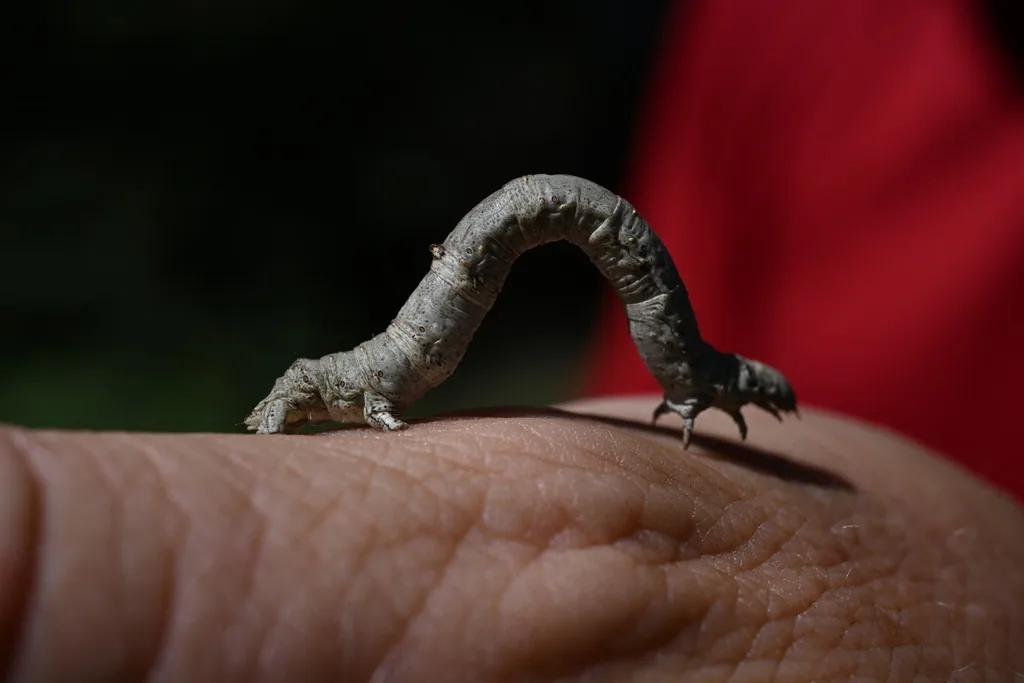
- A large, smooth-skinned looper, almost black when newly hatched and chocolate brown as it grows, with a mature length of about 2.5 inches (6 cm); the Forest Service guides describe the color as gray to brown or purple-brown, sometimes greenish or tan.[2][1][3]
- The front edge of the second thoracic segment is swollen into a raised collar that frames the head, marked with orange or red; a noticeable dark ridge with a few low bumps crosses the back behind the head, and there is an eared ridge on the fourth abdominal segment and a set of smaller warts on the eighth, all often dark and dotted with orange.[1][3][2]
- The head is somewhat flattened and uniformly brown or darkened with vague markings, sometimes with a pale patch around the eyes; the small tan-to-orange spiracles are rimmed with black, and stubby paraprocts stick out past the anal plate.[1][3]
- The adult is a light gray moth marked with rusty brown with a wingspan of about 2 inches.[2]
- The 1972 Eastern Forest Insects guide, which lists it under the older name Abbottana clemataria, describes full-grown larvae as purplish brown and up to 60 mm long, with a rounded, two-lobed head, the second and fourth abdominal segments swollen on top and prominent tubercles on the fifth and ninth.[4]
Look-alikes
| Look-alike | How to tell them apart |
|---|---|
| Brown spanworm (cranberry spanworm moth) | The common brown looper of cranberry bogs is much smaller, a little over an inch when full grown, with a 1-inch moth; the curved-toothed geometer reaches 2.5 inches and has the swollen collar and bumpy dorsal ridge.[2] |
| Pale beauty | Another large woodland geometrid caterpillar covered on PestControlBasics; the Forest Service guide's marks for the curved-toothed geometer are the raised collar on the second thoracic segment and the eared ridge over the fourth abdominal segment, often dark and dotted with orange.[1] |
| Cutworms on cranberry | UMass advises counting great cranberry spanworm with the cutworms in sweep-net samples because of its size, but mature cutworms feed at night and hide by day, while spanworms are slender, hairless loopers with only two pairs of hind legs that feed openly.[2] |
Where it lives
The Forest Service caterpillar guide gives forests and woodlands from Minnesota to Newfoundland south to Florida and Texas, and calls it common in Connecticut; the older Eastern Forest Insects guide gave a narrower range, southeastern Canada and the Middle Atlantic States west to the Mississippi River Valley. GBIF holds about 13,000 U.S. records since 1990, most of them from Alabama, North Carolina and Texas. On Massachusetts cranberry bogs it occurs in distinct patches.[1][4][5][2]
Biology and life cycle
The pupa overwinters in surface litter. Moths emerge in late May on Massachusetts bogs, and egg clusters that may contain hundreds of eggs hatch toward mid-June; the larvae mature and pupate in July.[1][2]
In Connecticut there is one principal generation, with mature caterpillars in June and July, and a small second generation in September and October; from Pennsylvania southward two generations are common, and the Eastern Forests guide gives caterpillars from June to October. UMass reports one generation a year on cranberry, and the 1972 guide gives larvae from June to August.[1][3][2][4]
Hosts include many woody shrubs and trees (ash, basswood, birch, cherry, cranberry, currant, dogwood, elderberry, elm, sweet gale, maple, oak, poplar, sweet gum, viburnum and willow) as well as softwoods such as fir and hemlock; the 1972 guide adds trembling aspen and paper birch.[1][3][4]
Like other twig-mimicking inchworms, the underside is colored much like the back and the last four abdominal segments are bunched together. The caterpillar rests in two ways: with the legs held tight against the thorax and the head rolled under so the front end looks like a fist, or with the swollen third pair of legs held outward to resemble the scar left by a fallen leaf.[1]
The 1972 guide says the winter is spent as a pupa in a cocoon among leaves on the ground.[4]
Damage and signs
- On cranberry the larvae prefer to sever flower buds and blossoms. The species usually occurs in distinct patches and can be particularly destructive on rare occasions.[2]
- In woodlands it is a general feeder on hardwoods and conifers; the Forest Service guides list no outbreak damage, only its wide host range.[1][3]
Health risk
None of the sources mentions any effect on people; this is a smooth, hairless looper caterpillar.[1][2]
Control
Prevention
In woodlands and yards no control is needed; the Forest Service guides treat it as a common native caterpillar and describe no outbreaks.[1][3]
Traps and physical control
On cranberry bogs, scout with a sweep net and, because of the larva's large size, count it along with the cutworms, where UMass's threshold is an average of more than 4 to 5 per 25 sweeps.[2]
Pesticides
Spot treating infested patches with a backpack sprayer has been highly effective and saves treating larger acreage that is not heavily infested. Bacillus thuringiensis products work against spanworms while they are small; larger caterpillars are much harder to control with any spray.[2]
Common questions
- Is the curved-toothed geometer the same as the great cranberry spanworm?
- Yes. Eutrapela clemataria is the great or big cranberry spanworm of the UMass sheet and the purplish-brown looper or curve-toothed geometer of the Forest Service guides.[2][1]
- How big does the caterpillar get?
- Fully grown larvae reach about 2.5 inches (6 cm), far larger than the other cranberry spanworms, and the moth spans about 2 inches.[2][1]
- Why can it be hard to spot on a twig?
- It is a stick mimic: the underside matches the back, the rear segments bunch together, and at rest it either curls the head under to look like a fist or holds its swollen third pair of legs out like a leaf scar.[1]
- Does it need control in a yard or woodlot?
- No. The Forest Service guides treat it as a common native caterpillar with a wide host range and describe no outbreaks; only on cranberry bogs does UMass describe patch damage worth treating.[1][3][2]
Sources
- USDA Forest Service, Forest Health Technology Enterprise Team, “Geometroid Caterpillars of Northeastern and Appalachian Forests, FHTET-2001-10 (D. L. Wagner, D. C. Ferguson, T. L. McCabe and R. C. Reardon, September 2001; scanned copy).” archive.org/details/geometroidcaterp00wagn (accessed 2026-11-11)
- UMass Amherst Cranberry Station, Center for Agriculture, Food, and the Environment, “Confusing Spring Caterpillars in Cranberry (1999) (UMass Cranberry Station fact sheet).” www.umass.edu/agriculture-food-environment/cranberry/fact-sheets/confusing-spring-caterpilars-in-cranberry-1999 (accessed 2026-11-11)
- USDA Forest Service, Forest Health Technology Enterprise Team, “Caterpillars of Eastern Forests, FHTET-96-34 (D. L. Wagner, V. Giles, R. C. Reardon and M. L. McManus, November 1997; scanned copy).” archive.org/details/caterpillarsofea001997 (accessed 2026-11-11)
- USDA Forest Service, “Eastern Forest Insects, Miscellaneous Publication 1175 (W. L. Baker, 1972; scanned copy).” archive.org/details/easternforestins1175bake (accessed 2026-11-11)
- Global Biodiversity Information Facility (GBIF), “Eutrapela clemataria: U.S. occurrence records since 1990 by state (GBIF occurrence search).” api.gbif.org/v1/occurrence/search?taxonKey=5148520&country=US&hasGeospatialIssue=false&occurrenceStatus=PRESENT&year=1990%2C2026&facet=stateProvince&facetLimit=400&limit=0 (accessed 2026-11-11)
- iNaturalist, “Eutrapela clemataria taxon page (order and family).” www.inaturalist.org/taxa/205197 (accessed 2026-11-10)