On this page
How to identify it
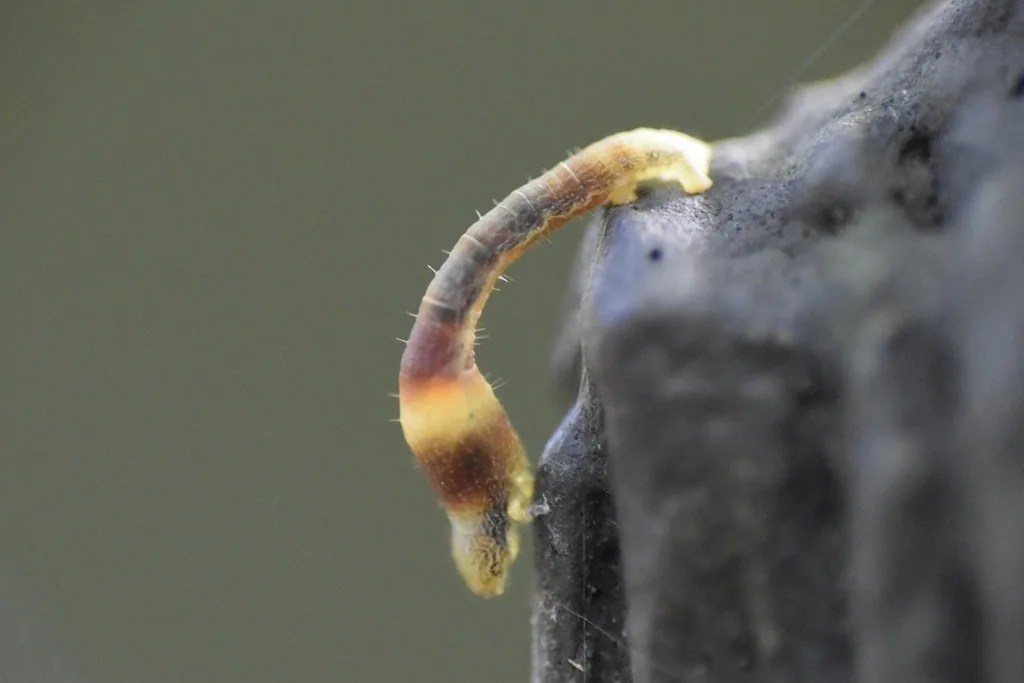
- The caterpillar is widest around the third thoracic and first abdominal segments, and the third thoracic segment is noticeably swollen at the base of the last pair of legs. The segments behind the head are short and bunched, with comparatively small legs.[1][2]
- Color varies widely, from nearly yellow or mauve to gray, chocolate brown or black, often with faint pinstripes. The pale head is covered in a network of dark spots that carries onto the body.[1][2]
- The breathing pores are orange to rusty orange with a thin black ring, and are often set in a dark patch on the side.[1][2]
- Full-grown caterpillars reach about 4 cm (1 1/2 inches).[1]
- The anal proleg at the rear is stout, with a vertical crease or line.[2]
Look-alikes
Where it lives
The USDA Forest Service gives its range as southern Ontario and Maine south to Florida and eastern Texas, in forests and woodlands; Butterflies and Moths of North America gives Massachusetts and southern Ontario to Florida, west to Illinois and Texas. GBIF's public U.S. records since 1990 (about 18,100) come from 27 states on the map, most from North Carolina, Virginia and Maryland.[1][5][7]
Biology and life cycle
Host lists differ. The Forest Service's geometroid guide names magnolia, redbay, sassafras, spicebush and tulip-tree, and its eastern-forest guide says many forest hardwoods; Butterflies and Moths of North America lists pawpaw, poplars, sassafras and tulip-tree.[1][2][5]
Connecticut has one generation, with full-grown caterpillars from late June to early August. Maryland has two, with full-grown caterpillars in May and June and again from August into November. Across its range the Forest Service gives caterpillars from May to November in one or two generations.[1][2]
It spends the winter as a pupa. Adults fly from late March to early October.[1][5]
A Maryland study classed it as a generalist and found caterpillars on spicebush, sassafras and tulip-tree. In warmer conditions they ate more spicebush and, more slowly, more sassafras, but the amount of tulip-tree they ate did not change with temperature.[6]
Researchers have also used it as a specialist herbivore to measure feeding on spicebush, and found that the effect of sun versus shade on how much the caterpillars ate differed among spicebush populations.[3]
Damage and signs
Health risk
None of the sources, the two USDA Forest Service guides, Butterflies and Moths of North America or the feeding studies, mention any bite, sting or other risk to people.[1][2][5][3][6]
Control
Prevention
None of the sources recommends any control for the tulip-tree beauty.[1][2][5]
Common questions
- What is the stout inchworm with a swollen front end on my tulip-tree or sassafras?
- If it is stout, swollen just behind the head and rests with its front end looped up, it is likely a tulip-tree beauty caterpillar.[1][2]
- Does the tulip-tree beauty feed on spicebush?
- Yes. Spicebush is one of its food plants, along with tulip-tree, magnolia, sassafras and redbay, and researchers have used the caterpillars to measure feeding on spicebush.[1][3]
- When do tulip-tree beauty moths fly?
- Adults fly from late March to early October, and the caterpillars can be found from May to November.[5][2]
Sources
- USDA Forest Service, Forest Health Technology Enterprise Team, “Geometroid Caterpillars of Northeastern and Appalachian Forests, FHTET-2001-10 (D. L. Wagner, D. C. Ferguson, T. L. McCabe and R. C. Reardon, September 2001; scanned copy).” archive.org/details/geometroidcaterp00wagn (accessed 2026-11-11)
- USDA Forest Service, Forest Health Technology Enterprise Team, “Caterpillars of Eastern Forests, FHTET-96-34 (D. L. Wagner, V. Giles, R. C. Reardon and M. L. McManus, November 1997; scanned copy).” archive.org/details/caterpillarsofea001997 (accessed 2026-11-11)
- Ecology (via NCBI PubMed), “Population-specific responses to light influence herbivory in the understory shrub Lindera benzoin (E. H. Mooney and R. A. Niesenbaum; Ecology 93(12): 2683-2692, 2012; abstract).” pubmed.ncbi.nlm.nih.gov/23431598/ (accessed 2026-11-11)
- iNaturalist, “Epimecis hortaria taxon page (order and family).” www.inaturalist.org/taxa/83090 (accessed 2026-11-11)
- Butterflies and Moths of North America, “Tulip-Tree Beauty, Epimecis hortaria.” www.butterfliesandmoths.org/species/Epimecis-hortaria (accessed 2026-11-11)
- PeerJ, via PubMed Central, “Variable effects of temperature on insect herbivory (Lemoine, Burkepile and Parker 2014).” pmc.ncbi.nlm.nih.gov/articles/PMC4017821/ (accessed 2026-11-11). Cited from the open-access full text.
- Global Biodiversity Information Facility (GBIF), “Epimecis hortaria: occurrence records in the U.S., 1990-2026 (GBIF occurrence search).” api.gbif.org/v1/occurrence/search?taxonKey=5149237&country=US&hasGeospatialIssue=false&occurrenceStatus=PRESENT&year=1990%2C2026&facet=stateProvince&facetLimit=400&limit=0 (accessed 2026-11-11). State counts are records reported (iNaturalist research-grade, museum specimens, surveys), not abundance.