On this page
How to identify it
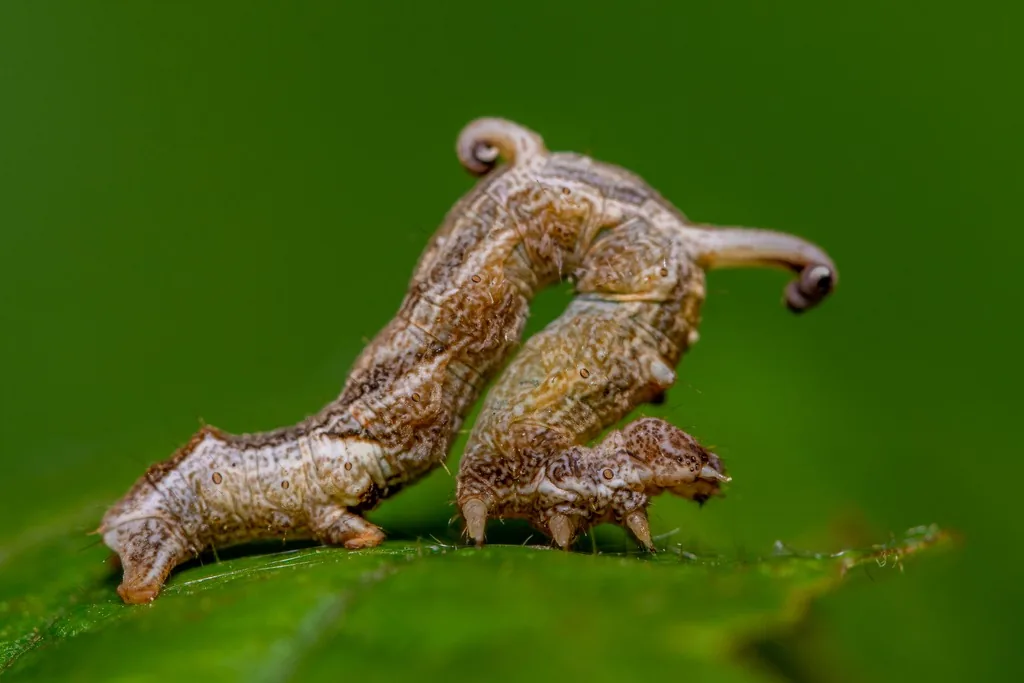
- The giveaway is two pairs of white- or pale-tipped tentacles (filaments) rising from the back of the second and third abdominal segments. The caterpillar can extend them, and when alarmed it may stretch them out to about three times their resting length.[1][2][3]
- The body is variegated brown with paler markings, ranging from yellow to rusty brown and sometimes tinted pink or purple. There are raised paired bumps on the back of the first and eighth abdominal segments, and a pale patch along the side toward the rear.[1][2][3]
- It is small: a full-grown caterpillar reaches about 2 cm (21 mm, a little under an inch). The head is mottled rusty brown.[1][3]
- At rest it sits in the open on the upper side of a leaf with the body thrown into a loop, sometimes arched forward over the head. The USDA Forest Service guide compares the effect to a fallen brown flower with its stamens sticking out.[1]
Look-alikes
| Look-alike | How to tell them apart |
|---|---|
| Baggett's horned spanworm (Nematocampa baggettaria) | A second Nematocampa species lives along the Gulf Coast, but its caterpillar has not been described.[2] |
Where it lives
It occurs across Canada and, in the eastern United States, south to Florida and Texas. Look for it in forests and woodlands, especially along edges, and in parks, meadows and other open places. Natural Resources Canada lists western hosts such as western hemlock, western larch, western redcedar and Engelmann spruce.[1][3]
Biology and life cycle
The caterpillars feed on a long list of plants, including alder, ash, basswood, birch, blueberry, catalpa, cherry, dogwood, elm, hawthorn, maple, oak, willow, carrot and strawberry, as well as conifers such as fir, hemlock, larch and spruce.[1][2]
The egg is the stage that survives winter.[1][3]
In Connecticut and Maryland there is one generation and at least a partial second, with full-grown caterpillars in late May and June and again in August. The eastern forest guide gives two generations in the North, with caterpillars from July to October.[1][2]
In Canada, Natural Resources Canada reports caterpillars in June and July, pupation in July or August, and moths about two weeks later.[3]
Damage and signs
- Each caterpillar feeds alone on the foliage, and noticeable defoliation is only occasional. During outbreaks in western Canada, considerable mortality may occur in western hemlock growing in the forest understory.[3]
Health risk
Despite the tentacles, nothing in the USDA Forest Service or Natural Resources Canada accounts suggests the filament bearer bites, stings or harms people; they treat it only as a leaf-feeding caterpillar.[1][2][3]
Control
Prevention
These sources describe the filament bearer as a common solitary feeder and give no control measures for it.[1][3]
Common questions
- What is the inchworm with little horns or antennae on its back?
- That is very likely the filament bearer, or horned spanworm. The USDA Forest Service guides call it unmistakable because of the two pairs of pale-tipped tentacles on the second and third abdominal segments.[1][2]
- Will it hurt my plants?
- Rarely. It feeds alone and only occasionally causes noticeable defoliation, although outbreaks in western Canada have killed understory western hemlock.[3]
Sources
- USDA Forest Service, Forest Health Technology Enterprise Team, “Geometroid Caterpillars of Northeastern and Appalachian Forests, FHTET-2001-10 (D. L. Wagner, D. C. Ferguson, T. L. McCabe and R. C. Reardon, September 2001; scanned copy).” archive.org/details/geometroidcaterp00wagn (accessed 2026-11-09)
- USDA Forest Service, Forest Health Technology Enterprise Team, “Caterpillars of Eastern Forests, FHTET-96-34 (D. L. Wagner, V. Giles, R. C. Reardon and M. L. McManus, November 1997; scanned copy).” archive.org/details/caterpillarsofea001997 (accessed 2026-11-09)
- Natural Resources Canada, Canadian Forest Service, “Filament bearer, Trees, insects and diseases of Canada's forests.” tidcf.nrcan.gc.ca/en/insects/factsheet/1000023 (accessed 2026-11-09)
- iNaturalist, “Nematocampa resistaria taxon page (order and family).” www.inaturalist.org/taxa/81656 (accessed 2026-11-09)