On this page
How to identify it
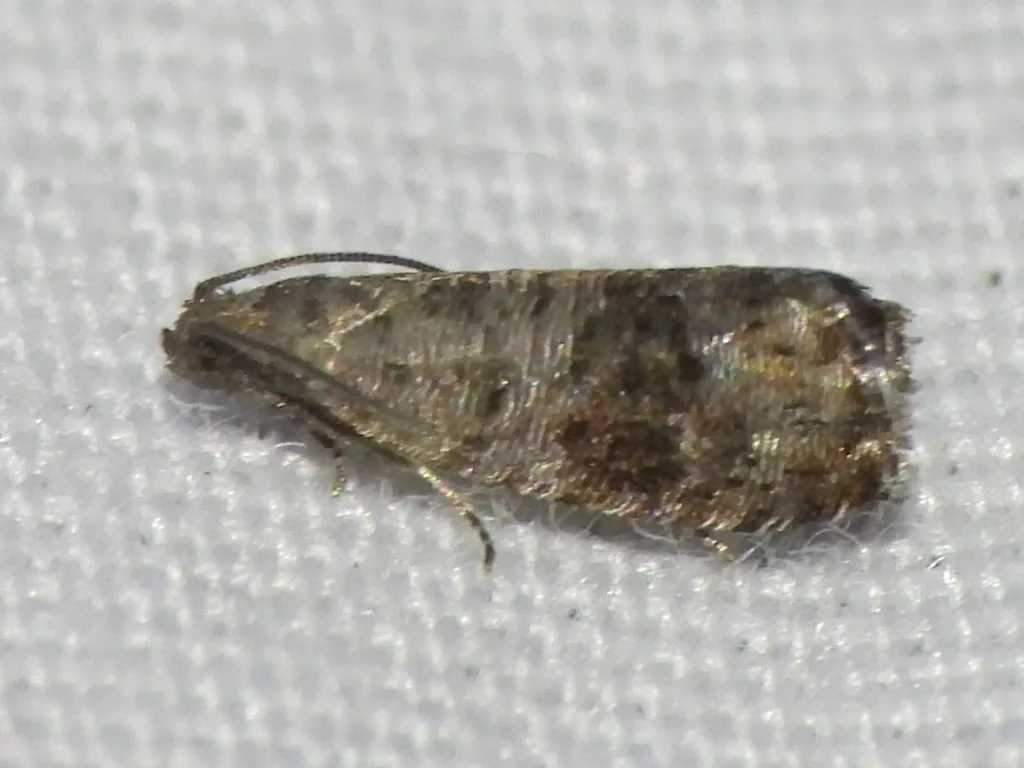
- The adult is a small, dark gray to brownish moth with a wingspan of about 9 to 10 mm (3/8 inch). It flies mostly at night, so it is rarely seen.[1]
- Moths range from light to dark. Light ones have silvery streaks and darker contrasting bands on the forewings, while dark ones lack a clear pattern. Males have a conspicuous patch of dark sex scales on the upper side of each hindwing.[2]
- Larvae are pinkish red. Full-grown larvae are about 8 to 9 mm (1/3 inch) long; the Pacific Northwest handbook describes a brown or black head, and the USDA fact sheet a yellowish-brown head with darker mottling and brown plates behind the head and on the tail end.[1][2]
- The eggs are flat, opaque and greenish white, and they are hard to see on leaves and small green berries.[1]
Look-alikes
| Look-alike | How to tell them apart |
|---|---|
| Oriental fruit moth | Dark cherry fruitworm moths can look like oriental fruit moths but are generally much smaller, and oriental fruit moth larvae, though similar, are generally larger.[2] |
| Lesser appleworm | The larvae are very similar. The lesser appleworm's abdomen is more reddish, while the cherry fruitworm has more prominent small plates (pinacula) on the eighth and ninth abdominal segments.[2] |
| Codling moth | Codling moth larvae are larger and lack the anal fork, the small comb under the tail end that cherry fruitworm larvae have.[2] |
Where it lives
It is widely distributed in eastern North America and also occurs in the Pacific Northwest (Washington and British Columbia) and probably other western fruit-growing regions. In the Pacific Northwest it has been found in blueberries only in parts of western Washington.[2][1]
Biology and life cycle
Larvae spend the winter fully grown, in cavities in dead wood on the bush or in pruning stubs, inside a cocoon. They pupate when spring warms up, and the moths emerge about two weeks later, in late spring; the USDA fact sheet reports adults in May and June.[1][2]
The moths mate and lay eggs a few days after emerging. In blueberries, eggs go on the undersides of leaves around blossom drop and on small green fruit, and the hatching larvae bore into the berries and eat the pulp. The USDA fact sheet describes females laying single eggs on leaves at the shoot tips, with larvae feeding inside shoots or fruit.[1][2]
The Pacific Northwest handbook reports one generation a year in blueberries, while the USDA fact sheet gives two to three generations a year.[1][2]
Larvae feed on many common fruit crops in the rose and heath families, including blueberry, apple, pear, plum, black cherry, firethorn, rose and hawthorn; hawthorn may be its native host. Feeding records vary a good deal from host to host, which suggests either that larvae behave differently on different hosts or that more than one species is involved.[2]
Damage and signs
- In blueberries, newly hatched larvae tunnel into the fruit, and one larva can destroy an entire cluster. Infested small berries shrink and turn blue too early, with a pin-sized entry hole near the stem.[1]
- On other hosts the larvae injure the fruit, cause early fruit drop, and stunt or kill shoots.[2]
Health risk
Neither the handbook nor the USDA fact sheet mentions any harm to people; both treat it as a fruit and shoot pest.[1][2]
Control
Sanitation
Remove places where larvae spend the winter, such as weeds, prunings and trash around the plants, and if possible manage alternate hosts such as cherry, apple and rose along field borders.[1]
Traps and physical control
Home gardeners can hand-pick larvae and eggs when they find them.[1]
Pesticides
Eggs are laid and hatch around bloom and petal fall, so take great care to protect bees. In home plantings, the handbook lists carbaryl and esfenvalerate, applied only after petal fall or at night.[1]
Commercial growers treat when larvae are small, usually at petal fall. The Pacific Northwest handbook's options include Bacillus thuringiensis and the Entrust formulation of spinosad (both OMRI-listed for organic use), methoxyfenozide, chlorantraniliprole and a number of broad-spectrum insecticides, many of them toxic to bees.[1]
Scouting blueberries
Start looking for eggs at petal fall or early fruit set, once moths are flying. The eggs are opaque and hard to see, so check the undersides of leaves and the small green berries carefully.[1]
Early in the season larvae leave little outside sign. Look for small, shrunken berries that have turned blue too early and have a pin-sized hole near the stem, then open the berries next to them to find the larvae.[1]
Common questions
- Why are some of my small blueberries turning blue early and shriveling?
- Small, shrunken berries that turn blue too early, with a pin-sized hole near the stem, are a sign to check for cherry fruitworm. Open the neighboring berries in the cluster to look for the pinkish larvae.[1]
- Does the cherry fruitworm attack only cherries?
- No. Its larvae feed on many fruits in the rose and heath families, including blueberry, apple, pear, plum, firethorn and hawthorn.[2]
- When should blueberries be treated for cherry fruitworm?
- When the larvae are small, usually at petal fall. Spraying during bloom risks harming bees, so in home plantings apply products only after petal fall or at night.[1]
Sources
- Pacific Northwest Pest Management Handbooks (Oregon State, Washington State and University of Idaho Extension), “Blueberry: Cherry fruitworm (Pacific Northwest Insect Management Handbook).” pnwhandbooks.org/insect/small-fruit/blueberry/blueberry-cherry-fruitworm (accessed 2026-11-09)
- USDA APHIS PPQ Center for Plant Health Science and Technology, with Colorado State University, “Grapholita packardi fact sheet, Tortricids of Agricultural Importance (T. M. Gilligan and M. E. Epstein; last updated August 2014).” idtools.org/id/leps/tortai/Grapholita_packardi.htm (accessed 2026-11-09)
- iNaturalist, “Aspila packardi taxon page (order and family).” www.inaturalist.org/taxa/1507300 (accessed 2026-11-09)