On this page
How to identify it
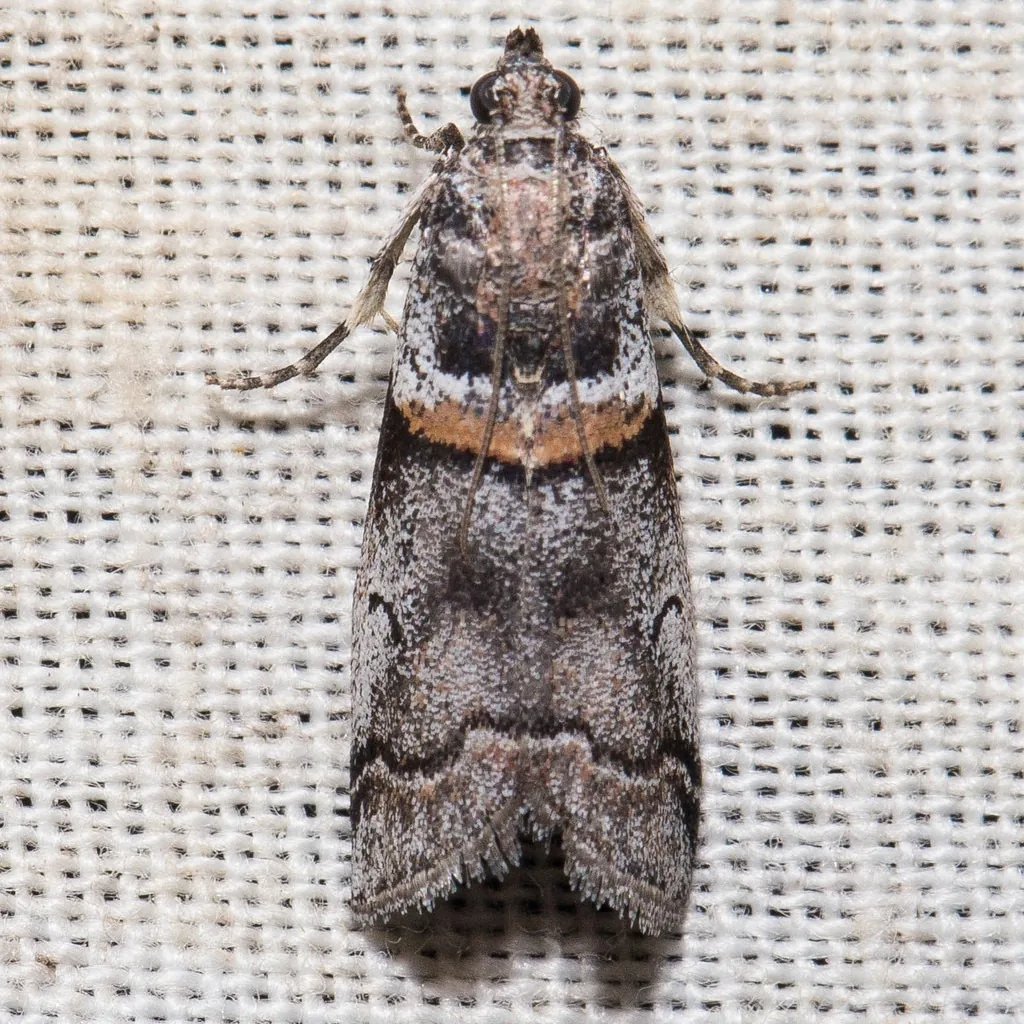
- The adult is a bluish-gray moth that looks distinctly wedge-shaped at rest, with a broad white stripe running across the middle of each forewing, bordered behind by reddish brown, and a narrower, more irregular white band near the rear edge of the wing.[2]
- A newly hatched larva is about 1.2 mm long, yellow with a brown head and a body covered with short spines; it darkens with age. The mature larva is brown on the upper half and lighter reddish brown below, with a distinct line midway along the side where the two colors meet; the legs are black and the head light brown.[2]
- The overwintering hibernacula are wart-like cases only 1 to 3 mm across, made of silk and bits of bark and tucked into the crotches of buds and twigs and in depressions in the bark, which makes them very hard to find.[2]
- In spring, look for nests of webbed-together leaves on cherry, the monitoring sign the Pacific Northwest handbook gives for this pest and the leaf crumpler.[1]
Look-alikes
| Look-alike | How to tell them apart |
|---|---|
| Peach twig borer | Prune growers confuse the two. Peach twig borer larvae are slightly under half an inch, with a black head and first segment and alternating light and dark brown bands across the body; they overwinter under bark in branch crotches, emerge later in spring, and bore into terminal twigs so the tips wilt, which the destructive prune worm does not do.[2] |
| Leaf crumpler | A related Acrobasis moth covered on the same Pacific Northwest cherry page; it lives in a silk tube on the twig surrounded by webbed, dead leaves rather than in a tiny bark hibernaculum, and the same sprays control both.[1][2] |
Where it lives
A pest of cherry and prune in the Pacific Northwest. The Idaho bulletin records it from apple near Yakima, Washington (1919) and near Boise, Idaho (1921), its first damaging outbreak in Idaho prunes in 1925, and by 1930 an infested belt about 80 miles long and 4 miles wide across southwestern Idaho and eastern Oregon; the bulletin notes that Hulst first described the insect in 1900 from an unknown host in Colorado.[1][2]
Biology and life cycle
Partly grown larvae spend the winter in their hibernacula on the tree and emerge from about the middle of March into early April, when they bore into the swelling buds. Before boring in, a larva spins dense webbing over the bud and twig, enters through the side of the bud and covers the hole with more webbing, into which it pushes its frass.[2]
The overwintered larvae finish growing within a few weeks of emerging and drop to the ground to pupate in the soil. Moths begin emerging about the middle of May and continue through June, laying eggs deep among the hairs on the undersides of the leaves; the eggs hatch in 7 to 10 days.[2]
There are two generations and a partial third. First-generation larvae feed about three weeks inside green prunes, then leave the fruit and pupate in the soil; second-generation moths emerge in July, and their larvae enter ripening fruit. Most of those larvae feed only briefly before leaving to spin hibernacula, while a few finish growing in the fruit and produce a partial third brood that overwinters as partly grown larvae.[2]
Damage and signs
- In early spring the overwintering larvae destroy many prune buds and blossoms by boring into the unopened buds and eating the floral parts; they also eat blossoms and a few young leaves after the buds open.[2]
- First-generation larvae feed almost entirely inside the green prunes, destroying the interior so that fruit shrivel and often drop; infested prunes can be picked out by their premature coloring. In rare cases the infestation has been heavy enough that the crop was not worth harvesting.[2]
- The Pacific Northwest handbook treats it as a cherry pest alongside the leaf crumpler.[1]
Health risk
Neither source mentions any effect on people; the mineola moth is an orchard pest only.[2][1]
Control
Prevention
Monitor cherry and prune trees in spring for larvae in nests of webbed-together leaves, and note that infestations have historically been light in orchards that received an annual dormant lime-sulfur spray for San Jose scale, peach twig borer and mites.[1][2]
Pesticides
No home-use product is specifically registered for this pest in the Pacific Northwest, but commercial insecticides applied for fruittree leafroller also control mineola moth. The 1941 Idaho trials found the hibernacula practically impervious to most spray materials and larvae inside the buds nearly as well protected, so the only spray that worked had to be timed to the few days after the overwintered larvae emerged, when buds were swelling and showing green at the tips.[1][2]
Common questions
- What is the destructive prune worm?
- It is the larva of the mineola moth, a small bluish-gray moth whose brown caterpillars bore into prune buds in early spring and into the green and ripening fruit in summer; the name dates from outbreaks in Idaho prune orchards beginning in 1925.[2]
- How is the mineola moth different from the peach twig borer?
- Mineola larvae are brown with black legs and a light brown head, darker above than below, and overwinter in tiny wart-like cases on the bark; peach twig borer larvae have a black head and first segment, show crosswise brown bands, overwinter under bark in crotches, and bore into twig tips so they wilt.[2]
- When should I expect mineola moth damage?
- Bud boring runs from mid-March to early April, moths fly from mid-May through June and again in July, and larvae are inside green prunes in early summer and ripening fruit later.[2]
Sources
- Pacific Northwest Pest Management Handbooks (Oregon State University, Washington State University and University of Idaho), “Cherry-Leaf crumpler and Mineola moth, Pacific Northwest Insect Management Handbook.” pnwhandbooks.org/insect/tree-fruit/cherry/cherry-leaf-crumpler-mineola-moth (accessed 2026-11-10)
- University of Idaho Agricultural Experiment Station, “The Mineola Moth or Destructive Prune Worm, Bulletin No. 242 (W. E. Shull and Claude Wakeland, December 1941; scanned copy).” objects.lib.uidaho.edu/uiext/uiext11394.pdf (accessed 2026-11-10). Historical bulletin; its spray recommendations are not current and are cited only for the insect's biology and for what they showed about spray timing.
- iNaturalist, “Acrobasis tricolorella taxon page (order and family).” www.inaturalist.org/taxa/208320 (accessed 2026-11-10)