On this page
How to identify it
- The caterpillar's silk tube is attached to a twig, enlarged with silk and leaf fragments as the larva grows, and can reach about 1/4 inch wide and 1.5 inches long; the leaves webbed around it die and hang on as a wad of dead material.[1]
- Mature larvae are about 3/4 inch long in North Carolina, with a pale reddish-brown head, a grayish-green back with purplish markings where the segments overlap, and a pale grayish-green underside; the Pacific Northwest handbook describes mature larvae as pinkish and about half an inch long.[1][2]
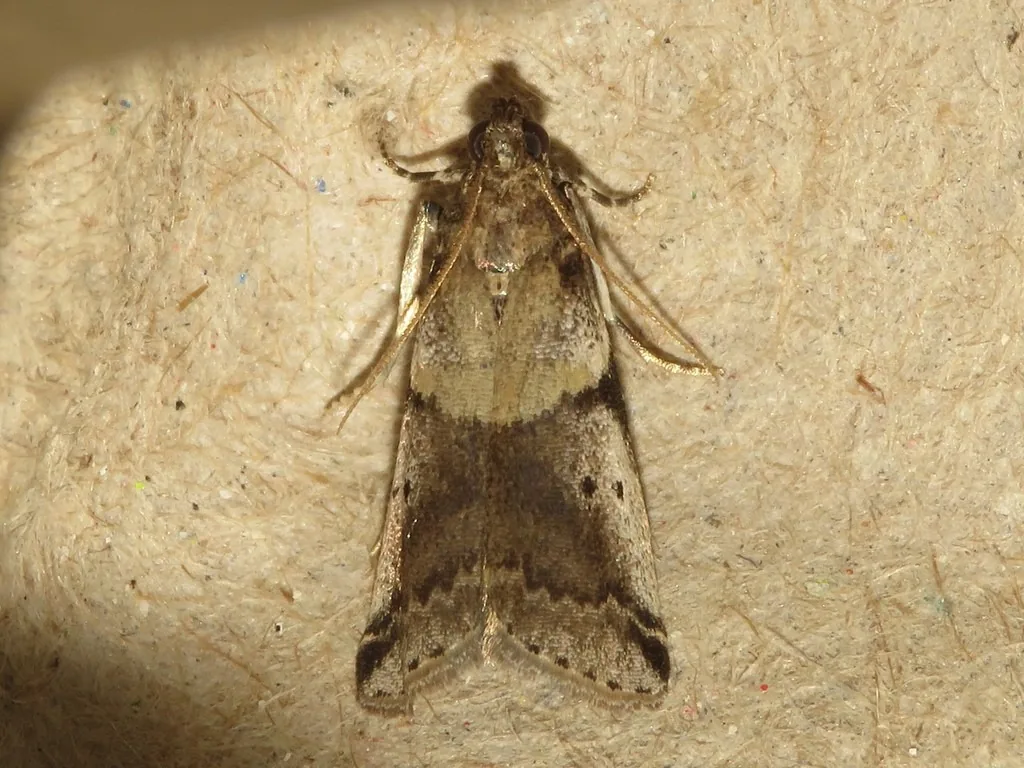
- The moth is small, with a wingspan of 1/2 to 3/4 inch; the forewings are light brown with a white patch on each wing and several black lines.[1][2]
- Pupae are just over 1/4 inch long and yellowish brown to reddish brown, formed inside the tube.[1]
Look-alikes
| Look-alike | How to tell them apart |
|---|---|
| Fire blight | The wads of dead, webbed leaves resemble fire blight dieback; pull the dead leaves apart and look for the silk tube and caterpillar to tell them apart.[1] |
| Mineola moth | A related Acrobasis moth covered on the same Pacific Northwest cherry page and controlled by the same sprays; see its own profile for the bark hibernacula and fruit boring that set it apart.[2] |
| Fruittree leafroller | Rolls and ties leaves with silk but does not build a permanent tube fastened to the twig; sprays for fruittree leafroller also control leaf crumpler.[2] |
Where it lives
Described from North Carolina, where it has two generations a year, and from the Pacific Northwest, where it attacks a wide range of rosaceous plants including native crabapple, pyracantha and most tree fruits.[1][2]
Biology and life cycle
Leaf crumplers overwinter as partially grown larvae inside their tubes on the host and resume feeding in spring, leaving the nest at night to bring back leaf fragments. Pupation takes place in the sealed tube in late spring (late July to mid-August for the summer generation in North Carolina) and lasts about two weeks.[1][2]
Moths emerge about two weeks after pupation and lay eggs on the foliage; in the Pacific Northwest first-generation adults lay in early June and most feeding of that brood is in June and July. Eggs hatch in two to three weeks.[1][2]
There are two generations a year in North Carolina and in warmer parts of the Pacific Northwest, with second-generation adults appearing in August to lay the eggs of the overwintering brood; in cooler regions only a single generation may be produced.[1][2]
Recorded hosts are apple, cherry, cotoneaster, crabapple, hawthorn, loquat, peach, pear, plum, pyracantha and quince.[1]
Damage and signs
- Damage comes from the larvae feeding on developing leaves and buds and from the tubes and clusters of dead, webbed leaves they leave on the twigs, which spoil the look of ornamentals and resemble disease.[1][2]
- Girdling of twigs and feeding on buds and fruit have also been reported, probably when larvae are crowded; in the Pacific Northwest, second-generation larvae burrow into cherries and prunes.[1][2]
Health risk
Neither source mentions any effect on people; the leaf crumpler is a plant pest only.[1][2]
Control
Prevention
In spring, look for nests of webbed-together leaves and the silk tubes on twigs, when the overwintered larvae are active and before the first moths fly.[2]
Pesticides
NC State says carbaryl or another insecticide labeled for landscape use in home grounds should give adequate control if applied thoroughly enough to get the spray into the nests. In Pacific Northwest orchards no home-use product is specifically registered, but commercial insecticides applied for fruittree leafroller also control leaf crumpler.[1][2]
Common questions
- My crabapple has clumps of dead brown leaves that look like fire blight. Could it be an insect?
- Yes. Leaf crumpler caterpillars web leaves around a silk tube on the twig, and the dead wads look like fire blight; pulling one apart reveals the tube and the grayish-green caterpillar.[1]
- When do leaf crumplers feed?
- The partly grown larvae overwinter in their tubes and feed again in spring, leaving the nest at night to collect leaf fragments; a summer generation follows, with moths in early June and again in August in the Pacific Northwest.[2][1]
- Do leaf crumplers damage fruit?
- Mostly they eat leaves and buds, but feeding on buds and fruit has been reported, and in the Pacific Northwest second-generation larvae burrow into cherries and prunes.[1][2]
Sources
- NC State Extension, North Carolina State University, “Leaf Crumpler, PDIC Factsheet (James Baker; published March 2, 2017, reviewed Oct. 1, 2026).” content.ces.ncsu.edu/leaf-crumpler (accessed 2026-11-10)
- Pacific Northwest Pest Management Handbooks (Oregon State University, Washington State University and University of Idaho), “Cherry-Leaf crumpler and Mineola moth, Pacific Northwest Insect Management Handbook.” pnwhandbooks.org/insect/tree-fruit/cherry/cherry-leaf-crumpler-mineola-moth (accessed 2026-11-10)
- iNaturalist, “Acrobasis indigenella taxon page (order and family).” www.inaturalist.org/taxa/212378 (accessed 2026-11-10)