On this page
How to identify it
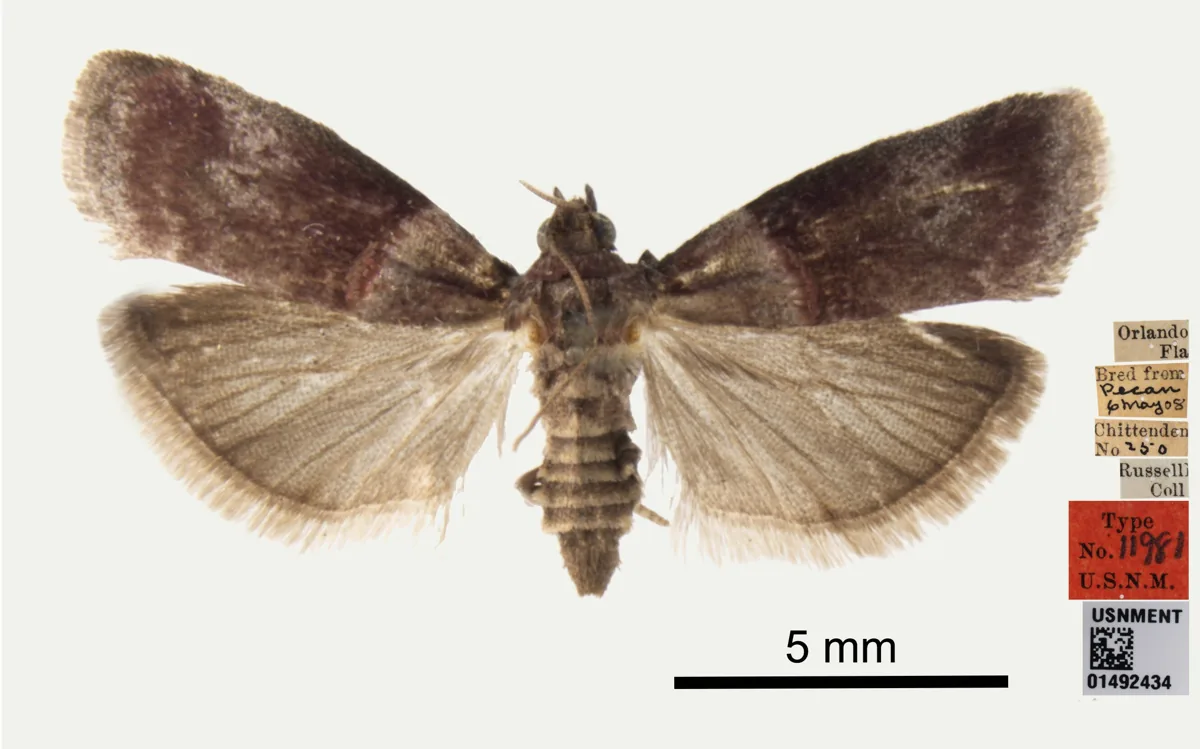
- Adult moths are about 1/3 inch long and gray to grayish brown, with a dark ridge of scales across each front wing.[1][2]
- Eggs are tiny ovals laid one at a time at the tip of a nutlet. They are white when laid and turn red three to five days before they hatch.[1]
- Newly hatched larvae are white to yellow. Full-grown larvae are about 1/2 inch long and olive gray to dark green, with yellowish-brown heads.[1][2]
- Black frass mixed with silk at the base of a nutlet marks the spot where a larva bored in.[1]
Look-alikes
| Look-alike | How to tell them apart |
|---|---|
| Hickory shuckworm | Shuckworm larvae are cream colored with brown heads, not olive or dark green, and first-generation shuckworm moths lay their eggs in June and July on pecan nuts that are already developed.[2] |
| Pecan bud moth and pecan leaf casebearer | These two moths (Gretchena bolliana and Acrobasis juglandis) sometimes end up on sticky traps baited with casebearer pheromone. Oklahoma State says most such off-type catches are easy to tell from casebearer moths.[1] |
Where it lives
It is found throughout pecan-growing regions from Florida to southern New Mexico.[1]
Biology and life cycle
The casebearer spends the winter as a small larva inside a tightly woven silk case, called a hibernaculum, near a bud or leaf scar. In spring the larvae leave their cases, tunnel into new shoots to feed, and pupate inside those tunnels.[1]
In Oklahoma the moths from these overwintering larvae emerge from late May to early June. They mate and lay eggs at night, and each female lays 50 to 150 eggs in a life of five to eight days, placing them singly on nutlets after the trees pollinate.[1]
The young larvae feed first on buds and move about for around two days, then bore into the base of one or more nutlets and feed inside for four to five weeks. They pupate in the nut, and moths emerge 9 to 14 days later.[1]
Oklahoma sees two to three generations a year, and Mississippi State puts the number at three to four depending on location. Second-generation larvae appear from mid-July and feed mostly on shucks, doing little harm unless numbers are very high, and later generations rarely threaten the crop.[1][2]
Damage and signs
- The first generation does most of the damage. A larva bores into the base of one or more nutlets, and a single larva may damage an entire cluster.[1]
- For pecans in home landscapes, Mississippi State counts the nut casebearer among several pecan pests that are mostly occasional and usually not practical to control on backyard trees.[3]
Health risk
A pest of pecan nuts. Neither Oklahoma State nor Mississippi State mentions any risk to people or pets.[1][2]
Control
Prevention
Pheromone-baited sticky traps catch male moths and show when the flight begins. Start looking for eggs seven to ten days after the first moth is caught; significant nut entry usually follows 12 to 16 days after that first catch, so spraying at peak moth catch is too early.[1]
Decide on treatment by scouting, not by trap counts. Beginning one to two weeks before larvae are expected to enter the nuts, check nut clusters with a hand lens for eggs or entry holes; Oklahoma State's guideline is to treat as soon as possible once 2 infested clusters turn up before 310 have been checked, and to look again in two to three days if fewer are found.[1]
Biological control
Natural enemies have not been shown to control the casebearer on their own, but parasitoids collected from first-generation larvae in Texas in 1983 gave about 40% control, and many predators and parasites feed on the eggs. Oklahoma State cites this as a reason to limit insecticide use.[1]
Pesticides
Time any spray for one to two days after the eggs hatch. Oklahoma State prefers Bacillus thuringiensis (Bt) or caterpillar-specific insect growth regulators to pyrethroids, carbamates and organophosphates, which also kill parasites and predators and can lead to aphid and spider mite outbreaks. Rain and sunlight break Bt down quickly, so its timing matters even more.[1]
Common questions
- When do pecans need to be sprayed for nut casebearer?
- Only when scouting finds infested clusters, and then within one to two days after the eggs hatch. In Oklahoma egg laying begins around the end of May in southern counties and as late as June 15 in the north.[1]
- What is the black material at the base of my pecan nutlets?
- Black frass with silk at the base of a nutlet shows where a casebearer larva bored in.[1]
- Do pheromone traps control pecan nut casebearers?
- They are a monitoring tool. The traps catch male moths to show when the flight starts, and they catch moths even when damaging numbers of larvae are unlikely, so the decision to treat rests on finding eggs or larvae on the nuts.[1]
Sources
- Oklahoma State University Extension, “The Pecan Nut Casebearer, EPP-7189 (P. G. Mulder and R. Grantham, February 2020).” pods.okstate.edu/fact-sheets/EPP-7189pod2020.pdf (accessed 2026-11-08)
- Mississippi State University Extension, “A Photo Guide to Pecan Insect Pests, Part 1, Publication 4197 (J. D. Perier, 2026).” extension.msstate.edu/sites/default/files/document/2026-06/P4197_web.pdf (accessed 2026-11-08)
- Mississippi State University Extension, “Disease and Insect Management for Pecans in Home Landscapes, Publication 3967 (R. A. Melanson and B. Layton, 2024).” extension.msstate.edu/publications/disease-and-insect-management-for-pecans-home-landscapes (accessed 2026-11-08)
- iNaturalist, “Acrobasis nuxvorella taxon page (order and family).” www.inaturalist.org/taxa/509867 (accessed 2026-11-08)