On this page
How to identify it
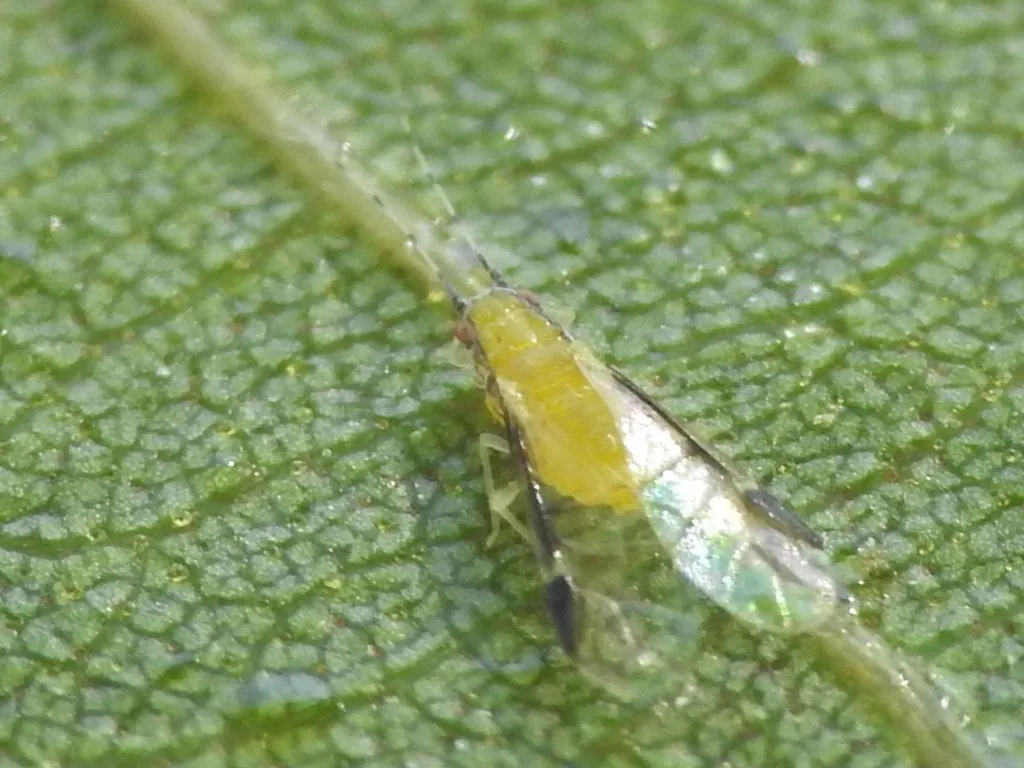
- Both are small, soft-bodied yellow aphids with black markings. The black gets heavier as the season moves from spring to fall, and their cornicles are reduced to pores.[1][2]
- Winged blackmargined aphids hold their wings flat over the body, with a black stripe along the outer edge of each wing.[1]
- Winged yellow pecan aphids hold their wings like a roof over the body and have no black stripe on the wing edge. Yellow pecan aphids have red eyes, and the wingless ones carry long hairs that stick out at steep angles, giving a pincushion look; blackmargined aphids have much shorter hairs lying closer to the body.[1][2]
- They feed mostly on the undersides of the leaves: blackmargined aphids along the main leaflet veins, yellow pecan aphids on the network of small veins across the leaf.[2]
Look-alikes
| Look-alike | How to tell them apart |
|---|---|
| Black pecan aphid | Black pecan aphids are much more destructive. The adults are tiny, pear-shaped and black, the nymphs dark olive green, and their feeding turns the leaf between the main veins bright yellow in patches up to a quarter inch across that later turn brown. As few as three per compound leaf can cause severe leaf damage and leaf drop.[1] |
Where it lives
Both are pecan pests. Texas A&M covers them in Texas home orchards, and UC IPM calls them significant pests of pecan in California. UC IPM also reports evidence of insecticide resistance in California, Texas and New Mexico, and growers have seen apparent resistance in Arizona.[1][2]
Biology and life cycle
Eggs spend the winter in bark crevices on twigs and trunks. Nymphs hatch in spring and feed on newly expanded leaves, maturing in about a week.[1]
Through spring and summer every aphid is a female that gives birth to live young without mating. In late September and October males and egg-laying females appear, and the females lay the eggs that overwinter.[1]
There are several generations a year. Blackmargined aphids usually build from June to August, and yellow pecan aphids tend to increase later in the season. UC IPM notes that numbers tend to peak in spring and again in fall.[1][2]
Damage and signs
- Their feeding pulls large amounts of water and sugars out of the leaves, which can slow the growth of shoots and roots. The honeydew they excrete collects on the leaves and feeds a black sooty mold that cuts down on photosynthesis.[1][2]
- Yellow pecan aphid outbreaks can cause late-season leaf drop and lower nut yield and quality. Blackmargined aphid infestations often collapse after about three weeks without measurable harm to foliage or yield.[1]
Health risk
These aphids feed only on plants. Texas A&M and UC IPM describe them as pecan pests and mention no risk to people or pets.[1][2]
Control
Prevention
Check the undersides of the leaves regularly, since numbers can climb quickly. UC IPM has orchards scout every 4 to 5 days from May through shoot and nut development, looking at 5 compound leaves on each of at least 10 trees.[2]
Biological control
Natural enemies, rain and wind often make yellow aphid infestations crash on their own. Spraying can kill those natural enemies and leave the aphids more numerous than before, so an insecticide is often not the best first move in a home orchard.[1]
Pesticides
UC IPM orchard thresholds: before June 1, treat if honeydew is building up; from June 1 to August 15, when the average tops 20 aphids per compound leaf; from August 15 to leaf fall, when it tops 10. Insecticides that spare beneficial insects bring aphid numbers down over time.[2]
For backyard trees, Texas A&M suggests products containing acetamiprid or imidacloprid labeled for aphids on bearing pecans when control is needed, and its product table also lists insecticidal soap for aphids. The table lists the imidacloprid soil drench, applied around the dripline, at one application a year.[1]
Insecticide resistance in yellow pecan aphids has been a problem in other pecan-growing states. UC IPM advises alternating products from different mode-of-action groups, using each no more than once a season, and applying imidacloprid to the foliage later in the season rather than relying on slow soil uptake. Its commercial list includes flupyradifurone, flonicamid and imidacloprid.[2]
Common questions
- Why are the leaves on my pecan tree sticky and turning black?
- Yellow aphids are one cause. As they feed on the undersides of the leaves they excrete sugary honeydew that collects on the foliage, and black sooty mold grows on it when the air is humid.[1][2]
- Do I need to spray my pecan tree for yellow aphids?
- Often not. Blackmargined aphid infestations commonly fade after about three weeks without measurable damage, and natural enemies, rain and wind knock populations down. Spraying can kill the natural enemies and let aphids rebound. Yellow pecan aphids late in the season deserve a closer look, because outbreaks can cause leaf drop and smaller crops.[1]
- How can I tell the blackmargined aphid from the yellow pecan aphid?
- Look at the winged adults. Blackmargined aphids hold their wings flat and have a black stripe along the wing edge; yellow pecan aphids hold their wings like a roof and lack the stripe. Yellow pecan aphids also have red eyes and a bristly, pincushion look.[1][2]
Sources
- Texas A&M AgriLife Extension Service, Extension Entomology, “Pecan Pests in the Home Orchard: Insects and mites that feed on leaves.” extensionentomology.tamu.edu/resources/management-guides/pecan-pests-in-the-home-orchard/insects-and-mites-that-feed-on-leaves/ (accessed 2026-11-08)
- University of California Statewide IPM Program, “Yellow Aphid Complex (Pecan Pest Management Guidelines).” ipm.ucanr.edu/agriculture/pecan/yellow-aphid-complex (accessed 2026-11-08)
- iNaturalist, “Monellia caryella taxon page (order and family).” www.inaturalist.org/taxa/782196 (accessed 2026-11-08)