On this page
How to identify it
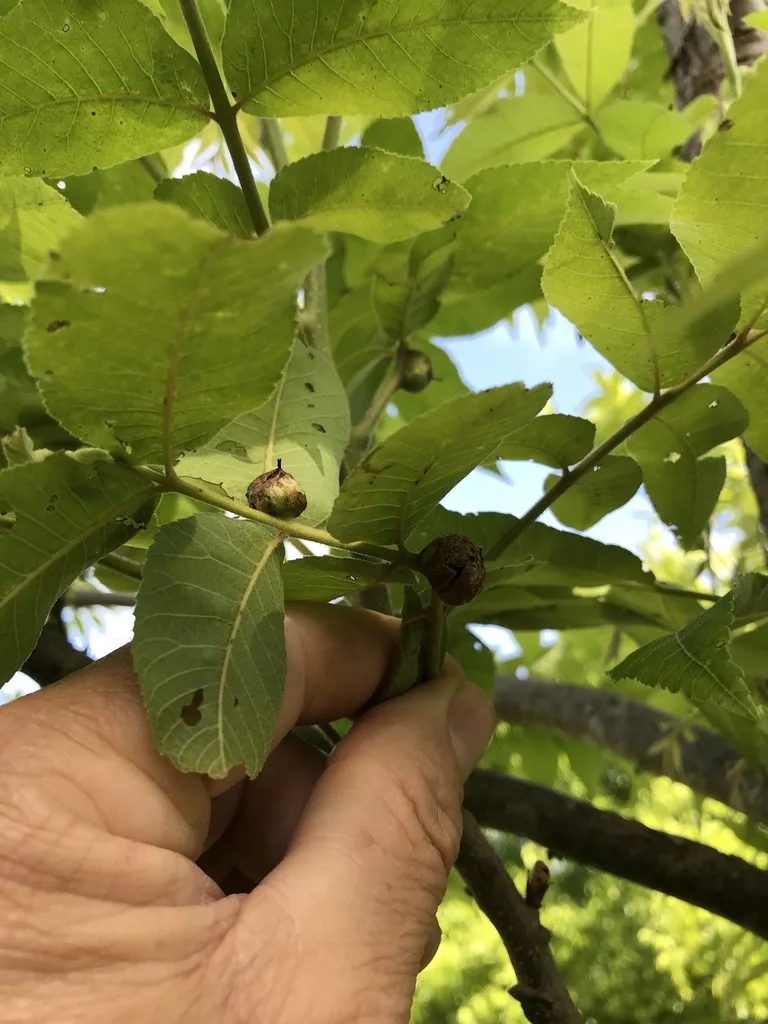
- The galls are hollow, thick-walled, tumor-like swellings on new twigs, and they can also form on leaves, leaf stems and nuts.[1][2]
- Galls appear on the new growth in April and split open in late May.[1][2]
- The insects inside are tiny, pale yellow and aphid-like, usually without pronounced cornicles (small tubes at the rear of the back). A gall split open in spring shows them developing inside.[4][2]
Look-alikes
Where it lives
It is a pest of pecan trees, described by extension entomologists in Mississippi and Kentucky.[1][3]
Biology and life cycle
Pecan phylloxera spend the winter as eggs in bark crevices. The nymphs hatch as leaf buds begin to expand in spring and crawl to the opening buds, where their feeding makes the plant form a gall around each one.[1][2][3]
Inside the gall the nymph matures and lays eggs, and a second generation develops there. In late May the galls split open and release dozens of these second-generation adult females.[1][2][3]
Those females produce a free-living generation of males and females that makes no galls and does no real damage. Each female of that generation produces a single egg, which spends the winter inside her body after she dies in a sheltered bark crevice.[1][2]
Outbreaks come in cycles. A tree may be heavily infested for a year or two and then go several years without a serious problem, even with no treatment.[1][2]
Damage and signs
- Galls distort the developing twigs, leaves and nuts. Heavy infestations make trees unsightly, reduce growth and can greatly cut yields for a season or two, though Mississippi State notes they will not kill the tree.[1][2]
- Trees that look devastated one year usually recover within a year or two even if left untreated, so Mississippi State advises against cutting them down in a hurry.[1]
- Hickory shuckworm moths also lay eggs on phylloxera galls in spring, and the galls serve as homes for the shuckworm's first generation.[4]
Health risk
A pest of pecan trees. Mississippi State and Kentucky mention no risk to people or pets.[1][3]
Control
Prevention
Treatment is preventive. Trees that had heavy galling last year are the ones most likely to benefit, and trees with no galls last year do not need it. Once galls are visible nothing can be done for that season.[2][1]
For new plantings, Mississippi State lists varieties better suited to low-maintenance trees, including Amling, Candy, Elliot, Excel, Curtis, Forkert, Gafford, Jackson, Kanza, Lakota, McMillan, Melrose and Syrup Mill. They were picked mainly for scab resistance, and their tolerance of insects varies.[1]
Pesticides
Sprays containing imidacloprid or carbaryl control phylloxera only when applied in the short window between bud break and the time new growth reaches 1 inch; Mississippi State suggests spraying at bud break and again 7 to 10 days later. Sprays applied after the galls start forming do not work.[2][1]
Kentucky starts control with a dormant oil application, then aims at the crawlers, which are active just before or at bud break, before any galls form.[3]
A soil application of imidacloprid is the easiest home treatment and carries the least drift risk, but it is costly on large trees, works erratically, and leaves trees more prone to mite outbreaks.[2]
When to call a professional
Spraying a mature pecan thoroughly is hard for most homeowners, and in dense neighborhoods drift concerns often rule it out. Some licensed commercial applicators will spray the foliage or inject imidacloprid into the soil, but the work is costly, must be arranged in advance, and may not be available everywhere.[1][2]
Common questions
- Can I spray the galls on my pecan tree now?
- No. Once galls are visible the damage for the year is done, and sprays applied after galls form will not work. Note which trees were hit, since those are the ones that benefit from treatment at bud break the following spring.[1][2]
- Will pecan phylloxera kill my tree?
- Heavy infestations will not kill a pecan, though they can make it look bad and cut yields for a season or two. Outbreaks are cyclic, and trees usually recover.[1]
- What are the knotty growths on my pecan twigs?
- Knotty growths on new pecan twigs are galls made by the pecan phylloxera, a small aphid-like insect that develops inside them.[1][2]
Sources
- Mississippi State University Extension, “Pecan Phylloxera, Bug's Eye View Vol. 10, No. 01 (B. Layton, 2024).” extension.msstate.edu/taxonomy/term/4171/2024/pecan-phylloxera-vol-10-no-01 (accessed 2026-11-08)
- Mississippi State University Extension, “Disease and Insect Management for Pecans in Home Landscapes, Publication 3967 (R. A. Melanson and B. Layton, 2024).” extension.msstate.edu/publications/disease-and-insect-management-for-pecans-home-landscapes (accessed 2026-11-08)
- University of Kentucky Entomology, “Pecan Insects, ENTFACT-210 (R. Bessin, revised January 2026).” entomology.ca.uky.edu/ef210 (accessed 2026-11-08)
- Mississippi State University Extension, “A Photo Guide to Pecan Insect Pests, Part 1, Publication 4197 (J. D. Perier, 2026).” extension.msstate.edu/sites/default/files/document/2026-06/P4197_web.pdf (accessed 2026-11-08)
- iNaturalist, “Phylloxera devastatrix taxon page (order and family).” www.inaturalist.org/taxa/547068 (accessed 2026-11-08)