On this page
How to identify it
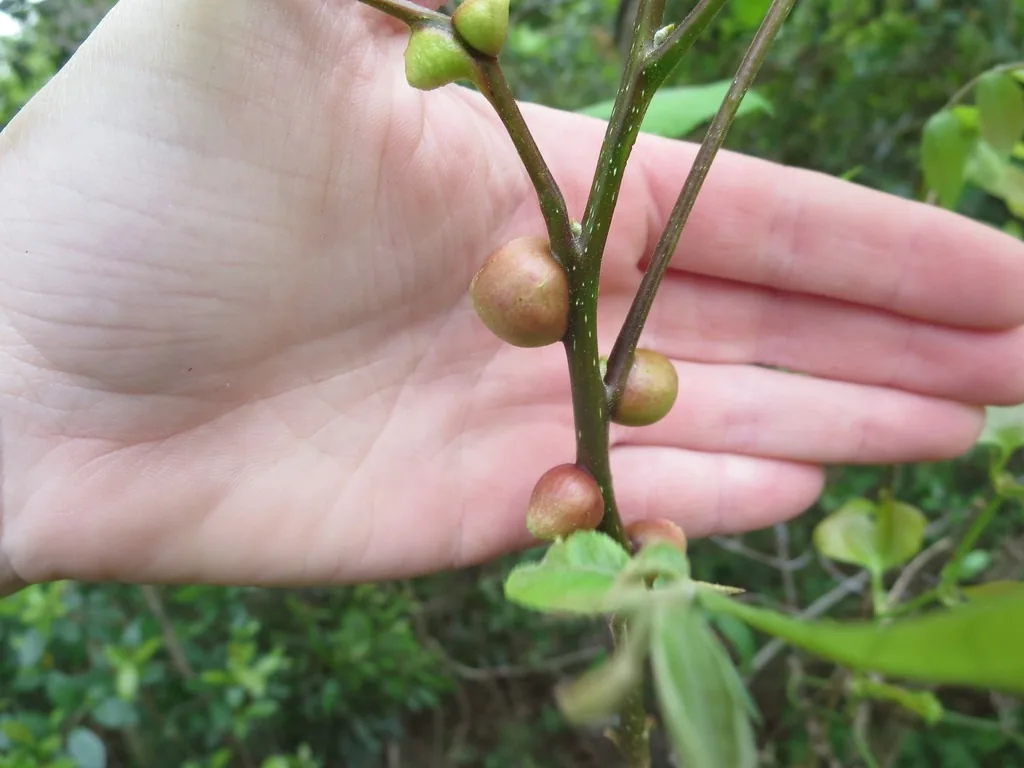
- Galls are round, up to almost an inch across, on the leaf stems (petioles), on shoots and sometimes on the midribs of the leaflets.[1][3][2]
- They start pale yellowish green, often turn red before they open, then dry to leathery or hard, woody black galls that can stay on the tree for years.[2][1]
- Each gall opens by a hole or split on the side facing away from the plant, through which the winged insects leave.[1][2]
Look-alikes
Where it lives
Reported on hickories by extension services in Massachusetts, Missouri and Minnesota; it attacks many native hickories and also pecan.[1][2][3]
Biology and life cycle
The life cycle takes about a year. In spring a wingless female, the stem mother, hatches from an overwintering egg and feeds on the new leaves and leaf stems, and the plant tissue grows around her into a closed gall by early May.[1][2]
Inside the gall she lays many eggs (UMass says 1,000 or more); the young feed on the gall tissue and become winged adults, and the galls split open around late May to release them.[1][2]
The winged adults lay eggs on the undersides of nearby leaflets; these hatch into males and females that mate, and each female lays a single egg in an old gall or bark crevice, which overwinters.[1][2]
Damage and signs
- Galls are mostly unsightly and don't kill the tree, but many galls can deform leaves, leaves may drop early in late summer, and canopies can look thin.[1][3]
- Severe infestations several years in a row can defoliate limbs and kill whole branches; dead branch tips with clustered galls at their base are an easy sign.[2]
- Hosts include shagbark, shellbark, pignut, bitternut and mockernut hickory and pecan; galls are smooth on most hosts but have been reported as spiny on mockernut and bitternut.[2][1]
Health risk
It feeds only on hickories and pecan; none of the sources reports any harm to people or pets.[1][2]
Control
Prevention
Check shoots, leaf stems and leaflet midribs for new galls in May; old, woody galls from earlier years can be spotted any time.[1]
Traps and physical control
Prune off twigs with new galls before the galls open and the winged insects leave.[1][2]
Pesticides
Usually not necessary; UMass notes dormant oil can be applied to the stems before the overwintering eggs hatch in April, when the weather allows.[1]
Common questions
- What are the round balls on my hickory's leaf stems?
- Round green to red galls on the leaf stems and shoots in May are most likely made by the hickory gall phylloxera, a tiny aphid relative.[1][2][3]
- Will hickory galls hurt my tree?
- Usually not; they are unsightly and can thin the canopy, but serious branch dieback takes severe infestations several years in a row.[1][2][3]
Sources
- UMass Extension Landscape, Nursery and Urban Forestry Program (Landscape Insect & Mite Guide), “Phylloxera caryaecaulis (Hickory Leafstem Gall Phylloxera).” www.umass.edu/agriculture-food-environment/landscape/publications-resources/insect-mite-guide/phylloxera-caryaecaulis (accessed 2026-10-17)
- University of Missouri Extension (Integrated Pest Management), “Hickory Galls Induced by Phylloxera (Missouri Environment and Garden, May 2012).” ipm.missouri.edu/MEG/2012/5/Hickory-Galls-Induced-by-Phylloxera (accessed 2026-10-17)
- University of Minnesota Extension (What's wrong with my plant?), “Hickory: distorted or deformed leaves or petioles.” apps.extension.umn.edu/garden/diagnose/plant/deciduous/hickory/leavesdistorted.html (accessed 2026-10-17)
- iNaturalist, “Phylloxera caryaecaulis taxon page (order and family).” www.inaturalist.org/taxa/707993 (accessed 2026-10-06)