On this page
How to identify it
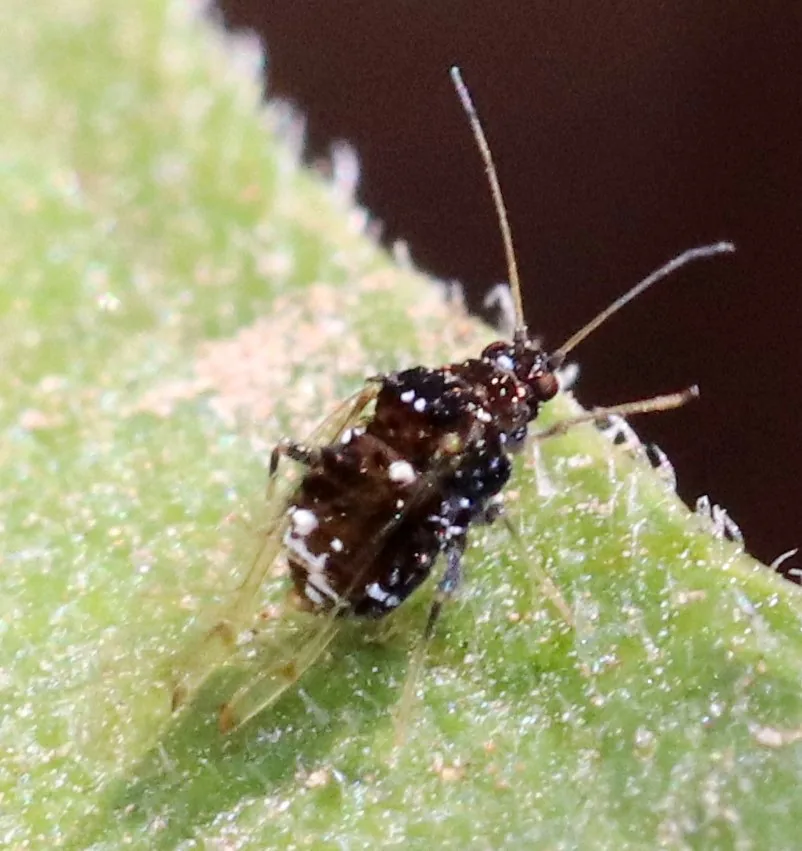
- Adults are black or greenish black and the nymphs are olive green. Winged adults have clear wings and white specks along the back.[1][2]
- They settle in the shady inner parts of the tree and feed on the undersides of the leaflets.[1][3]
- The giveaway is bright yellow, angular spots on the leaflets where they fed, which later turn brown. Unlike yellow aphids, they rarely leave much honeydew.[1][3][2]
Look-alikes
| Look-alike | How to tell them apart |
|---|---|
| Yellow pecan aphids | Yellow aphids are pale yellow without obvious markings and usually far more numerous, and large colonies coat leaves with honeydew and sooty mold. They are much less damaging per aphid: Kentucky's threshold is 10 yellow aphids per compound leaf, against about one black aphid or damaged spot.[2][3][1] |
Where it lives
Extension entomologists in Kentucky and Mississippi both list it as a pest of pecan, chiefly late in the season.[1][2]
Biology and life cycle
Kentucky describes pecan aphids as spending the winter as eggs laid in bark crevices on the tree. They hatch in spring and soon begin reproducing without mating, so several to many generations develop each year.[1][2]
Serious numbers usually do not build until late summer, and the black pecan aphid is typically a late-season pest.[1]
Aphids on pecan are secondary pests that often build up after insecticide sprays, which disrupt the natural enemies that keep them down.[1][3]
Damage and signs
- The toxic saliva yellows the leaf tissue around each feeding site. The spots turn brown, the leaflets die, and heavy infestations make trees lose their leaves earlier than normal.[1][3][2]
- Heavy infestations may reduce the nut crop in the current year, the following year or both, and severe ones can cut the next season's bloom.[1][2]
Health risk
It feeds on pecan leaves. Kentucky and Mississippi State mention no risk to people or pets.[1][2]
Control
Prevention
When planting, avoid cultivars that are especially susceptible to black pecan aphids. Mississippi State names Sumner, Schley and Gloria Grande as examples.[3]
Biological control
In orchards, Kentucky recommends a winter cover crop of crimson clover or hairy vetch: in early spring, beneficial insects build up on it by feeding on pea aphids and other insects.[1]
Pesticides
For a home tree, Mississippi State says a soil-applied drench of the systemic insecticide imidacloprid, applied after the tree leafs out, also helps control black pecan aphids. Results are erratic and large trees are costly to treat, it may be applied only once a year, and treated trees are more prone to mite outbreaks.[3]
Kentucky's economic threshold is an average of one black aphid or damaged spot per compound leaf. It notes that organophosphate insecticides appear more effective against black aphids and advises no more than two pyrethroid applications, so aphids do not develop resistance.[1]
Common questions
- What causes bright yellow spots on pecan leaves?
- One cause is the black pecan aphid. Its toxic saliva leaves angular yellow spots where it feeds, and they turn brown before the leaflets fall.[3][1]
- Should I spray my pecan tree for aphids?
- Mississippi State notes that aphids are hard to control with sprays and that spraying can increase them by disrupting natural enemies. For black pecan aphids on home trees it points to less susceptible cultivars and a soil-applied imidacloprid drench instead.[3]
- Why did aphids get worse after I sprayed?
- Aphids on pecan are secondary pests that often build up after insecticide sprays, because the sprays disrupt the natural enemies that hold them down.[1][3]
Sources
- University of Kentucky Entomology, “Pecan Insects, ENTFACT-210 (R. Bessin, revised January 2026).” entomology.ca.uky.edu/ef210 (accessed 2026-11-08)
- Mississippi State University Extension, “A Photo Guide to Pecan Insect Pests, Part 1, Publication 4197 (J. D. Perier, 2026).” extension.msstate.edu/sites/default/files/document/2026-06/P4197_web.pdf (accessed 2026-11-08)
- Mississippi State University Extension, “Disease and Insect Management for Pecans in Home Landscapes, Publication 3967 (R. A. Melanson and B. Layton, 2024).” extension.msstate.edu/publications/disease-and-insect-management-for-pecans-home-landscapes (accessed 2026-11-08)
- iNaturalist, “Melanocallis caryaefoliae taxon page (order and family).” www.inaturalist.org/taxa/712399 (accessed 2026-11-08)