On this page
How to identify it
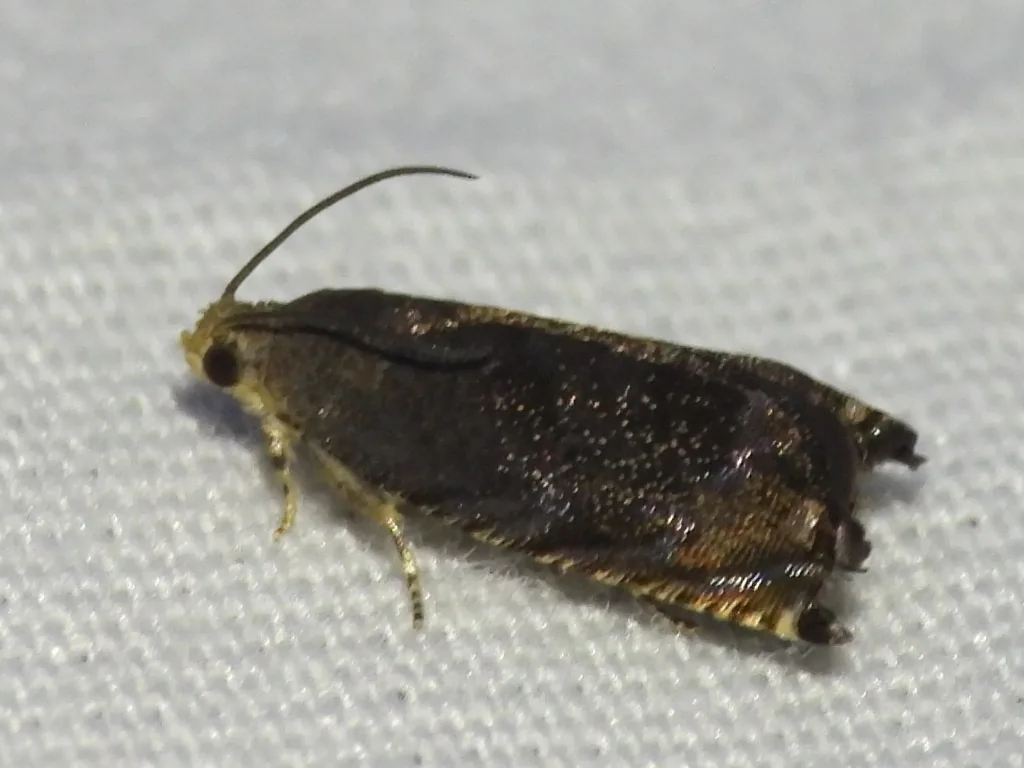
- The moth is about 3/8 inch long and dark brown to grayish black, with a row of dark and white marks along the outer edges of the wings.[2]
- Larvae are white to cream with brown heads and grow to about 3/8 to 1/2 inch long.[1][2]
- Scarred or stained shells and shucks that stay stuck to the nut, the so-called sticktights, are signs of shuckworms feeding after the shells hardened.[2][1]
Look-alikes
| Look-alike | How to tell them apart |
|---|---|
| Pecan nut casebearer | Full-grown casebearer larvae are olive green to dark green with yellowish-brown heads and feed in clusters of young nutlets, while shuckworm larvae are cream with brown heads.[2] |
Where it lives
Extension entomologists in Kentucky and Mississippi both list it as a pecan pest, and in spring its moths also lay eggs on hickory.[1][2]
Biology and life cycle
Shuckworms spend the winter as full-grown larvae inside old shucks, either on the ground or still on the tree, and pupate there in late winter.[1]
Moths of this overwintering generation emerge in April and May and lay their eggs on hickory or on phylloxera galls, which serve as homes for the first generation. First-generation moths fly in June and July and lay eggs on pecan nuts that are already well formed. Kentucky notes there can be two generations.[2][1]
Damage and signs
- Larvae that tunnel into small nuts before the shells harden make them drop, mostly in July and August.[1][2]
- Once the shells have hardened, larvae tunnel in the shucks instead. That keeps the kernels from developing properly, can delay maturity, stains or scars the shells and leaves shucks stuck to the nuts.[1][2]
- Mississippi State lists hickory shuckworms with several other pecan pests that are mostly occasional and that usually aren't practical to control on home landscape trees.[3]
Health risk
A pest of pecans that also develops on hickory. Kentucky and Mississippi State mention no risk to people or pets.[1][2]
Control
Sanitation
Gather and destroy the shucks at harvest, since larvae spend the winter in them, and pick up and destroy the small nuts that drop in midsummer. Kentucky recommends this cleanup especially for growers who are not equipped to spray.[1]
Traps and physical control
In cultivated orchards, covering shed nuts with soil in July and August, for example with a disk set to turn the soil about three inches deep, makes most of them decay before the larvae finish developing.[1]
Common questions
- Why are small green pecans falling off my tree in July?
- Hickory shuckworm larvae tunneling into young nuts are one cause; Kentucky notes infested nuts drop in July and August.[1]
- Why won't the shucks come off some of my pecans?
- Shucks stuck to the nut, called sticktights, are a sign of shuckworm larvae feeding in the shuck after the shell hardened.[2][1]
- How can I reduce shuckworms without spraying?
- Clean up. Destroy the shucks at harvest, where the larvae overwinter, and gather the small nuts that fall in midsummer.[1]
Sources
- University of Kentucky Entomology, “Pecan Insects, ENTFACT-210 (R. Bessin, revised January 2026).” entomology.ca.uky.edu/ef210 (accessed 2026-11-08)
- Mississippi State University Extension, “A Photo Guide to Pecan Insect Pests, Part 1, Publication 4197 (J. D. Perier, 2026).” extension.msstate.edu/sites/default/files/document/2026-06/P4197_web.pdf (accessed 2026-11-08)
- Mississippi State University Extension, “Disease and Insect Management for Pecans in Home Landscapes, Publication 3967 (R. A. Melanson and B. Layton, 2024).” extension.msstate.edu/publications/disease-and-insect-management-for-pecans-home-landscapes (accessed 2026-11-08)
- iNaturalist, “Cydia caryana taxon page (order and family).” www.inaturalist.org/taxa/217982 (accessed 2026-11-08)