On this page
How to identify it
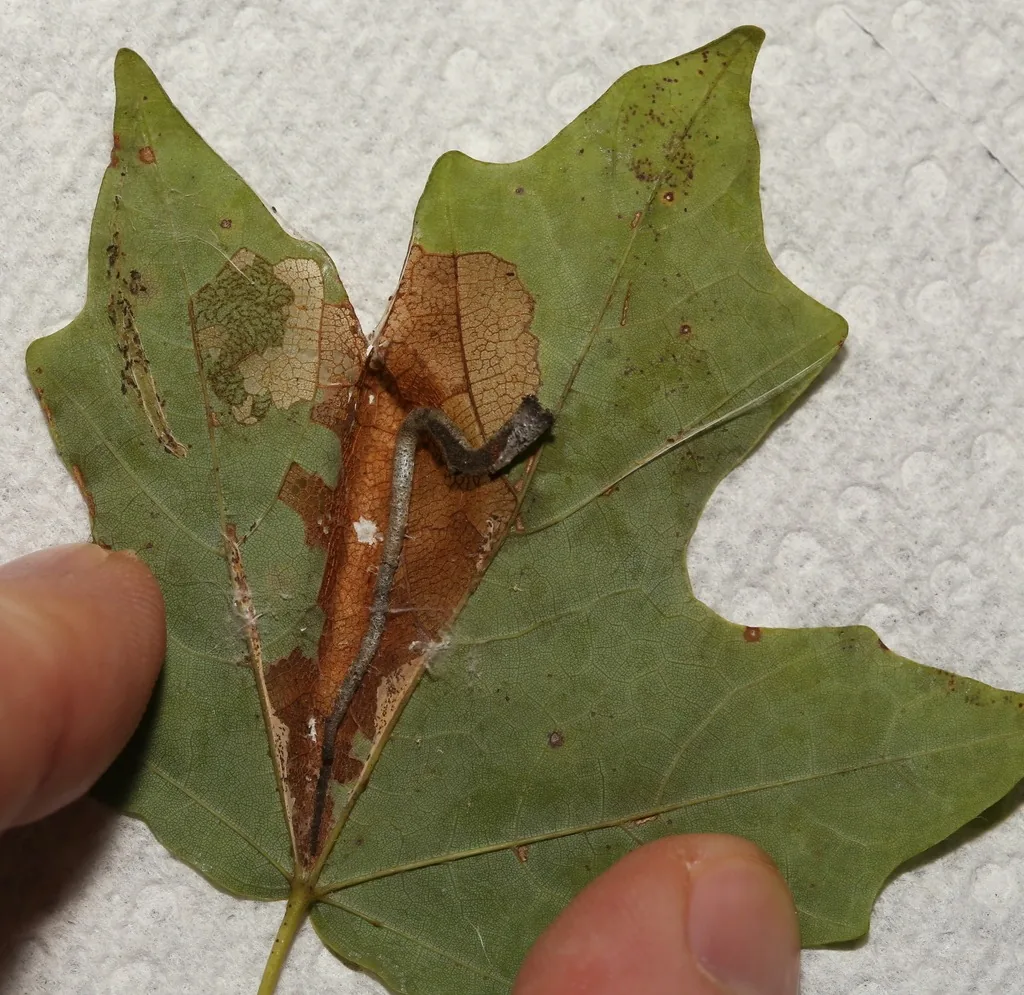
- A maple leaf folded and webbed on its underside; pull it apart and you find a trumpet-shaped tube of silk and frass, about 5 cm long, with the leaf tissue under the webbing skeletonized down to a thin layer of upper epidermis and the leaf crumpled.[1][2]
- The caterpillar is pale yellow-green with a yellowish head, up to 13 mm long, feeding from within its tube.[1]
- The adult is a small moth with a wingspread of about 15 mm, described by UMass as gray and by the Forest Service as white dusted with gray or brown; it comes to lights at night and can be seen as early as April.[1][2]
Look-alikes
| Look-alike | How to tell them apart |
|---|---|
| Maple leafcutter | Another sugar maple caterpillar, but it cuts round and oval pieces from the leaf to build a movable case and leaves ring-shaped feeding marks and holes; the trumpet skeletonizer stays under a folded leaf in a fixed tube of silk and frass.[2][1] |
| Oak-feeding skeletonizers | UMass notes a similar species on oak that can be confused with this one; the maple trumpet skeletonizer prefers sugar and red maple and turns to oak, beech and hawthorn mainly when maple is scarce.[1][2] |
Where it lives
Southern Canada to North Carolina, and throughout much of New England. Hosts are principally red and sugar maples, with records from hawthorn, beech and black, chestnut, red and white oaks.[2][1]
Biology and life cycle
Moths are present as early as April, and females lay their eggs randomly on the undersides of host leaves from late June through mid-July.[1]
Caterpillars are active from early July to early October. They first feed between the larger veins on the underside of the leaf, then spin silk webbing, fold the leaf and build the trumpet-shaped tube of silk and frass from which they feed, skeletonizing the leaf beneath the webbing.[1][2]
Mature caterpillars drop to the ground and spin a cocoon between two fallen leaves, which is why fall leaf cleanup reduces next year's numbers.[1]
Damage and signs
- Feeding is on the undersides of sugar maple leaves, with other hosts used mainly when maple is scarce. Minor damage is common every year and occasional outbreaks occur, but even heavy populations rarely need management because the damage comes late in the growing season and seldom affects tree health; the Forest Service likewise calls the damage usually not very serious.[1][2]
Health risk
Neither source mentions any effect on people; this is a leaf-feeding caterpillar of maples.[1][2]
Control
Prevention
Management is rarely needed. Watch for moths at lights in April and flip skeletonized or folded maple leaves from July to early October to confirm the tubes if you want to know what is causing the damage.[1]
Sanitation
Rake and destroy or remove dropped leaves under affected maples in the fall, since the caterpillars overwinter in cocoons between fallen leaves.[1]
Biological control
Reported parasitoid activity often keeps this native insect below damaging levels, so chemical treatment is usually unnecessary.[1]
Pesticides
Spinosad against the larvae is the only active ingredient UMass lists as labeled for this pest in Massachusetts; apply after bloom to protect pollinators.[1]
Common questions
- What makes the folded, crumpled leaves on my sugar maple in late summer?
- The maple trumpet skeletonizer. Open a folded leaf and you will find a trumpet of silk and frass with a pale yellow-green caterpillar inside, and skeletonized leaf tissue around it.[1][2]
- Should I spray my maple for it?
- Almost never. The damage comes late in the season, rarely affects tree health, and parasitoids usually keep the insect in check; raking up fallen leaves in autumn is the practical step.[1]
- Does it attack trees other than maple?
- Yes, but mostly when maple is scarce: beech, hawthorn and several oaks are recorded hosts.[1][2]
Sources
- UMass Extension Landscape, Nursery and Urban Forestry Program, University of Massachusetts Amherst, “Catastega (formerly Epinotia) aceriella, Maple Trumpet Skeletonizer, Insect & Mite Guide (Professional Guide for IPM in Trees and Shrubs).” www.umass.edu/agriculture-food-environment/landscape/publications-resources/insect-mite-guide/catastega-formerly-epinotia-aceriella (accessed 2026-11-10)
- USDA Forest Service, “Eastern Forest Insects, Miscellaneous Publication 1175 (W. L. Baker, 1972; scanned copy).” archive.org/details/easternforestins1175bake (accessed 2026-11-10)
- iNaturalist, “Catastega aceriella taxon page (order and family).” www.inaturalist.org/taxa/318534 (accessed 2026-11-10)