On this page
How to identify it
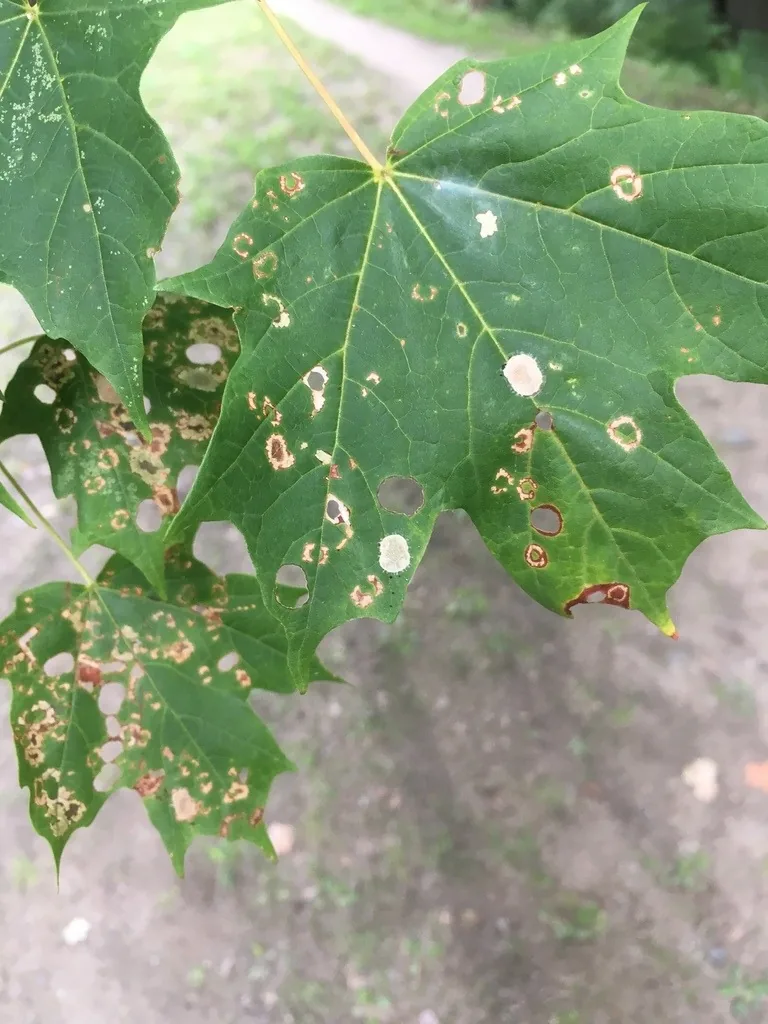
- The clearest sign is on the leaves in summer: oval holes of different sizes, and small rings where the upper surface has been eaten away around an intact green center.[1]
- The caterpillar lives in a flat case made of two oval leaf disks, one on top of the other, attached to the leaf surface. It cuts a new disk at each molt, so a leaf can have many cut holes.[1]
- Older caterpillars feed from inside the case, eating the leaf surface in a circle around themselves as far as they can reach, which makes the ring pattern.[1]
- The adult is a tiny moth with a wingspan of about 8.5 to 13 millimeters (about 1/3 to 1/2 inch). It belongs to the family Incurvariidae and was first described by Asa Fitch.[1][4]
Where it lives
It is native to North America. Natural Resources Canada lists it in eastern Canada, where Ontario and Quebec saw the largest outbreaks.[1]
Biology and life cycle
Hosts include sugar maple, red maple, red, white and black oak, and hawthorns. Natural Resources Canada's photos also show a female laying eggs on a saskatoon (serviceberry) leaf.[1]
In spring, as the leaves unfold, the female lays each egg in a tiny pocket just under the lower surface of a leaf. The young caterpillar mines the tissue inside the leaf, then cuts its case out of the leaf and lives as a case-bearer.[1]
Full-grown caterpillars drop to the ground inside their cases, spin a silk cocoon and pupate. The pupa spends the winter in the fallen leaves.[1][2]
In a study of sugar maples, most leaf mines were on leaves near the bottom of the crown and close to the trunk, rather than out toward the edge of the foliage. Later, case-bearing caterpillars and leaf damage were most common from the trunk out to about 3 meters (10 feet).[3]
Damage and signs
- The caterpillars destroy the upper surface of the leaves, and the many disks they cut out make the foliage dry out.[1]
- There have been many outbreaks in eastern Canada over the past two centuries. The two largest and best known were in Ontario and Quebec between 1939 and 1965, and periodic outbreaks have continued since, with damage varying from year to year.[1]
Health risk
The sources describe it only as a leaf-feeding caterpillar of maples and other trees; they mention no harm to people.[1]
Control
Sanitation
To keep an infestation on ornamental trees from repeating the next year, Natural Resources Canada recommends collecting and burning all the fallen leaves in the fall, which destroys the overwintering pupae.[1]
In a 1977 test published in The Great Lakes Entomologist, burning the leaf litter in spring killed 87.5% of maple leafcutter pupae, with no apparent damage to sugar maple or beech trees in the burned area.[2]
Common questions
- What is cutting round holes and rings in my maple leaves?
- A likely cause is the maple leafcutter. Its tiny caterpillar cuts oval disks from the leaf to build a case and eats the leaf surface in a ring around itself, leaving oval holes and rings with green centers.[1]
- Where do maple leafcutters spend the winter?
- As pupae in silk cocoons among the fallen leaves on the ground. That is why removing and destroying the leaves in fall can cut down next year's numbers.[1][2]
Sources
- Natural Resources Canada, Canadian Forest Service, “Maple leafcutter, Trees, insects and diseases of Canada's forests.” tidcf.nrcan.gc.ca/en/insects/factsheet/9365 (accessed 2026-11-09)
- The Great Lakes Entomologist (Michigan Entomological Society), “Preliminary test of prescribed burning for control of maple leaf cutter (Lepidoptera: Incurvariidae) (G. A. Simmons, J. Mahar, M. K. Kennedy and J. Ball), The Great Lakes Entomologist 10(4), 1977 (abstract).” scholar.valpo.edu/tgle/vol10/iss4/7 (accessed 2026-11-09)
- The Canadian Entomologist (Entomological Society of Canada / Cambridge University Press), “Population distribution of the maple leafcutter, Paraclemensia acerifoliella (Lepidoptera: Incurvariidae), in sugar maple trees (H. B. Teillon), The Canadian Entomologist 115(3): 315-318, 1983 (abstract).” www.cambridge.org/core/journals/canadian-entomologist/article/population-distribution-of-the-maple-leafcutter-paraclemensia-acerifoliella-lepidoptera-incurvariidae-in-sugar-maple-trees1/F3A921256495CDB96F7F1007A05F2330 (accessed 2026-11-09)
- The Canadian Entomologist (Entomological Society of Canada / Cambridge University Press), “The maple leaf cutter, Paraclemensia acerifoliella (Fitch) (Lepidoptera: Incurvariidae), descriptions of stages, The Canadian Entomologist 90(9) (extract).” www.cambridge.org/core/journals/canadian-entomologist/article/maple-leaf-cutter-paraclemensia-acerifoliella-fitch-lepidoptera-incurvariidae-descriptions-of-stages1/3E0A31D65DABDFEA3DF21A8A2DAD55D8 (accessed 2026-11-09)
- iNaturalist, “Paraclemensia acerifoliella taxon page (order and family).” www.inaturalist.org/taxa/176089 (accessed 2026-11-09)