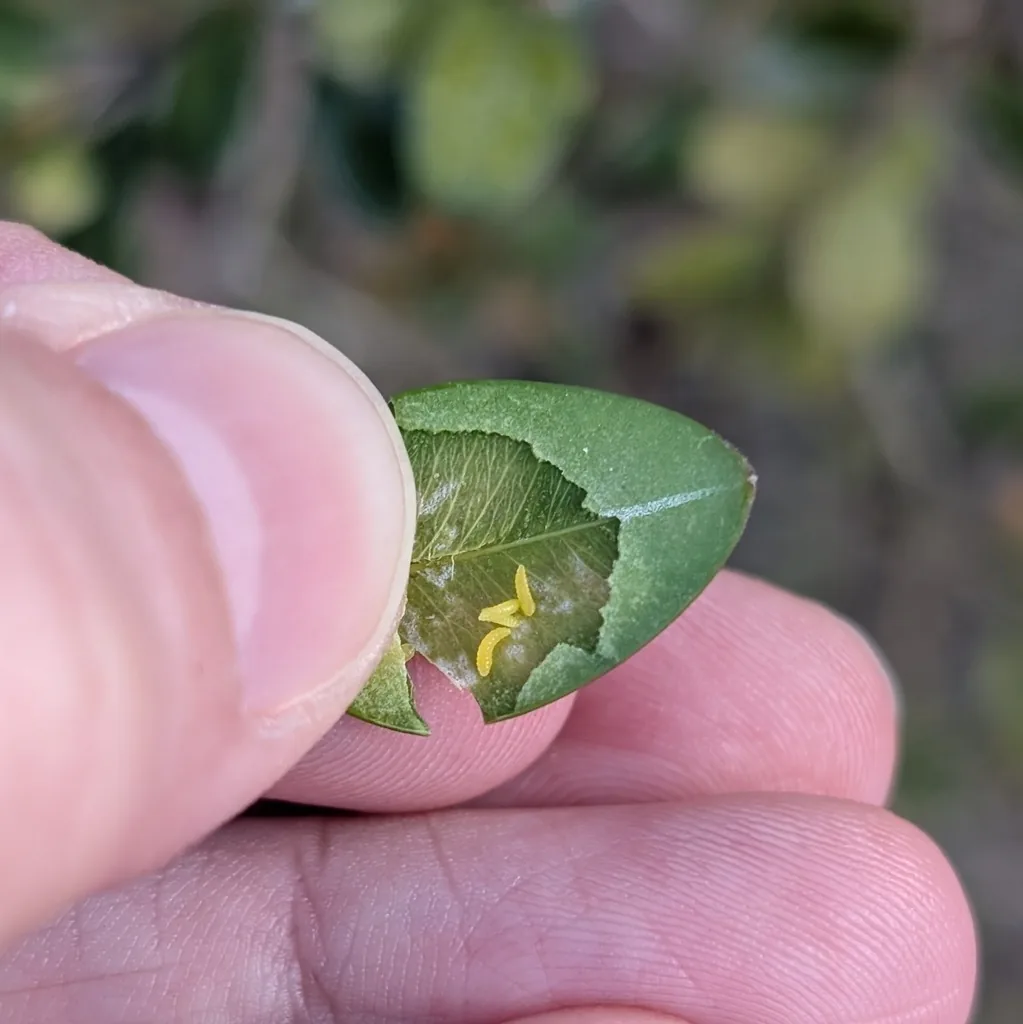
How to identify it
- Leafminer damage shows as off-color patches, blisters or winding trails in leaves; the host plant and the shape of the mine help identify which insect made it.[3]
- Boxwood leafminer makes a blotch-shaped blister on the underside of boxwood leaves that turns yellow or brown and gives the leaf a puffy look.[2][1]
- Opening a blister reveals two to six small, bright yellow to orange maggots, about 3 mm long.[2][1]
- Adults are tiny yellow to orange-red, gnat-like flies about 2.5 to 3 mm long that swarm around boxwood in late spring.[1][2]
Look-alikes
| Look-alike | How to tell them apart |
|---|---|
| Citrus leafminer | A tiny moth whose larvae make shallow, winding mines with a thin dark trail of droppings in young citrus leaves, then curl the leaf edge to pupate.[4] |
| Box tree moth | Its lime green, black-striped caterpillars eat leaves down to the midrib and leave loose silk webbing and green-black frass, instead of hiding inside blistered leaves.[6][7][2] |
Where it lives
Boxwood leafminer came from Europe and is now found coast to coast wherever boxwood grows in the United States.[2][1]
Biology and life cycle
Boxwood leafminer has one generation a year and spends the winter as a partly grown larva inside the leaf.[1][2]
Larvae finish feeding in spring and pupate; the blisters develop a clear window as they mature.[1][2]
Adults emerge from about late April to early June, often while weigela is blooming; the adult stage lasts only two to three weeks.[1][2][5]
Each female inserts about 29 eggs into the new season's leaves and dies within hours; the eggs hatch in about two to three weeks, and larvae feed slowly through summer.[1][2]
Damage and signs
- Heavily mined boxwood leaves may swell, yellow and drop early, leaving sparse, ragged plants with some dead twigs.[1][2]
- Repeated attack can cause branch dieback, weaken plants and may make boxwood in cold climates more prone to winter kill.[2]
- Common boxwood and its many cultivars are most attacked; some Japanese boxwood and certain common boxwood cultivars are more resistant.[2]
- In general, established woody plants tolerate a lot of leaf mining and are rarely if ever killed.[3]
Health risk
Leafminers are plant pests only; the harm is to leaves and the plant's appearance.[3]
Control
Prevention
Keep plants vigorous with proper watering and site conditions, and choose resistant species or cultivars when planting.[3][2]
Traps and physical control
Pruning out and disposing of infested foliage improves appearance and gives some control; for boxwood, cut back first-year growth after egg-laying in June and destroy the clippings.[3][2]
Biological control
Natural enemies control some leafminers, so avoid broad-spectrum, persistent insecticides that kill them; for boxwood leafminer, UMass knows of no effective natural enemies.[3][2]
Pesticides
For boxwood, time sprays of registered insecticides to the brief adult flight in May, when weigela blooms, since larvae are protected inside leaves.[1][2]
UMass lists systemic soil drenches such as imidacloprid for boxwood leafminer, but advises choosing alternatives where possible to protect pollinators.[2]
Citrus leafminer on backyard citrus
Citrus leafminer (Phyllocnistis citrella) is a tiny moth native to Asia that reached Florida in 1993 and California in 2000.[4]
Larvae can survive only in tender new citrus leaves, which become curled and distorted; older, hardened leaves are not attacked unless numbers are very high.[4]
Mature backyard trees tolerate the damage, and even young trees with heavy infestations are unlikely to die.[4]
UC IPM recommends leaving it alone so natural enemies can build up, and not pruning live branches more than once a year, since the moths are drawn to new flush.[4]
Common questions
- Why do my boxwood leaves look puffy and yellow underneath?
- That is the classic sign of boxwood leafminer: larvae feed between the leaf surfaces and create swollen blisters that turn yellow or brown.[2][1]
- When should I treat boxwood leafminer?
- Target the adult flies when they emerge, typically in May while weigela is blooming; at other times the larvae are sealed inside the leaves.[1][2]
- Will leafminers kill my plants?
- Rarely. Established woody plants tolerate extensive mining, though years of heavy attack can thin boxwood and cause dieback.[3][2]
Sources
- Penn State Extension, “Boxwood Leafminer (updated June 24, 2026).” extension.psu.edu/boxwood-leafminer (accessed 2026-10-06)
- UMass Extension Landscape, Nursery and Urban Forestry Program, “Boxwood Leafminer (fact sheet, updated January 3, 2023).” www.umass.edu/agriculture-food-environment/landscape/fact-sheets/boxwood-leafminer (accessed 2026-10-06)
- University of California Statewide IPM Program, “Foliage Miners (Home and Landscape).” ipm.ucanr.edu/home-and-landscape/foliage-miners/ (accessed 2026-10-06)
- University of California Statewide IPM Program, “Pest Notes: Citrus Leafminer (Home and Landscape).” ipm.ucanr.edu/home-and-landscape/citrus-leafminer/ (accessed 2026-10-06)
- Oregon State University, Department of Horticulture, “Boxwood Leafminer (Nursery Pest Management, updated May 2013).” agsci.oregonstate.edu/nurspest/insects/boxwood-leafminer (accessed 2026-10-06)
- USDA Animal and Plant Health Inspection Service (APHIS), “Box Tree Moth.” www.aphis.usda.gov/plant-pests-diseases/box-tree-moth (accessed 2026-10-06)
- UMass Extension Landscape, Nursery and Urban Forestry Program, “Cydalima perspectalis (Box Tree Moth), Landscape, Nursery and Urban Forestry Insect and Mite Guide.” www.umass.edu/agriculture-food-environment/landscape/publications-resources/insect-mite-guide/cydalima-perspectalis (accessed 2026-10-06)
- iNaturalist, “Monarthropalpus flavus taxon page (order and family).” www.inaturalist.org/taxa/467578 (accessed 2026-10-06)