On this page
How to identify it
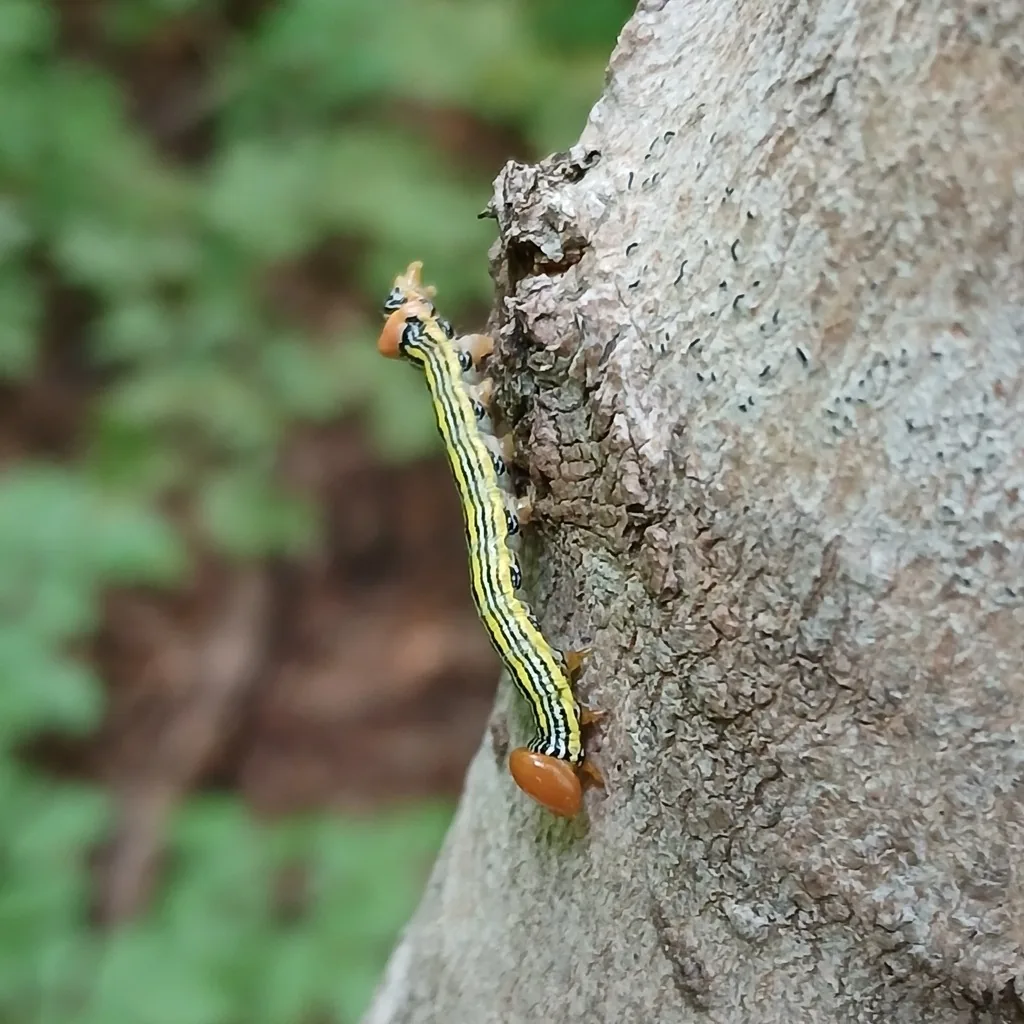
- The full-grown caterpillar is about 1-1/2 inches long, with an orange head and an orange hump on the eighth abdominal segment, near the rear. Its back has three black lines separated by whitish gray, framed by colored stripes, which separates it from close relatives.[1][2]
- Young caterpillars look different: the first stage is pale with a dark head, the second light lemon yellow, and later stages yellowish with scarlet side stripes before the head and hump turn orange. In the last stage the yellow stripes turn orange.[1]
- Young caterpillars feed in groups on the undersides of leaves; most spread out to feed alone by the fourth stage.[1][2]
- The moth has a wingspan of 1.2 to 1.5 inches. It is ash-gray with a few darker marks and a distinctive irregular whitish band along the outer two-thirds of the front edge of each forewing, with one or more tooth-like points facing back. The head and collar are yellowish.[1]
Look-alikes
| Look-alike | How to tell them apart |
|---|---|
| Red-humped oakworm (Symmerista canicosta) | A close relative with a bright orange head and hump, but its back has five black and four white stripes, and it favors oaks, beeches and chestnuts. The orangehumped mapleworm is yellower, with three black and two white stripes between the yellow stripes in the last stage.[2] |
| Variable oakleaf caterpillar | Often feeds alongside the orangehumped mapleworm in Maine outbreaks on sugar maple and beech.[1] |
Where it lives
It is a forest caterpillar of the eastern United States; the USDA Forest Service guide to eastern forest caterpillars notes two generations a year in the South and one in the North. In Maine it is found statewide, mostly in forests.[2][1]
Biology and life cycle
It feeds on many forest trees, especially maples; in Maine it prefers sugar maple and beech.[2][1]
In Maine, moths fly from early June through July, peaking in July. Females lay single-layer clusters of about 50 tiny, light greenish-yellow, keg-shaped eggs on the undersides of sugar maple leaves in July. The eggs hatch in about 12 days; black eggs have usually been parasitized.[1]
Caterpillars feed from July to September and usually pass through six stages. From late August, peaking in September, full-grown caterpillars drop to the leaf litter.[2][1]
They pupate between leaves tied into a mat above the mineral soil, and the dark chestnut-brown pupae, about 3/4 inch long, spend the winter there.[1]
In heavy populations, caterpillars may gather in masses on tree trunks, rocks and stumps. A wilt disease and parasites also kill them.[1]
Damage and signs
- Outbreaks of northern hardwood defoliators are usually a mix of species. In central Maine from 1986 to 1990, the orangehumped mapleworm and the variable oakleaf caterpillar did most of the damage to sugar maple and beech, and an earlier outbreak in 1956 defoliated about 23,500 acres of northern hardwoods.[1]
- Hilltops and ridges are often the first to show severe feeding. Populations normally fade after two or three years without a serious impact, and the lateness of the feeding has spared trees from serious injury in past outbreaks.[1]
Health risk
The sources describe it only as a leaf-feeding caterpillar of hardwoods; they mention no harm to people.[1][2]
Control
Prevention
Controls have not usually been recommended or necessary, and none have been developed for this species. Outbreaks normally end on their own within two or three years.[1]
Common questions
- What are the striped caterpillars with an orange head on my maple in August?
- If they have an orange head, an orange hump near the rear and three black lines down the back, they are likely orangehumped mapleworms, which feed on maples and beech from July to September.[1][2]
- Will orangehumped mapleworms kill my maple?
- Unlikely. They feed late in the season, and past outbreaks faded after two or three years without serious injury to the trees.[1]
Sources
- Maine Forest Service, Maine Department of Agriculture, Conservation and Forestry, “Orangehumped Mapleworm, Forest Pest Index.” www.maine.gov/dacf/mfs/forest_health/insects/orangehumped_mapleworm.htm (accessed 2026-11-09)
- USDA Forest Service, Forest Health Technology Enterprise Team, “Caterpillars of Eastern Forests, FHTET-96-34 (D. L. Wagner et al., 1997).” archive.org/details/caterpillarsofea001997 (accessed 2026-11-09)
- iNaturalist, “Symmerista leucitys taxon page (order and family).” www.inaturalist.org/taxa/232057 (accessed 2026-11-09)