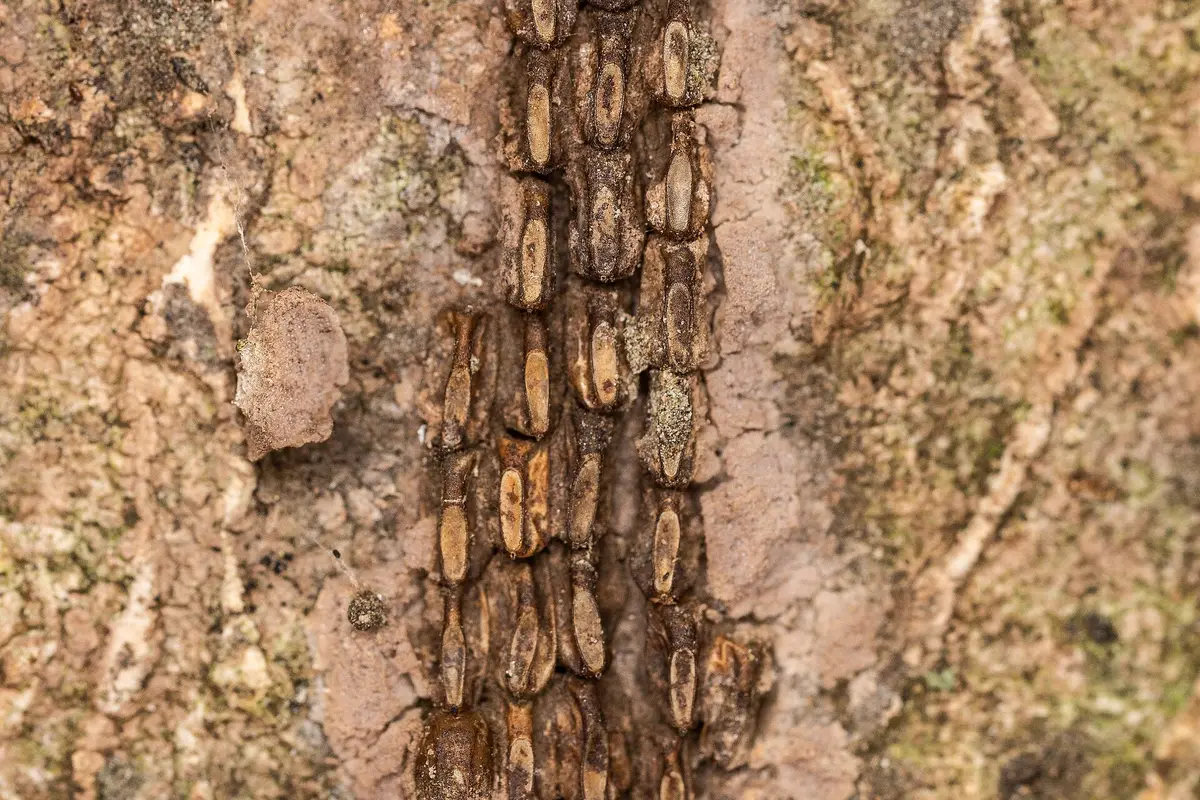
The adult spotted lanternflies that turned up on porches, cars and tree trunks across the Northeast this summer are starting to die as the nights get cold. The females aren't finished, though. In early October the Connecticut Agricultural Experiment Station said egg laying was under way, and the Massachusetts Department of Agricultural Resources says that while the first hard frost kills the adults, the egg masses come through a Massachusetts winter without trouble.
Each female lays one or two masses of 30 to 50 eggs. A mass you miss this winter is a cluster of nymphs on your trees next spring, and this year the insect reached places it hadn't been before.
Where it spread in 2026
Ohio became a quarantine zone from border to border on February 17, up from 18 counties. Trees and nursery stock can't leave the state without a compliance agreement, permit or inspection certificate, and every load shipped to a non-regulated area needs a certificate that it is free of the insect. The Ohio Department of Agriculture also stopped asking residents to report sightings.
New Hampshire had its first field detection in late August, when the state Department of Agriculture, Markets and Food confirmed a small number of adults in a mixed residential and commercial part of Salem. Earlier finds in the state had all come in on goods from other states. Officials said there was no evidence of an established population, and State Entomologist Piera Siegert told the Derry News, "We don't know that it is a population."
Massachusetts now has confirmed sightings in nearly 150 cities and towns, about triple the count a year earlier, with sightings reported in every county except Nantucket, Peabody Weekly News reported in October. University of Rhode Island researchers say the insect has been found in all five Rhode Island counties. Vermont has had sightings but no established population, state officials told the Valley News.
Report it or just destroy it? It depends on your state
Where the insect hasn't settled in, officials use public reports to track its spread and catch a new population early. Where it is established statewide, as in Ohio, they have stopped asking. Here is what each state asked residents to do this fall:
- New Hampshire: report any sighting on the state's NHBugs.org website.
- Vermont: report any life stage at VTInvasives.org, and squish the insect or scrape off the egg mass.
- Massachusetts: kill it and report it on the state's online reporting form; a photo and the location help the state track the spread.
- Connecticut: egg masses can be reported the same way as sightings of the insect itself.
- Ohio: reports are no longer encouraged; the Department of Agriculture points property owners to its Spotted Lanternfly Management Guide instead.
Anywhere else, check your state department of agriculture's page before you assume it wants to hear from you. Our spotted lanternfly profile covers what to do if you find one outside the known range.
What an egg mass looks like
Penn State Extension describes a mass as about an inch long and a half to three-quarters of an inch wide, with a gray-brown covering that looks like a smear of mud. A fresh one can look shiny and waxy; the coating dries and cracks over time, and an old mass can lose it entirely, leaving four to seven columns of seed-like eggs like the ones in the photo above. You can find them from September through May.
Check tree bark first, then the smooth surfaces around you: rocks, patio furniture, porches, the sides of houses, cars and garden equipment all get used. The University of Rhode Island's Biocontrol Lab says the only egg masses that look much like them belong to the spongy moth, which are tan; our spongy moth profile describes those as oval and covered in buff-colored hairs.
How to destroy them
Scrape, then crush. Jacob Ricker, a state entomologist at the Connecticut Agricultural Experiment Station, suggests a paint scraper or an old plastic card to lift the mass, then either squishing what comes off or dropping it into rubbing alcohol. Scraping alone can leave some eggs intact, he says, which is why the second step matters. URI's lab gives the same advice and adds hand sanitizer as an alternative to alcohol.
For more thorough control on a tree than scraping can give, URI suggests horticultural oil applied to the egg masses during the dormant season, with February to April the best window, or you can have a pest management professional apply it. Use a product whose label lists that use; our horticultural oil page covers the label precautions.
Check what you move
Egg masses are how the insect travels. Females lay on almost anything left outdoors, including cars and bikes on a rack, and Vermont's experts warn that a mass carried home that way can hatch wherever the vehicle sits next spring. Before you drive back from a lanternfly area or move outdoor furniture, look over the vehicle and the gear, and don't carry firewood across state lines. New Hampshire's earlier finds came in on goods from other states, and Ohio's certificate rule for nursery shipments targets the same route.
What happens in spring
Masses that survive the winter hatch in May and June, URI says. The University of Rhode Island lab's director calls egg management the best bet against the insect, because every mass destroyed now means fewer nymphs and adults feeding next season. Our May posts followed the hatch on Long Island and the 103 known host plants; the time to keep those numbers down is now, with a scraper, before the eggs hatch.
Sources: Concord Monitor via NHPR (August 26, 2026); Derry News (August 2026); Ohio Department of Agriculture release on the statewide quarantine, as posted by Ohio State University Extension's Buckeye Yard & Garden onLine (February 2026); WFSB, with the Connecticut Agricultural Experiment Station (October 7, 2026); Peabody Weekly News, with the Massachusetts Department of Agricultural Resources (October 13, 2026); University of Rhode Island news release (October 14, 2026); Valley News (October 13, 2026); Penn State Extension, Have you seen a spotted lanternfly?. The Wire summarizes and contextualizes primary reporting; we do not republish.