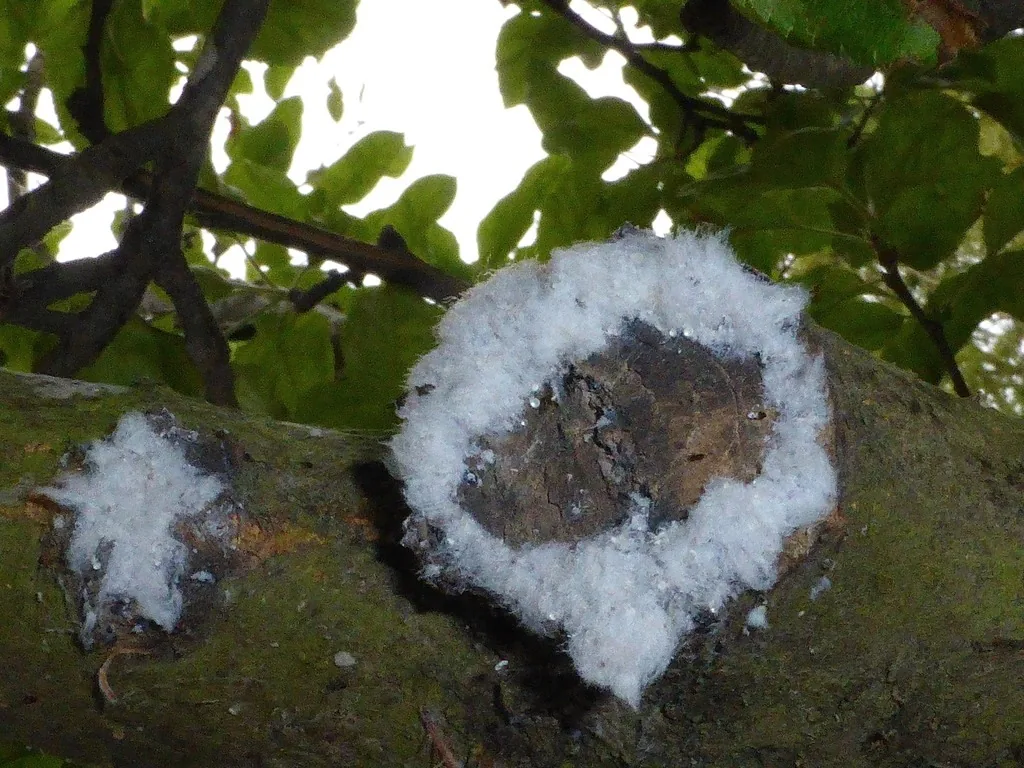
How to identify it
Look-alikes
| Look-alike | How to tell them apart |
|---|---|
| Mealybugs and whiteflies | Some mealybugs and whiteflies also produce white wax; check for the aphids and warty bark galls underneath.[1] |
Where it lives
It feeds on apple, cotoneaster and pyracantha, less often hawthorn and pear, and is especially a problem on apples in coastal areas.[1]
Biology and life cycle
It sucks phloem sap from limbs, shoots, trunks, leaf axils and roots on first- and second-year wood.[1]
Aphids that overwinter above ground lack wax and are hard to see on bark.[1]
Damage and signs
Health risk
It feeds on plants only; UC IPM mentions no risk to people.[1]
Control
Prevention
Where it's a serious problem on apples, consider trees on resistant rootstocks such as M106 or M111.[1]
Biological control
The wasp Aphelinus mali can completely control above-ground colonies if broad-spectrum insecticides aren't used; parasitized aphids turn into black mummies.[1]
Pesticides
Horticultural oil or insecticidal soap give partial control; UC IPM lists acetamiprid or imidacloprid only after petal fall to protect bees.[1]
Common questions
Sources
- University of California Statewide IPM Program, “Woolly Apple Aphid (Pests in Gardens and Landscapes).” ipm.ucanr.edu/PMG/GARDEN/FRUIT/PESTS/woolyapaph.html (accessed 2026-10-06)
- iNaturalist, “Eriosoma lanigerum taxon page (order and family).” www.inaturalist.org/taxa/360308 (accessed 2026-10-06)