On this page
How to identify it
Look-alikes
| Look-alike | How to tell them apart |
|---|---|
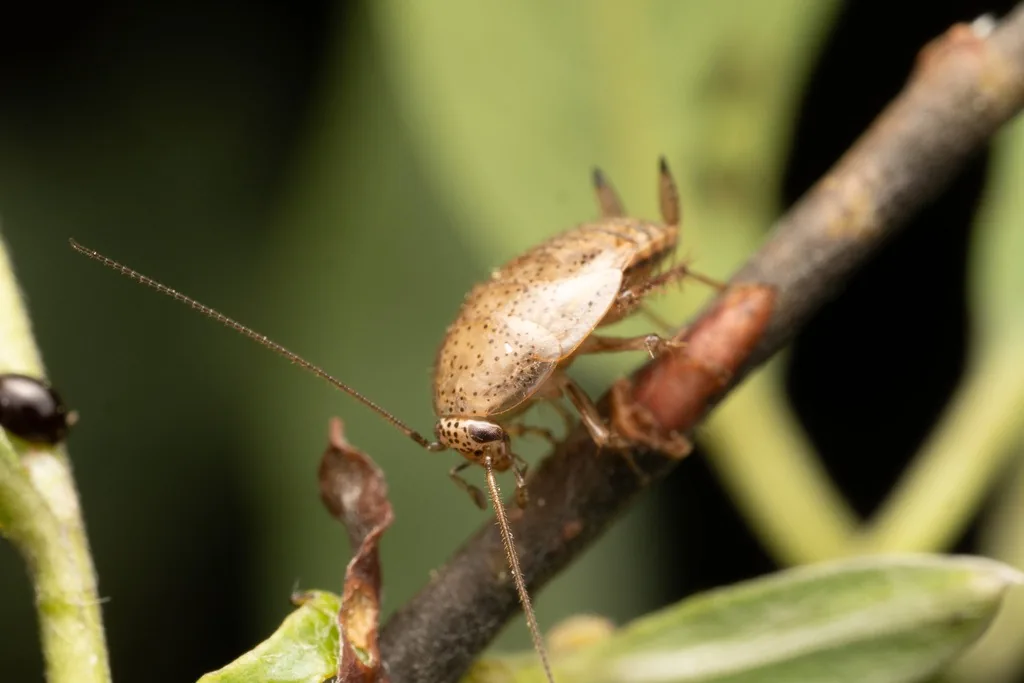
| Wood cockroaches (Parcoblatta) | Wood cockroaches are native and larger: the winged males that stray indoors are golden brown and about 3/4 inch long, and the females are wingless. Tawny cockroaches are 1/4 to 1/2 inch long, pale with brown spots, and both sexes have wings.[1][2] |
Where it lives
It is native to England and much of Central and Southern Europe and has been recorded in North Africa, including Algeria and Tunisia. In North America it is introduced: it was first recorded on Cape Cod in the 1940s, has been spreading slowly south along the New England coast, and has been reported more often in Connecticut since 2010.[1][2]
Biology and life cycle
It is an omnivorous cockroach of woodland and forest that lives outdoors.[2][1]
Nymphs pass through six stages. The species overwinters as fourth-stage nymphs, which resume development in April, and adults are present from late June to October or November.[2]
In England, the specimen used for its genome study was found under a wooden board on coastal dunes, and the species had also been swept from birch, oak and willow trees nearby.[2]
Damage and signs
- Indoors it is only a visitor: home invasions are infrequent, and it does not breed indoors.[1]
Health risk
The Connecticut Agricultural Experiment Station lists it among the harmless cockroach visitors, noting that it does not breed indoors.[1]
Control
Keep them out
Physical exclusion is the best way to keep it, and other outdoor insects, out of homes. For the similar wood cockroaches, the Connecticut Agricultural Experiment Station recommends making sure windows and screens fit properly and are free of rips or holes.[1]
Common questions
- Is the tawny cockroach the same as the spotted Mediterranean cockroach?
- Yes. Both names refer to Ectobius pallidus: the Connecticut Agricultural Experiment Station calls it the spotted Mediterranean cockroach, and the 2025 genome study calls it the tawny cockroach.[1][2]
- Will tawny cockroaches infest my house?
- No. They live outdoors in wooded areas, home invasions are infrequent, and they do not breed indoors.[1][2]
- How is it different from a wood cockroach?
- It is smaller, 1/4 to 1/2 inch long, pale with small brown spots, and both sexes have wings. Wood cockroach males are golden brown and about 3/4 inch long, and wood cockroach females have no wings.[1][2]
Sources
- Connecticut Agricultural Experiment Station, “Cockroaches (Blattodea) fact sheet (K. Dugas, Department of Entomology).” portal.ct.gov/-/media/CAES/DOCUMENTS/Publications/Fact_Sheets/Entomology/Cockroaches_Blattodea.pdf (accessed 2026-11-09)
- Wellcome Open Research (Darwin Tree of Life genome note), indexed in PubMed (PMID 39866809), “The genome sequence of the tawny cockroach, Ectobius (Ectobius) pallidus (Olivier, 1789). Wellcome Open Research 10:22 (2025), doi:10.12688/wellcomeopenres.23463.1.” doi.org/10.12688/wellcomeopenres.23463.1 (accessed 2026-11-09)
- iNaturalist, “Ectobius pallidus taxon page (order and family).” www.inaturalist.org/taxa/130139 (accessed 2026-11-09)