How to identify it
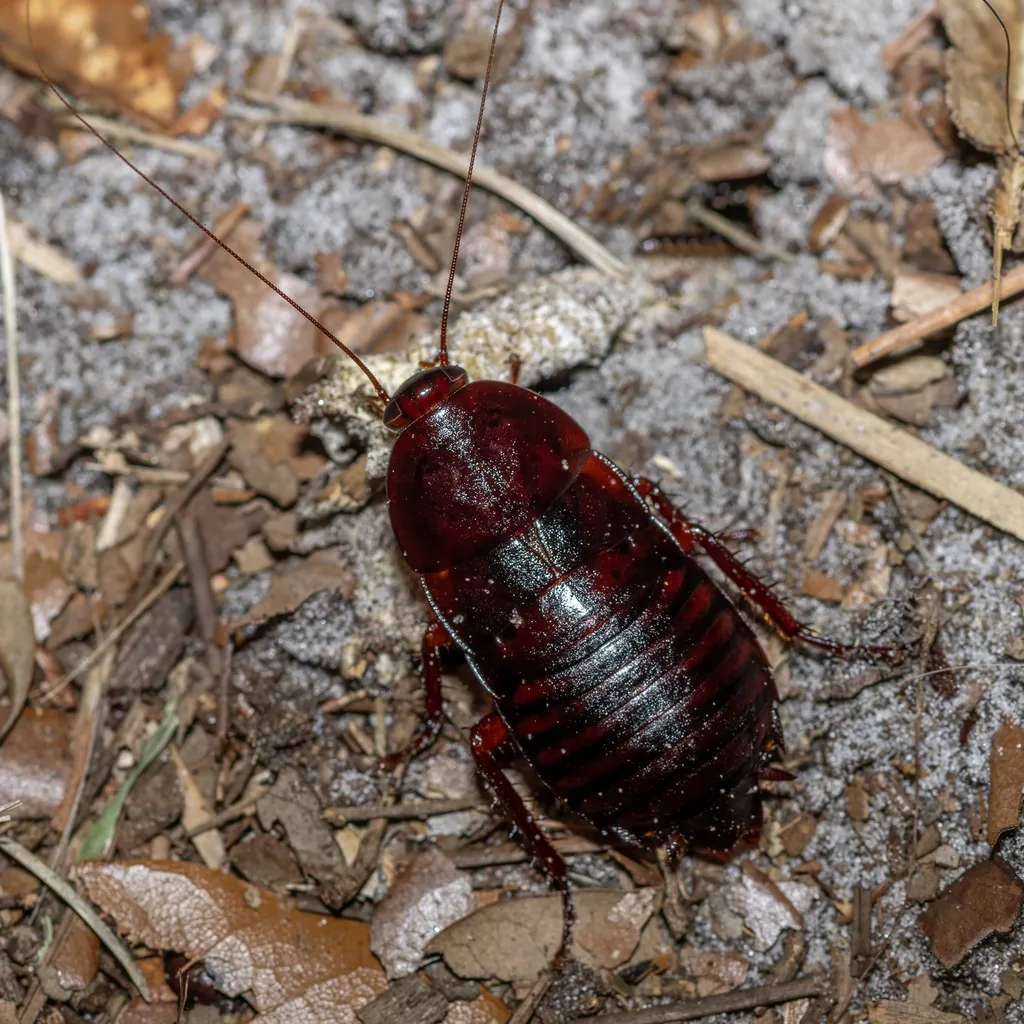
- Adults are large and broad, about 1.2 to 1.6 inches (30 to 40 mm) long, and reddish brown to nearly black.[1][2]
- Neither sex has working wings; the short, leathery wing pads barely meet in the middle and leave the whole abdomen exposed, so adults cannot fly.[1][2]
- It moves slowly and doesn't rush away when disturbed, unlike most large roaches.[1]
- Older nymphs often have yellow edges on the plates behind the head.[1]
- Other common names include Florida stinkroach, skunk cockroach and stinking cockroach, for the foul-smelling fluid it releases.[1][2]
Look-alikes
| Look-alike | How to tell them apart |
|---|---|
| American cockroach | Both get called palmetto bugs, but the Florida woods cockroach has only short wing pads that leave its abdomen bare, and it is broader and slower.[1][3] |
| Smokybrown cockroach | Also lumped in as a palmetto bug; look for the Florida woods cockroach's stubby wing pads and slow, unhurried movement.[1] |
Where it lives
Native to the southeastern United States: most of Florida plus coastal Georgia, Alabama and Mississippi.[1][2]
Biology and life cycle
Females glue egg cases, each holding about 20 to 24 eggs, onto surfaces such as decaying logs.[1][2]
Eggs take about 48 days to hatch, and development from egg to adult takes about 150 days; adults can live more than a year.[1][2]
It feeds mainly on decaying plant matter, such as dead leaves, bark, lichens, mosses and molds, so homes offer it little food.[1]
Outdoors it shelters in tree cavities, stumps, under bark, in leaf litter, shaded shrubs, woodpiles and around the bases of palms.[1][2]
Adults spray a defensive fluid from a gland under the abdomen, up to about 1 meter (roughly 3 feet), and it can take up to 30 days to refill.[1]
Damage and signs
Health risk
Its oily, smelly defensive spray irritates skin and sensitive tissue such as the eyes, so avoid handling adults bare-handed.[1]
Control
Keep them out
Caulk gaps around doors, windows and pipes, keep screens repaired, and weather-strip doors.[3]
Sanitation
Stack firewood off the ground and away from the house, pull mulch back from the foundation, and keep shrubs trimmed away from walls.[3]
Bring firewood in only as needed, since the Florida woods cockroach usually gets indoors by riding in on items like firewood.[1]
Traps and physical control
Outdoor cockroaches don't survive well inside, and often simply removing them from the house is all the control needed.[3]
Pesticides
For large outdoor roaches, granular baits in mulched areas and a perimeter treatment at the foundation and entry points can help, after sealing cracks.[3]
Common questions
- Can Florida woods cockroaches fly?
- No. Both males and females have only short wing pads and no hind wings, so they can't fly.[1][2]
- Why does this roach smell so bad?
- Adults release an oily, foul-smelling defensive fluid when threatened; it repels predators and irritates skin and eyes.[1]
- Will Florida woods cockroaches infest my house?
- Rarely. They feed on decaying plant matter outdoors and don't live long inside structures.[1][2]
Sources
- University of Florida IFAS Extension, “Florida Woods Cockroach (AKA Palmetto Bug), Eurycotis floridana (Walker) (Featured Creatures, IN915).” ask.ifas.ufl.edu/publication/IN915 (accessed 2026-10-06)
- University of Florida, Department of Entomology and Nematology, “Florida woods cockroach, Eurycotis floridana (Cockroach image gallery).” entnemdept.ufl.edu/projex/gallery/dl/cockroaches/text/florida_woods_cockroach.htm (accessed 2026-10-06)
- University of Florida IFAS Extension, “Cockroaches and Their Management (IG082).” ask.ifas.ufl.edu/publication/IG082 (accessed 2026-10-06)
- iNaturalist, “Eurycotis floridana taxon page (order and family).” www.inaturalist.org/taxa/372251 (accessed 2026-10-06)