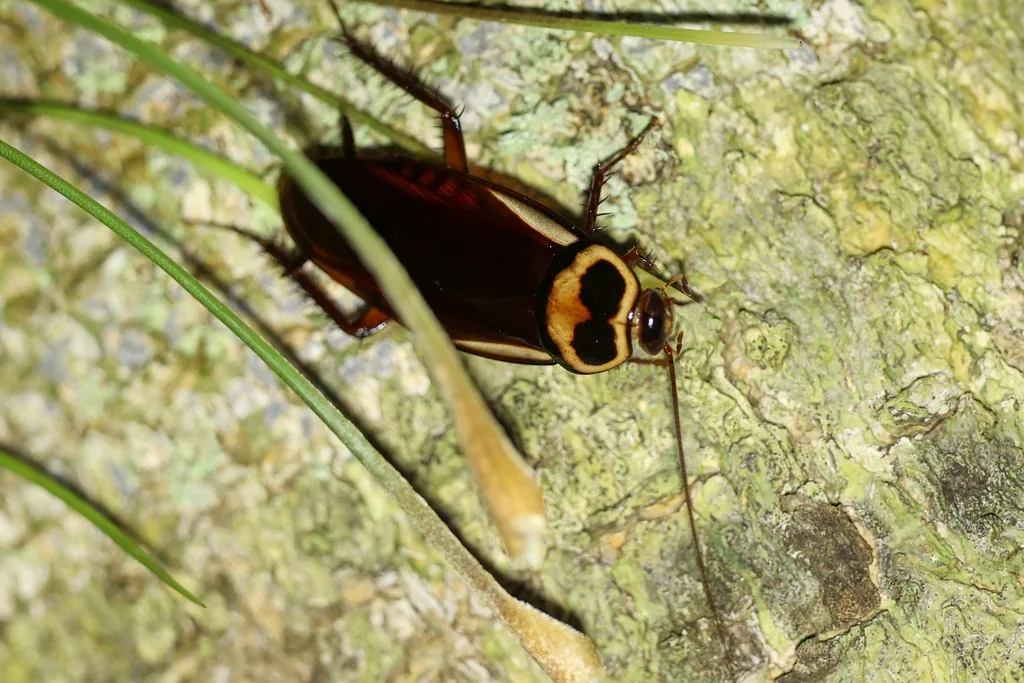
How to identify it
- Adults are about 1 1/4 to 1 3/8 inches (32 to 35 mm) long and reddish brown to dark brown, with fully developed wings.[1][2]
- The key mark is a light yellow band along the outer front edge of each forewing, near where it attaches.[1][2][3]
- The shield behind the head has bold markings, with two dark eye-like spots that are usually crisper than on the American cockroach.[2][3]
- Nymphs are wingless and have light yellow spots on top of the abdomen, becoming more mottled as they grow.[1][2]
Look-alikes
| Look-alike | How to tell them apart |
|---|---|
| American cockroach | Similar in size, shape and color, but lacks the yellow wing bands, has paler and less distinct shield markings, and its nymphs are solid colored.[1][3] |
| Smokybrown cockroach | Shares the same outdoor habitats; the Australian cockroach's yellow wing bands set it apart.[1] |
Where it lives
Found worldwide; in the U.S. it is most common in Florida and the coastal Southeast, and farther north it turns up in greenhouses and conservatories.[1][2][3]
Biology and life cycle
Females carry the egg case on the tip of the abdomen for a while, then drop or glue it in a hidden crack; each case holds about 24 eggs.[1][2]
A female can produce 20 to 30 egg cases in her life; eggs take about 40 days to develop.[1][2]
Development to adult takes about a year, and adult females live another four to six months.[1]
Outdoors it lives under tree bark, in firewood piles and in other moist spots; indoors it uses dark, warm places around pipes, sinks, toilets and cupboards.[1]
Both sexes fly; Featured Creatures describes their flight as gliding.[1][2]
Damage and signs
Health risk
Cockroaches can contaminate food and produce allergens; Australian cockroaches carried Salmonella in lab studies, though they haven't been tied to an actual food poisoning outbreak.[1]
Control
Keep them out
Fit door thresholds tightly, since a gap the width of a quarter lets it in; look for light showing around closed doors and windows from inside.[1]
Sanitation
Remove woodpiles and other harborage near the house, and pull mulch back from the foundation.[1][4]
Traps and physical control
If roaches are actually living indoors, sticky monitors help pinpoint where they are getting in.[1]
Pesticides
If pesticides are needed, follow the label strictly; baits and a perimeter treatment at entry points are options for large outdoor roaches.[1][4]
Common questions
- How do I tell an Australian cockroach from an American cockroach?
- Look at the front edges of the wings: the Australian cockroach has light yellow bands there, and the American cockroach doesn't.[1][3]
- Is the Australian cockroach actually from Australia?
- Probably not. It likely originated in Africa and was named after specimens described from Australia.[1][3]
- Can Australian cockroaches fly?
- Yes. Both males and females have full wings and are good fliers.[2]
Sources
- University of Florida IFAS Extension, “Australian Cockroach, Periplaneta australasiae Fabricius (Featured Creatures, IN1088).” ask.ifas.ufl.edu/publication/IN1088 (accessed 2026-10-06)
- University of Florida, Department of Entomology and Nematology, “Australian cockroach, Periplaneta australasiae (Cockroach image gallery).” entnemdept.ufl.edu/projex/gallery/dl/cockroaches/text/australian_cockroach.htm (accessed 2026-10-06)
- Ohio State University Extension, “Unusual Plant-Eating Cockroach (Buckeye Yard and Garden onLine, August 24, 2017).” bygl.osu.edu/node/880 (accessed 2026-10-06)
- University of Florida IFAS Extension, “Cockroaches and Their Management (IG082).” ask.ifas.ufl.edu/publication/IG082 (accessed 2026-10-06)
- iNaturalist, “Validiblatta australasiae taxon page (order and family).” www.inaturalist.org/taxa/1649046 (accessed 2026-10-06)