How to identify it
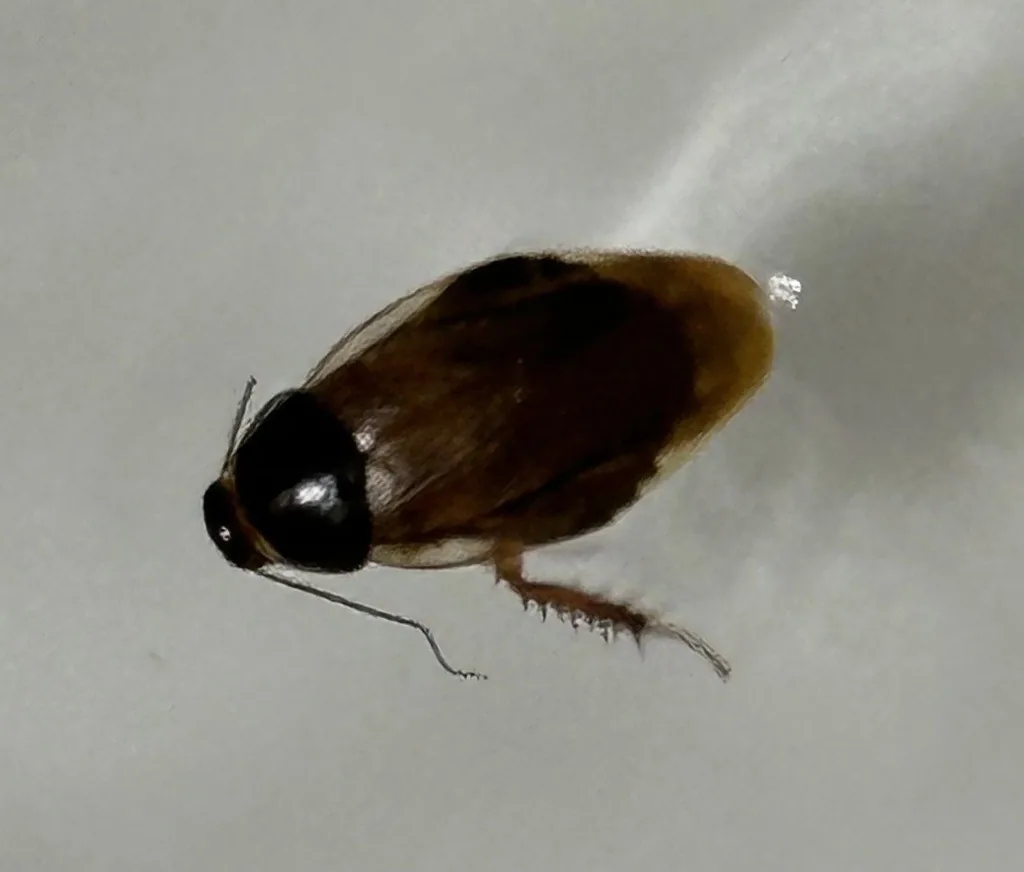
- Adults are about 3/4 to 1 inch (18 to 25 mm) long, with a dark brown to black shield behind the head that has a pale tan or yellow front edge.[1][2]
- Adult wings are brown and cover the abdomen completely.[2]
- Nymphs are dark brown to blackish brown, with dull, rough-textured rear abdominal segments.[1][2]
- You'll usually find it digging in soil or potting mix rather than running on walls; it mostly feeds on plant roots.[1][3]
Look-alikes
| Look-alike | How to tell them apart |
|---|---|
| Oriental cockroach | Surinam nymphs resemble Oriental cockroaches but have dull, rough rear abdominal segments.[2] |
| Australian cockroach | Another tropical, plant-feeding roach, but the Australian cockroach flies well and climbs into plant canopies, while the Surinam burrows and eats roots.[3] |
Where it lives
Originally from Southeast Asia and now found in tropical areas worldwide. In the U.S. it is common in the Gulf states and also shows up farther north in greenhouses, mall atriums and other indoor plantings.[1][2]
Biology and life cycle
Many populations have no males; females reproduce without mating.[2]
The female pulls her egg case back inside her body, so the young appear to be born live; each case holds about 26 eggs, and she produces about three.[1][2]
Development from egg to adult takes about 160 to 220 days, and adult females live about 307 days on average.[1]
It can't survive winters outdoors in northern states like Ohio, but it spreads year-round in infested plants.[3]
Damage and signs
Health risk
Like other cockroaches, it can produce allergens from droppings, shed skins and body parts that trigger reactions in sensitive people.[4]
Control
Prevention
Inspect plants before bringing them indoors, including plants that spent the summer outside, since infested pots are how this roach gets in.[1][3]
Sanitation
Pull mulch away from the house and keep plantings trimmed back from walls; outdoor roaches breed heavily in pine straw mulch.[4]
Traps and physical control
Sticky traps help confirm what you have; the roaches hide by day, so check plants and pots closely.[3]
When to call a professional
Ohio State Extension notes that treating greenhouses, interior plantscapes and buildings falls under different licenses and product labels, so a professional is often needed.[3]
Common questions
Sources
- University of Florida, Department of Entomology and Nematology, “Surinam cockroach, Pycnoscelus surinamensis (Cockroach image gallery).” entnemdept.ufl.edu/projex/gallery/dl/cockroaches/text/surinam_cockroach.htm (accessed 2026-10-06)
- Los Angeles County Department of Agricultural Commissioner/Weights and Measures, “Surinam Cockroach (Pycnoscelus surinamensis) pest sheet (June 2015).” file.lacounty.gov/SDSInter/acwm/235109_SurinamCockroach.pdf (accessed 2026-10-06). County agricultural commissioner (government) pest identification sheet.
- Ohio State University Extension, “Unusual Plant-Eating Cockroach (Buckeye Yard and Garden onLine, August 24, 2017).” bygl.osu.edu/node/880 (accessed 2026-10-06)
- University of Florida IFAS Extension, “Cockroaches and Their Management (IG082).” ask.ifas.ufl.edu/publication/IG082 (accessed 2026-10-06)
- iNaturalist, “Pycnoscelus surinamensis taxon page (order and family).” www.inaturalist.org/taxa/84635 (accessed 2026-10-06)