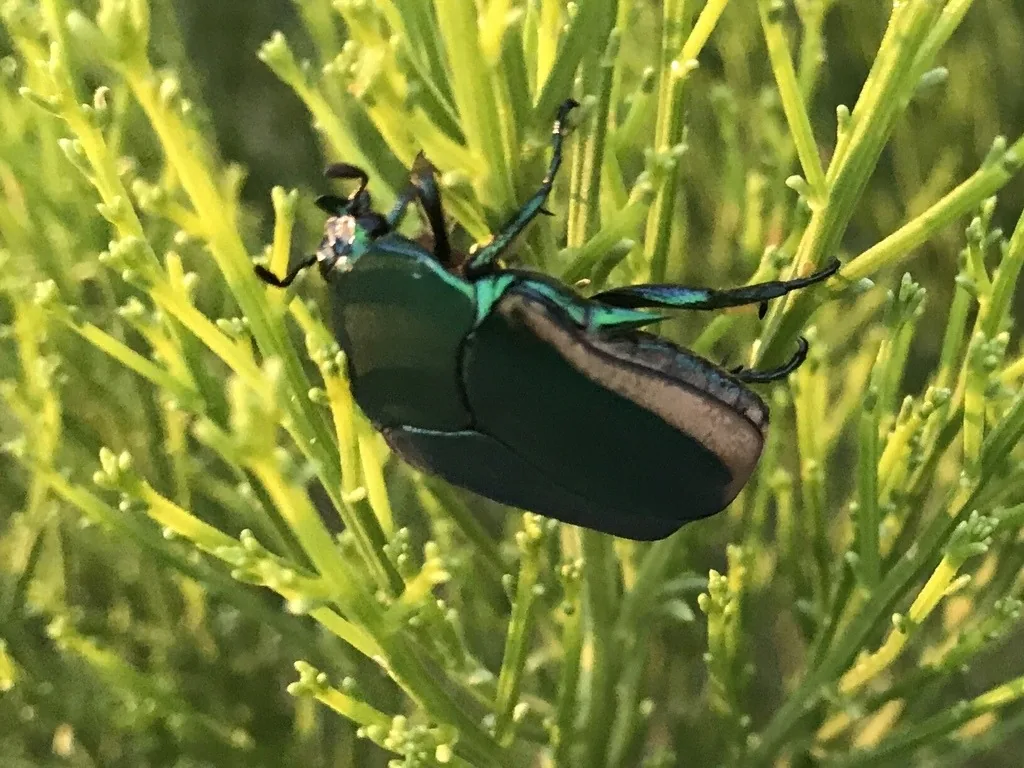
How to identify it
Look-alikes
| Look-alike | How to tell them apart |
|---|---|
| Japanese beetle | Japanese beetles are half the size or less and have 12 tufts of white hair around the abdomen.[1] |
| Green June beetle | The eastern green June beetle is nearly identical but smaller on average; in California it's reported only in the south.[1] |
Where it lives
UC IPM calls it an occasional pest of ripe fruit in California; adults fly long distances toward ripe fruit, manure and fermenting fruit.[1]
Biology and life cycle
Females lay eggs just under the surface of compost, grass clippings, mulch and manure; eggs hatch in about a week.[1]
Grubs overwinter, pupate in spring, and adults are around from late spring to early fall; one generation a year.[1]
Damage and signs
Health risk
It feeds on fruit and organic matter; UC IPM mentions no risk to people.[1]
Control
Prevention
Choose early-ripening varieties, harvest early and pick up fallen fruit.[1]
Sanitation
Thinly spread or remove compost, clippings, leaves and manure near fruit trees, or compost in screened bins and turn piles often.[1]
Traps and physical control
Homemade traps baited with diluted grape or peach juice catch some adults; UC IPM recommends no insecticide.[1]
Common questions
Sources
- University of California Statewide IPM Program, “Green Fruit Beetle (Pests in Gardens and Landscapes).” ipm.ucanr.edu/PMG/GARDEN/FRUIT/PESTS/grfruitbeetle.html (accessed 2026-10-06)
- iNaturalist, “Cotinis mutabilis taxon page (order and family).” www.inaturalist.org/taxa/57665 (accessed 2026-10-06)