The short answer
- Dig before you treat. Count grubs in a few square-foot samples of soil at the edge of damaged turf. Penn State's common threshold is 5 to 10 grubs per square foot, depending on species; a healthy lawn tolerates a few without visible damage.[2][1][4]
- If you find grubs now (usually August to September), use a curative insecticide while they are still small, 1/2 inch or less. Trichlorfon is the fast-acting choice; once grubs are full size, expect only partial control.[4][7][5]
- If the lawn had grub damage in recent years, a preventive product applied before or around egg-laying (often May to July, depending on the active ingredient and where you live) kills the young grubs as they hatch.[7][4][6]
- Water every grub treatment in with about half an inch of water, unless the label says otherwise. Insecticide left in the grass blades or thatch doesn't reach the grubs.[6][3][1]
- Spring treatments rarely pay off: grubs are big, hard to kill and about to stop feeding. Milky spore has done poorly in recent university trials, and nematodes are hit-and-miss.[4][2][6][7]
- To protect bees, mow off flowering clover and dandelions before you apply. Chlorantraniliprole is the lowest-risk option for bees.[4][11]
Lawn grub species
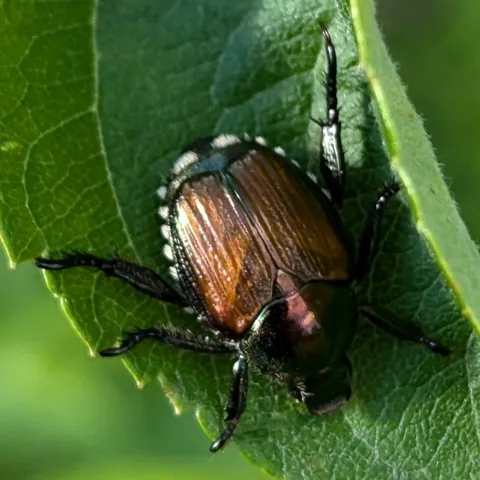 Japanese Beetle
Popillia japonica
The Japanese beetle damages landscapes twice: metallic green adults chew the leaves, flowers and fruit of hundreds of plants in early summer, and their white grubs feed on grass roots underground. A review of its biology calls it the most widespread and destructive insect pest of turf, landscapes and nursery crops in the eastern United States.
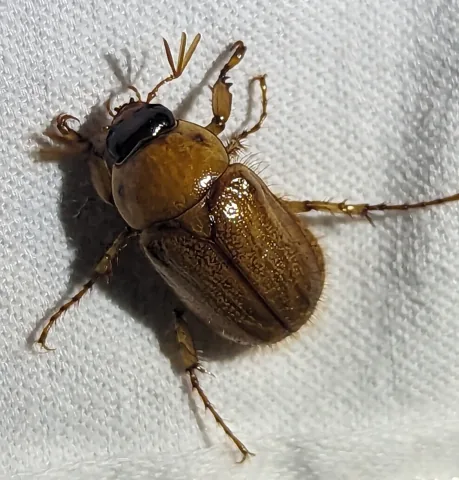 Masked Chafers
Cyclocephala species (northern masked chafer, C. borealis; southern masked chafer, C. lurida)
Masked chafers are native North American beetles whose larvae, called white grubs, feed on turfgrass roots. The adults don't feed at all; the grubs do the damage, mostly in late summer and fall.
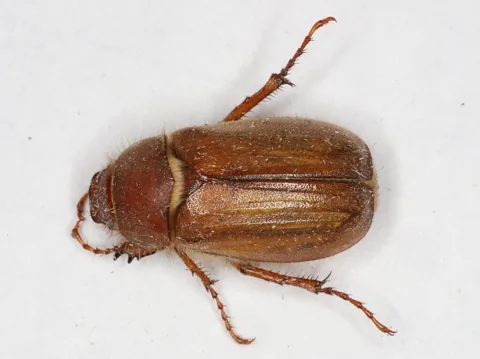 European Chafer
Amphimallon majale
The European chafer is an invasive beetle whose C-shaped white grubs are a severe pest of lawns. The grubs feed longer during the year than Japanese beetle grubs, so they are considered more destructive to turf.
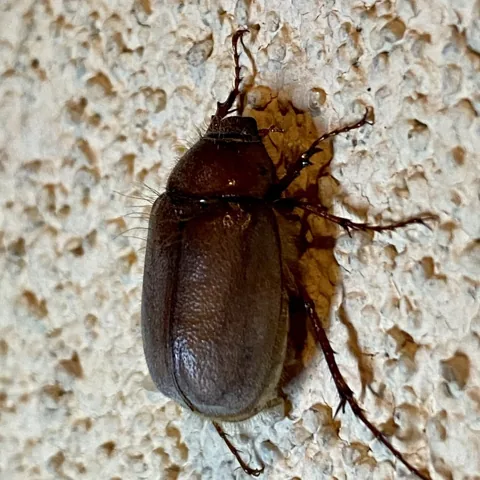 May and June Beetles
Phyllophaga species
May and June beetles, or June bugs, are native scarab beetles in the genus Phyllophaga. The adults buzz around porch lights on early summer nights, while their C-shaped grubs feed on roots, mostly in turf.
 Oriental Beetle
Anomala orientalis (Exomala orientalis)
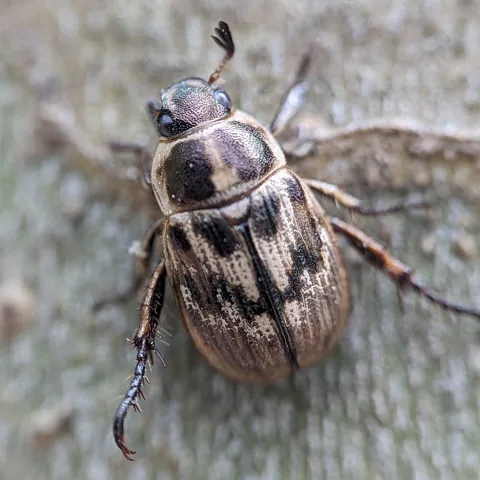
The oriental beetle (Anomala orientalis, also placed in the genus Exomala) is a small scarab from Asia whose white grubs chew the roots of turf and ornamental plants. It is considered the most serious grub pest of turf and woody ornamentals on Long Island, in northern New Jersey and in Connecticut, and in parts of the Northeast most lawn grubs turn out to be oriental beetles rather than Japanese beetles.
 Asiatic Garden Beetle
Maladera formosae (long known as Maladera castanea)
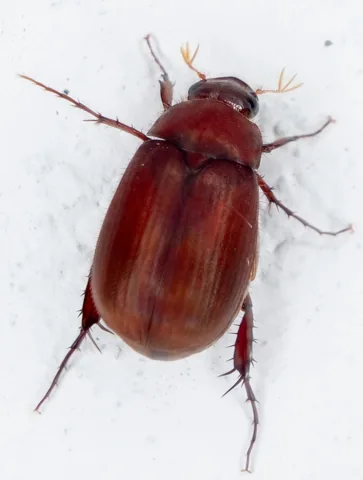
The Asiatic garden beetle is an imported scarab about the size and shape of a coffee bean. It hides in the soil by day and comes out at night to shred leaves and flowers, and it is so drawn to lights that it can gather in large numbers on windows and screen doors.
 Black Turfgrass Ataenius
Ataenius spretulus
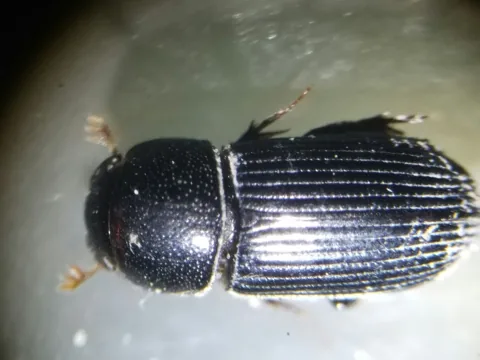
The black turfgrass ataenius is a small scarab beetle whose tiny white grubs feed on grass roots. It is mainly a golf course pest of greens, tees and fairways, and it only occasionally damages home lawns.
 Green June Beetle
Cotinis nitida
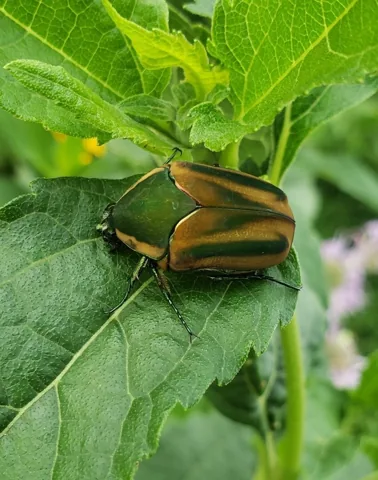
Green June beetles are large, metallic green scarabs that cruise a few feet above lawns on summer days with a loud buzz. They are harmless to people; the adults damage ripe fruit, and their oversized grubs burrow in lawns rich in organic matter.
Confirm grubs and count them first
Brown patches have other causes too. Minnesota Extension advises checking under the grass before you assume grubs, and Clemson warns that rainfall and irrigation can hide root damage, so the turf may look fine until a dry spell.[4][1]
Our lawn insect identification guide covers the tug test and the square-foot dig step by step. In short: cut and fold back a square foot of sod at several spots along the edge of damaged areas, count the grubs in the top few inches of soil, average the counts, then press the sod back and water it.[2][1]
Penn State says sampling in August through early September gives the most useful count for deciding on a curative treatment, because that is when the treatment will work best.[2]
Wisconsin Extension points out that most lawns have a few white grubs and that most turf there never needs a grub treatment. It adds that most white grubs in the Midwest are scavengers that help break down organic matter.[6]
How many grubs justify treatment
There is no single number. Penn State says 5 to 10 grubs per square foot is often used as the threshold for curative treatment, depending on species, and that each lawn has to be judged on its own. Clemson says healthy, unstressed turf can tolerate 5-7 per square foot, and that poorly managed turf may show damage at lower numbers.[2][1]
Clemson's species-by-species figures show why identification matters:[1]
- Japanese beetle: healthy turf usually tolerates 10 grubs per square foot, but six to eight may be a safer trigger where skunks, armadillos or raccoons dig for them. Minnesota also gives up to 10.[1][4]
- Masked chafers: well-managed turf may tolerate 20 per square foot; stressed turf shows symptoms at eight or more. Clemson notes populations of 40 or more per square foot are fairly common.[1]
- May and June beetles (Phyllophaga): the usual threshold is four to five per square foot, and more than seven can strip the roots completely. Aim controls at first and second instar grubs.[1]
- Green June beetle: the grubs feed mostly on decaying organic matter, not roots, but their tunneling causes problems above five to seven per square foot.[1]
Which grub you have changes the plan
Most lawn grubs look alike to the eye; the pattern of spines and hairs on the underside of the last segment (the raster) tells them apart, and an extension office or diagnostic lab can identify them. Species matters for treatment in a few specific ways:[2][4]
- Japanese beetle and masked chafers: one generation a year, with eggs laid in early summer and the grubs feeding from mid to late summer into fall. Most timing advice on this page is built around them.[1][2]
- European chafer: the life cycle runs about two weeks earlier than the other Northeast species in any given location (UMass). Wisconsin's preventive window for it starts in late May.[5][6]
- Oriental beetle and Asiatic garden beetle: UMass says imidacloprid is not effective against Asiatic garden beetle grubs, and the other neonicotinoids have limited or no activity against them. UMass rates chlorantraniliprole extremely effective against all the white grubs in New England.[5]
- May and June beetles: a two- to three-year life cycle (Clemson; Penn State says three years), with most of it spent as a large third instar grub. Missouri says first-year grubs should be treated in late July to early August, and in the second year treatments can be made from April through September while the grubs keep feeding.[1][2][9]
- Green June beetle: the grubs crawl on their backs and push up mounds of soil. NC State says carbaryl used against them should not be watered in; treated grubs come to the surface, and Clemson says they appear within 12 hours and may need to be removed to avoid a strong odor as they decay.[3][1]
- Black turfgrass ataenius: a tiny grub that Missouri describes as mainly a golf course pest, not a home lawn one.[9]
- Milky spore works only on Japanese beetle grubs, and Penn State says it is of little or no value against other scarabs.[2][3]
Preventive or curative: two different strategies
Preventive (often sold as "season-long") products are systemic or long-lasting in the soil. Grass roots take them up, and grubs that hatch later die when they feed. They work best on small, newly hatched grubs and often poorly on large ones, so they must go down before or around egg-laying.[1][4][6]
Curative (often sold as "24-hour") products are contact insecticides that move down through the soil and kill grubs already there. They last a short time, so they have to be applied while grubs are present and still small.[1][4][2]
A preventive treatment is insurance. Minnesota, Kentucky and NC State all reserve it for lawns with a history of grub damage, or a summer with a heavy beetle flight. If damage has been sporadic, Minnesota suggests waiting and watching, then treating curatively only if grubs show up.[4][7][3]
Penn State adds that a spring curative treatment gives no protection against new eggs laid later in the season, so it does not substitute for either strategy.[2]
Grub insecticides by active ingredient
Store products are sold under many brand names; check the active ingredient on the label. These are the ones extension services list for home lawns:[6][7]
- Chlorantraniliprole (a diamide): preventive. Kentucky and UMass rate it effective against grubs, and it also controls cutworms, sod webworms and other caterpillars. UMass says it has very low toxicity to vertebrates and no activity against bees. It lasts a long time in the soil: Ohio State gives 12 to 16 weeks of residual activity, and UMass says it takes 60 to 90 days to fully dissipate in the soil.[7][5][8]
- Imidacloprid (a neonicotinoid): preventive. Kentucky calls it relatively ineffective as a curative against large grubs. UMass has found its residual activity shorter than it was in the 1990s, and says it is not effective against Asiatic garden beetle grubs.[7][5]
- Clothianidin and thiamethoxam (neonicotinoids): preventive, with some curative activity. UMass found clothianidin takes at least 10 days to affect grubs, with grubs dying within two weeks, which may make it the best option where trichlorfon and carbaryl can't be used. Minnesota lists clothianidin among effective curatives.[7][6][5][4]
- Dinotefuran (a neonicotinoid): listed by Wisconsin as preventive and by Ohio State as useful for curative treatment if watered in.[6][8]
- Trichlorfon (an organophosphate): curative. Kentucky says it is good for rescue treatments against larger grubs and relatively good at getting through thatch. UMass says it ordinarily kills what it will within one to three days and breaks down within seven to ten days.[7][5]
- Carbaryl (a carbamate): curative, but less reliable. Kentucky calls it generally less effective than trichlorfon and very toxic to earthworms; UMass has found it very inconsistent; Ohio State says thick thatch ties it up.[7][5][8]
- Combination products: some lawn products pair a neonicotinoid with a pyrethroid. UMass explains that the neonicotinoid targets grubs while the pyrethroid controls caterpillars and billbug adults.[5][3]
When to apply
Timing is the single biggest reason grub treatments fail. Eggs hatch about 10 days to 2 weeks after adults lay them (Clemson), so the target is the small grub just out of the egg. Because beetle flights shift with weather, Penn State suggests watching your own area's adult activity and adjusting the dates below.[1][2]
Preventive timing differs by active ingredient:[5][8][7]
- Chlorantraniliprole: because it lasts so long, it can go down earliest. UMass recommends mid-April to early June in New England; Ohio State says April into early August works; Kentucky gives May 15 to late July, with mid-June to mid-July best for most species.[5][8][7]
- Neonicotinoids: closer to egg-laying. Ohio State says they have four to eight weeks of residual activity and can go on in June and July for masked chafers. UMass advises against imidacloprid before mid-June and suggests mid-June to early August for the neonicotinoids. Minnesota times preventives for mid-June to mid-July.[8][5][4]
- In the South the calendar is earlier: Clemson recommends preventive products in April through May and curative treatments in July through August for South Carolina.[1]
Curative timing and the rescue window
Curative treatments work best on young grubs feeding near the surface. Minnesota gives late July to mid-September, while grubs are 1/2 inch or less; Penn State gives August through mid-September depending on location; Wisconsin gives August to October for most species, and July to September for May and June beetles, noting that the start of the window is most effective.[4][2][6]
Wisconsin's preventive and curative windows by species:[6]
- Japanese beetle: preventive June to July; curative August to October.[6]
- Northern masked chafer: preventive June to July; curative August to October.[6]
- European chafer: preventive late May to mid July; curative August to October.[6]
- May/June beetle: preventive May to early June; curative July to September.[6]
Late-season and spring treatments
Once grubs are full size, curative treatments lose much of their punch. UMass says that by then (often by mid-September) they seldom give more than a 50% reduction; Minnesota calls a September rescue treatment partial control at best. After grubs move deeper for winter, insecticides don't reach them.[5][4]
Spring treatment is usually wasted. Minnesota advises against it because the large grubs are hard to kill, feed only briefly and rarely cause damage then. Penn State and NC State both say spring applications are generally less effective than late-summer ones.[4][2][3]
If the lawn is already badly damaged in fall, Wisconsin's advice is to reseed damaged areas as needed.[6]
Watering in
Grubs live in the root zone, so the insecticide has to get there. Wisconsin says to apply about half an inch of water after any grub product and that failure to water in will result in poor control. Clemson says granules must be watered in immediately.[6][1]
NC State also recommends irrigating a day or two before a curative application in dry weather, because grubs stay deep when the soil is dry and moisture brings them closer to the surface.[3]
The exception is carbaryl against green June beetle grubs, which NC State says should not be watered in.[3]
UMass notes that trichlorfon and carbaryl break down quickly in water with a pH above 7.2; if your water is alkaline, it suggests adding a suitable product to lower or buffer the pH.[5]
Read the label for rate and the maximum allowed per year. Clemson notes most products have a maximum application rate per 1000 square feet per year.[1]
Beneficial nematodes
Insect-parasitic nematodes are microscopic worms that enter grubs and kill them with bacteria they carry. Penn State and Ohio State both say Heterorhabditis species usually do better against white grubs than Steinernema species, which are better at cutworms and billbugs.[1][2][8]
Results are the problem. Penn State calls research results inconsistent, Minnesota calls their effectiveness inconsistent, and Kentucky lists them as inconsistent in its field trials. Cornell's IPM program says Hb nematodes can be very effective under the right conditions.[2][4][7][10]
Getting the conditions right is most of the battle:[8][10][4]
- Buy fresh and use right away. Ohio State says most suppliers need about a month to prepare fresh nematodes, and Penn State says to check the expiration date on every package.[8][2]
- Target small grubs: Ohio State says applications work best against late first and second instar grubs, usually in August.[8][1]
- Warm soil: Cornell says Hb nematodes do best in soil above 68 °F.[10]
- Apply in the early morning, the evening or on an overcast day to limit sun exposure.[10][4]
- Water before and after, and keep the soil moist; Cornell suggests for at least 2 weeks. Kentucky advises against applying in hot or dry weather.[10][4][7]
- Some pesticides can harm the nematodes, so read the supplier's instructions before combining treatments.[2]
Milky spore and other biological products
Milky spore is a bacterium (Paenibacillus popilliae) that infects only Japanese beetle grubs. NC State describes it favorably: applied in late September or early October to soil with a pH between 6 and 7, it acts slowly but lasts for years and spreads on its own. Penn State says it may take three to five years to become established, needs a Japanese beetle grub population to do so, and shouldn't be combined with an insecticide.[3][2]
Recent trials are less encouraging. Minnesota says commercial milky spore has shown no benefit in modern university research trials, Wisconsin says it has not been found effective in recent university research, and Kentucky reports poor performance in its field trials. In a California study published in 2000, soil treated with the bacterium did not cause substantial grub mortality. Ohio State notes that a related strain of milky disease occurs naturally in masked chafer grubs there but usually infects less than 20–25% of a population.[4][6][7][12][8]
Products based on Bacillus thuringiensis galleriae (Btg) also get mixed reviews: Ohio State reports 70% control and better against late first and second instar grubs, while Minnesota calls university results inconsistent, Wisconsin calls biological products limited and highly variable, and Clemson calls control marginal.[8][4][6][1]
Lawn care that reduces grub damage
None of these will clear a heavy infestation, but they make a lawn less inviting to egg-laying beetles and better able to ride out a moderate grub population.[6][2][8]
- Keep the turf vigorous. Water, fertilize and mow at the right height and frequency to encourage deep roots, which let a lawn tolerate more grubs. Clemson cautions that grubs can still damage the best-maintained turf.[6][1]
- Skip summer watering if you can live with brown grass. Beetle eggs need moisture: Penn State says eggs may dry up and die if the lawn stays dry in July and early August, and Ohio State says restricting irrigation then may significantly reduce their survival. The cost is a brown lawn until you water again.[2][8]
- Masked chafer adults are drawn to lights at night, and Ohio State notes damage is common under street lights.[8]
- Don't use Japanese beetle traps to protect the lawn. NC State says they have no real impact on the next year's grubs and can draw more adults into the yard.[3]
Protecting bees
Several grub insecticides are hazardous to bees. Minnesota lists trichlorfon, clothianidin and carbaryl as toxic to bees, and says clothianidin can move into the nectar and pollen of flowering lawn weeds. Imidacloprid and clothianidin used preventively can also harm bees foraging on weeds or nesting in the lawn.[4]
A field study with bumble bees supports both the risk and the fix. Colonies that foraged on blooming white clover sprayed with clothianidin gained weight more slowly and produced no new queens. Colonies on chlorantraniliprole-treated clover developed normally, and neither insecticide harmed colonies after the treated lawn was mown to remove the blooms and new flowers had formed.[11]
Before applying, mow off clover, dandelions and other flowering weeds, and avoid areas where ground-nesting bees are active. Choose chlorantraniliprole where it fits the timing. Our pollinator spraying guide has more on reading the bee hazard statements on labels.[4][11]
Skunks, raccoons and other diggers
Animals digging for grubs can tear up more turf than the grubs do. Skunks dig small cone-shaped holes: the Internet Center for Wildlife Damage Management (ICWDM) describes 3- to 4-inch holes, UC IPM pits 3 to 5 inches across. Skunks work through a lawn section by section. ICWDM says the digging generally stops after about 3 weeks once the food runs out.[13][14][1]
Raccoons tend to roll back sod rather than dig holes, especially freshly laid sod, and may return night after night. ICWDM says this is most common in mid to late summer when young raccoons are learning to forage and in dry weather.[16][18][14]
Controlling the grubs reduces the attraction, but timing matters: ICWDM says grub insecticides only help if the grubs are controlled before the digging starts. Penn State suggests insecticide to stop skunk digging and reminds readers that it can affect other species.[17][15]
For new sod, ICWDM suggests pinning strips down with long wire pins, wooden stakes or nylon netting until they root, and installing sod in spring or early summer to avoid the late-summer raccoon season. UC IPM mentions a temporary electric fence around new sod. Our skunk and raccoon guides cover exclusion and removal rules.[17][18]
Moles feed on grubs too, but Penn State notes they also eat earthworms, so mole tunnels alone don't prove a grub problem.[2]
Repairing the damage
Grub-killed turf won't recover where the roots are gone. Wisconsin Extension's advice is simply to reseed damaged areas as needed once grubs are under control.[6]
Where sod was lifted for sampling or rolled back by animals, press it firmly back into contact with the soil and water it so it doesn't dry out.[2]
Common questions
- What is the best time of year to kill grubs?
- Late summer, while the new generation is small and feeding near the surface: roughly late July to mid-September in the North (Minnesota, Penn State) and July to August in South Carolina (Clemson). Preventive products go on earlier, before or around egg-laying.[4][2][1]
- Does grub killer work in the spring?
- Usually not well. Spring grubs are large and hard to kill, feed only briefly and rarely cause much damage, and a spring treatment doesn't protect against the eggs laid that summer.[4][2]
- Do I need to water in grub control?
- Yes, for nearly all products. Wisconsin says to apply about half an inch of water afterward. The exception NC State notes is carbaryl used on green June beetle grubs.[6][3]
- Is milky spore worth it?
- The evidence is weak. It affects only Japanese beetle grubs, may take years to establish, and Minnesota, Wisconsin and Kentucky report no benefit or poor performance in university trials.[4][6][7][2]
- Which grub control is safest for bees?
- Chlorantraniliprole. UMass says it has no activity against bees, and a bumble bee field study found no harm to colonies foraging on treated clover. With any product, mow flowering weeds first.[5][11][4]
- Will treating grubs stop skunks from digging?
- Only if the grubs are controlled before the digging starts. Once animals are already feeding, the damage often stops on its own when the grubs run out, which ICWDM says is usually within about 3 weeks.[17][13]
Photo credits
- Japanese Beetle: (c) Emmett Collins-Sussman, some rights reserved (CC BY) — via iNaturalist, CC BY 4.0
- Masked Chafers: (c) Michael, Antoni and Nihat Hinczewski, some rights reserved (CC BY) — via iNaturalist, CC BY 4.0
- European Chafer: Allan Harris, public domain (CC0), via iNaturalist
- May and June Beetles: (c) Elliott Gordon, some rights reserved (CC BY) — via iNaturalist, CC BY 4.0
- Oriental Beetle: cgmayers, public domain (CC0), via iNaturalist
- Asiatic Garden Beetle: Mirko Schoenitz, public domain (CC0), via iNaturalist
- Black Turfgrass Ataenius: (c) Tyler Bishop, some rights reserved (CC BY) — via iNaturalist, CC BY 4.0
- Green June Beetle: Jack, public domain (CC0), via iNaturalist
Sources
- Clemson Cooperative Extension Home & Garden Information Center, “White Grub Management in Turfgrass (HGIC).” hgic.clemson.edu/factsheet/white-grub-management-in-turfgrass/ (accessed 2026-11-10)
- Penn State Extension, “White Grubs in Home Lawns.” extension.psu.edu/white-grubs-in-home-lawns (accessed 2026-11-10)
- NC State Extension, “White Grubs in Turf.” content.ces.ncsu.edu/white-grubs-in-turf (accessed 2026-11-10)
- University of Minnesota Extension, “Japanese beetles in yards and gardens.” extension.umn.edu/yard-and-garden-insects/japanese-beetles (accessed 2026-11-10)
- UMass Amherst Center for Agriculture, Food, and the Environment, Turf Program, “Current Insecticide Approaches for White Grub Control.” www.umass.edu/agriculture-food-environment/turf/fact-sheets/current-insecticide-approaches-for-white-grub-control (accessed 2026-11-10)
- University of Wisconsin-Madison Extension, Wisconsin Horticulture, “White Grub Control in Turfgrass.” hort.extension.wisc.edu/articles/grub-control-home-lawn/ (accessed 2026-11-10)
- University of Kentucky Entomology, “Insecticides for Control of White Grubs in Kentucky Turfgrass, ENTFACT-441.” entomology.ca.uky.edu/files/ef441.pdf (accessed 2026-11-10)
- Ohio State University Extension, “Masked Chafers (ENT-51).” ohioline.osu.edu/factsheet/ENT-51 (accessed 2026-11-10)
- University of Missouri Extension, “Turfgrass Insects, IPM1020, page 2: annual white grub species.” extension.missouri.edu/publications/ipm1020/2 (accessed 2026-11-10)
- New York State Integrated Pest Management Program, Cornell University, “Heterorhabditis bacteriophora, Beneficial Hb Nematode (NYSIPM Biocontrol Fact Sheet, June 2022).” cals.cornell.edu/integrated-pest-management/outreach-education/fact-sheets/heterorhabditis-bacteriophora-beneficial-hb-nematode (accessed 2026-11-10)
- PLoS ONE, via PubMed Central, “Larson, Redmond and Potter (2013), Assessing Insecticide Hazard to Bumble Bees Foraging on Flowering Weeds in Treated Lawns, PLoS ONE 8(6):e66375.” pmc.ncbi.nlm.nih.gov/articles/PMC3680470/ (accessed 2026-11-10)
- Journal of Economic Entomology, via PubMed, “Koppenhofer et al. (2000), Biological control agents for white grubs in anticipation of the establishment of the Japanese beetle in California, J Econ Entomol.” pubmed.ncbi.nlm.nih.gov/14658514/ (accessed 2026-11-10)
- Internet Center for Wildlife Damage Management, “Skunk Damage Identification.” icwdm.org/species/carnivores/skunks/skunk-damage-identification/ (accessed 2026-11-10)
- University of California Statewide IPM Program, “Skunks (Pest Notes).” ipm.ucanr.edu/home-and-landscape/skunks/ (accessed 2026-11-10)
- Penn State Extension, “Skunks - Solutions to Common Problems.” extension.psu.edu/skunks (accessed 2026-11-10)
- Internet Center for Wildlife Damage Management, “Raccoon Damage Identification.” icwdm.org/species/carnivores/raccoons/raccoon-damage-identification/ (accessed 2026-11-10)
- Internet Center for Wildlife Damage Management, “Raccoon Damage Prevention and Control Methods.” icwdm.org/species/carnivores/raccoons/raccoon-damage-prevention-and-control-methods/ (accessed 2026-11-10)
- University of California Statewide IPM Program, “Pest Notes: Raccoons.” ipm.ucanr.edu/home-and-landscape/raccoons/ (accessed 2026-11-10)