The short answer
- Confirm them first with a soapy water flush: mix dish soap in a gallon of water, pour it over a square foot or two of tunneled turf, and mole crickets come to the surface within minutes.[1][6][4]
- Mark the areas where you find them in spring. Mole crickets tend to come back to the same spots year after year, so you can treat those patches instead of the whole lawn.[1][2][6]
- Treat the young nymphs, not the spring adults. Clemson recommends June and July in South Carolina, Texas A&M says May through July, and Auburn says June, July and even early August, while the nymphs are still small.[1][4][6]
- Water the lawn the day before treating, apply late in the day, and water in sprays and granules afterward. Do not water baits for 2 to 3 days.[1]
- Treatments in fall and winter on full-grown crickets work poorly. Expect management, not elimination: no program gives 100% control.[1][2]
Mole crickets and their enemies
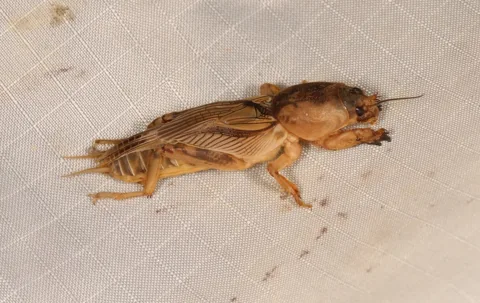 Mole Crickets
Neoscapteriscus species (tawny, southern and shortwinged mole crickets; N. vicinus shown)
Tawny and southern mole crickets are introduced species, thought to have arrived from South America in ships' ballast and first found in Southeastern port towns in the late 1800s and early 1900s. They are now serious turf pests in the sandy coastal Southeast: both tunnel just under the lawn, uprooting and drying out grass, and the tawny mole cricket also feeds on grass roots and shoots.
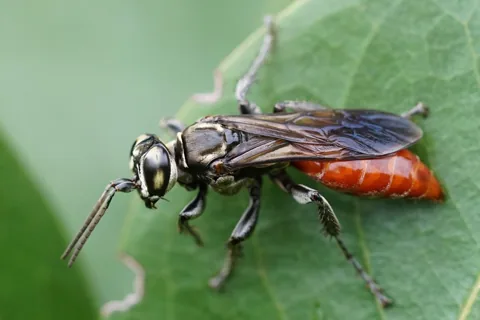 Mole cricket hunter
Larra bicolor
Larra bicolor is a black wasp with a solid red abdomen that develops only on mole crickets. It is native to South America and was released in Florida to control the invasive Scapteriscus mole crickets that damage turf and pasture grasses, and it has since spread into neighboring states.
No photo yet
Brazilian Red-Eyed Fly
Ormia depleta
The Brazilian red-eyed fly (Ormia depleta) is a South American tachinid fly that parasitizes pest mole crickets. Females find their hosts by the songs of male mole crickets. University of Florida researchers released it starting in 1988, and it is now established in much of central and southern Florida, where it has helped reduce mole cricket damage to turf.
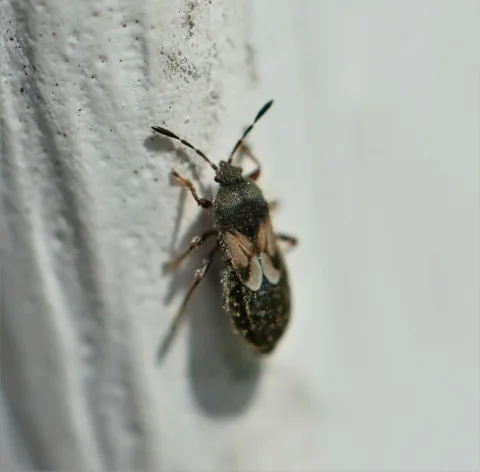 Southern Chinch Bug
Blissus insularis
The southern chinch bug is a tiny sap-sucking bug and the most important insect pest of St. Augustinegrass lawns in the southern United States. Feeding groups kill grass in spreading, irregular patches, often first in hot, dry, sunny spots.
Is it mole crickets?
Look for raised, loosened soil, shallow tunnels like small mole runs, small mounds, and grass that dries out because its roots have been uprooted. Texas A&M's insect field guide says the crickets can tunnel up to 20 feet per night when the soil is moist, and that infestations are usually spotty and localized.[5][2][1]
In spring, males dig a calling chamber with an opening at the surface. Clemson says this mound looks like soil pushed up from underneath with a hole in the middle, while an earthworm mound is built from small round pellets.[1]
Damage is worst in bermudagrass and bahiagrass on sandy soil, and Texas A&M says those grasses are often more affected than St. Augustinegrass. A Texas A&M turf fact sheet adds that zoysiagrass, centipedegrass and creeping bentgrass can also be damaged. Clemson notes that the tunneling also breaks up a pre-emergent herbicide barrier.[5][4][2]
- Tawny mole cricket: tan, feeds mainly on grass roots and shoots and is the most destructive species in lawns. The two dactyls (the digging "fingers" on the front leg) nearly touch at the base and form a V.[1][4][3]
- Southern mole cricket: darker brown with four pale spots on the shield behind the head, with a U-shaped gap between the dactyls. It is mostly a predator of small soil animals, but its tunneling still uproots grass. Texas A&M says it eats about 80 percent animal food and 20 percent plants.[1][4][5]
- Northern mole cricket: a native species with four dactyls on the front leg. Clemson says it causes little if any lawn damage in South Carolina; Texas A&M's field guide says it is less numerous in Texas but produces damage similar to the southern mole cricket.[1][5][4]
- Size: sources differ a little. Clemson gives 1 1/2 to 2 inches for tawny and 1 to 1 1/2 inches for southern adults, a Texas A&M fact sheet says adults of both are about 1 1/4 inches, and Auburn says 1 to 1 1/4 inches.[1][4][6]
- For other causes of brown patches (grubs, chinch bugs, caterpillars, drought), use the lawn insect identification guide linked below. The mole cricket profile has photos and species details.[1]
How to do a soap flush
A soap flush irritates mole crickets and drives them to the surface, so you can see whether they are present, which species they are and how big they are. It is a scouting method, not a treatment.[4][1][2]
- Mix liquid dish soap in a gallon of water. Recipes vary: Clemson's home lawn fact sheet uses 1 to 2 fluid ounces of liquid dish soap per gallon, Texas A&M uses 1 tablespoon of lemon-scented liquid dish detergent, and Auburn uses 2 tablespoons of lemon-scented liquid dishwashing detergent.[1][4][6]
- Pour it over 1 to 2 square feet of tunneled turf (Clemson says a 2-square-foot area). Any mole crickets present come up within a few minutes.[6][1]
- Do it early or late in the day, and water the spot afterward to keep the soapy turf from scalding in the sun, as Auburn advises.[6]
- Flush several suspect spots and write down where you found crickets. Auburn says flushing can be repeated from spring to fall to confirm activity and follow the crickets' development.[6][1]
How many is too many?
None of the extension sources used here gives a number of crickets per flush for a home lawn. Clemson's advice is to match the effort to how the turf is used: a golf putting green has zero tolerance, sports fields and sod farms tolerate a little more, and home lawns can tolerate the most mole cricket activity.[1]
Spring treatment of the overwintered adults is optional for a home lawn. Auburn says early spring treatment reduces tunneling but usually does not replace the summer treatment, and Clemson does not recommend treating spring adults unless activity is heavy enough to kill turf, because all the adults die once egg laying is finished.[6][1]
The decision that matters is whether to treat the new nymphs in early summer. If you found crickets in a spot in March, April or May, Auburn says there are usually treatable young nymphs there in June and July, even though the lawn may look fine by then.[6][2]
Timing: the mole cricket year
Tawny and southern mole crickets typically have one generation a year in South Carolina and Texas. Clemson says areas further south can have two or more, and Texas A&M's field guide says a second generation may occur in southern Texas.[1][4][5]
Treat when most eggs have hatched and the nymphs are still small. Clemson says to treat in June and July, with additional summer treatments along the South Carolina coast in mid-July to early August, when most eggs have hatched and nymphs are under 1/2 inch long. Hatch dates move with spring weather, so use a soap flush to check for tiny nymphs before you treat.[1][6][2]
- Late winter to spring: overwintered crickets become active as the soil warms; Auburn says when night temperatures approach 60 degrees F. Clemson's turf IPM page says peak flight and tunneling usually come in April and May, with tunneling as early as February on warm days.[6][2][1]
- Spring: males call for about an hour after sunset on warm nights in late March and April in South Carolina, and mating follows.[1]
- Egg laying: Clemson's home lawn fact sheet says a female lays clusters of around 35 eggs in 3 to 5 chambers, 100 to 150 eggs in all; Clemson's turf IPM page says two to five clusters of 25 to 60 eggs. In Texas, egg laying starts in April in the south and in June or July in the north.[1][2][4]
- Hatch: Clemson's fact sheet says about 20 days after laying, the turf IPM page says 10 to 40 days, and Texas A&M's field guide says about 2 weeks. Tawny eggs hatch from May to July and southern eggs in June and July (Clemson), and Auburn says Alabama hatch usually begins between mid-May and early June.[1][2][5][6]
- Early summer: new nymphs are about 1/4 inch long and do little visible damage, so the crickets seem to have disappeared. This is the time to treat.[1][4][2]
- Late summer and fall: nymphs reach maturity from late August to October, and damage peaks, worst in warm, wet weather. Larger crickets are harder to kill.[1][4]
- Winter: crickets move deeper into the soil. Clemson calls winter treatments the least effective, worth doing only during warm spells with heavy activity.[1]
Insecticides for nymphs, by active ingredient
Several lawn insecticides are labeled for mole crickets. Pick one that lists mole crickets and home lawns on the label and follow its rate and timing directions. Clemson lists these active ingredients for residential lawns: the neonicotinoids imidacloprid and clothianidin, the organophosphate trichlorfon, and the pyrethroids lambda- or gamma-cyhalothrin, bifenthrin, beta-cyfluthrin, zeta-cypermethrin and permethrin. Texas A&M names bifenthrin, fipronil, indoxacarb and thiamethoxam as effective.[1][4]
Match the product to the stage. NC State's turf table says to apply imidacloprid while the crickets are less than 1/2 inch long (June, early July) and dinotefuran at egg hatch. Clemson suggests a neonicotinoid before the early summer hatch, then a pyrethroid or organophosphate for the nymphs that emerge, so you rotate insecticide classes and slow resistance.[3][1]
Later in the season, Clemson's turf IPM page names acephate and fipronil among the most effective insecticides against adults and older nymphs, though it says adults are less susceptible and can detect and avoid insecticide residue. A laboratory study found mole crickets detected and avoided areas treated with fipronil and imidacloprid, while acephate and bifenthrin made them tunnel more in the first 90 minutes.[2][9]
- Water the lawn well the day before. If the soil is very dry, water deeply or wait for an inch of rain, because mole crickets dig deeper in dry soil, out of reach of the treatment.[1]
- Apply as late in the day as possible.[1]
- Water in liquid and granular insecticides after applying, as most labels require, but check the label: NC State notes some products, such as acephate, should not be watered in.[1][3]
- If activity is still high in early fall, Clemson says a follow-up treatment may be needed.[1]
Mole cricket baits
Clemson says home lawn baits contain carbaryl or indoxacarb and give good control in spring and fall when adults are active; its turf IPM page also calls indoxacarb and carbaryl baits effective in early spring and late fall. Because they are a different insecticide class from the sprays above, they help with resistance management.[1][2]
Water the lawn the day before, spread the bait late in the day, and then do not water for 2 to 3 days, since water dissolves the bait. NC State's table also says not to water in indoxacarb granules.[1][3]
Beneficial nematodes
Steinernema scapterisci is a nematode that attacks mole crickets. In laboratory tests it was more pathogenic to insects in the cricket and grasshopper order than to the moths, bees and wasps tested, and it was not pathogenic to earthworms.[10]
Whether you can buy it is the catch, and sources differ. Clemson's home lawn fact sheet (updated 2022) calls a beneficial nematode the only commercially available nonchemical product, while warning it can be slow and may not work as well as insecticides. Clemson's turf IPM page says the nematode was previously sold but no commercial product is currently available, and Auburn's older fact sheet also says it was not available commercially.[1][2][6]
If you find a product labeled for mole crickets, Auburn says these nematodes most effectively infect adults, so apply them in spring before females lay eggs, or in fall. NC State says adequate soil moisture is critical. A laboratory study found the nematode survived and stayed infective in solutions of acephate and bifenthrin, but infectivity dropped below 40% in imidacloprid. The beneficial nematodes guide covers handling and applying nematodes in general.[6][3][7]
The Larra wasp and other natural enemies
Larra bicolor is a wasp that parasitizes only Scapteriscus mole crickets, attacking adults and medium to large nymphs. Clemson says several mole cricket enemies were released in Florida and Georgia, that Larra bicolor has spread on its own to other southeastern states, and that it cannot be purchased and released.[8][2]
Adult wasps feed on flower nectar. In north Florida pasture trials, many more wasps visited Spermacoce verticillata, a non-native plant that flowers until the first hard freeze, than several native plants, and parasitized mole crickets were found as far as 200 meters from a nectar plot. The researchers suggest that where the wasp is present, planting plots of that nectar plant could help reduce mole cricket numbers.[8]
A parasitic fly has also been released against mole crickets, and NC State notes studies were under way on whether it could establish in North Carolina. Clemson says the effect of native predators such as ground beetles and birds is unknown.[3][2]
Lawn care that limits damage
Clemson's turf IPM page calls healthy turf the best cultural defense. Its home lawn fact sheet recommends a soil test and the recommended fertilizer and lime, mowing at the right height for the grass, and watering for the season and soil type, and the turf IPM page adds aerifying and topdressing.[1][2]
Damage shows more in closely mowed turf, so raising the mowing height can help mask it. Clemson says no turfgrass species or cultivar is immune; NC State says coarser bermudagrass cultivars are less susceptible than fine-textured hybrids.[2][3]
Where crickets have tunneled, Auburn recommends keeping the grass watered and pressing the tunneled areas back down.[6]
Mole crickets in the house
Mole crickets live in the soil, though Texas A&M says they sometimes come to the surface at night and run about. They aren't medically harmful to people or animals, according to Texas A&M's field guide, so a stray one can simply be put outside. See the house cricket guide linked below for keeping crickets out.[5]
Common questions
- When is the best time to treat mole crickets?
- Early summer, aimed at the small nymphs: June and July in South Carolina (Clemson), May through July in Texas (Texas A&M), and June to early August in Alabama (Auburn). Use a soap flush to confirm the nymphs have hatched.[1][4][6]
- Why did the mole crickets disappear in early summer and come back in August?
- The adults die after egg laying, and the new nymphs are too small to make noticeable tunnels at first. Clemson says they seem to disappear in spring and early summer, then reappear in late summer as older nymphs start tunneling.[2][1]
- Does the soap flush kill mole crickets?
- It is meant for scouting. The soapy water irritates the crickets and brings them up so you can count and identify them; treatment comes afterward.[4][1]
- Why didn't my fall treatment work?
- Large nymphs and adults are harder to kill, and Clemson's turf IPM page says adults can detect and avoid insecticide residue. Dry soil also drives them deeper. Treat young nymphs next June or July.[2][1]
- Can I buy Larra wasps or nematodes for mole crickets?
- Larra wasps cannot be bought. The mole cricket nematode Steinernema scapterisci has been sold in the past; Clemson's turf IPM page says no product is currently available, while Clemson's home lawn fact sheet still lists a nematode product, so check what your local extension office can find.[2][1]
Photo credits
- Mole Crickets: (c) Laura Gaudette, some rights reserved (CC BY) — via iNaturalist, CC BY 4.0
- Mole cricket hunter: (c) Eridan Xharahi, some rights reserved (CC BY) — via iNaturalist, CC BY 4.0
- Southern Chinch Bug: (c) Barry Cottam, some rights reserved (CC BY) — via iNaturalist, CC BY 4.0
Sources
- Clemson Cooperative Extension, Home & Garden Information Center, “HGIC 2155: Mole Cricket Management in Turfgrass (updated August 2022).” hgic.clemson.edu/factsheet/mole-cricket-management-in-turfgrass/ (accessed 2026-11-10)
- Clemson University Turfgrass and Ornamental IPM (TandoIPM), “Mole Crickets Information.” blogs.clemson.edu/tandoipm/mole-crickets (accessed 2026-11-10)
- NC State Extension, “Mole Crickets in Turf (TurfFiles).” content.ces.ncsu.edu/mole-cricket-in-turf (accessed 2026-11-10)
- Texas A&M AgriLife Extension, “SCSC-PU-159: Tawny and Southern Mole Crickets, Identification and Control (August 2015).” extensionentomology.tamu.edu/wp-content/uploads/2025/03/tawny-and-southern-mole-crickets-1.pdf (accessed 2026-11-10)
- Texas A&M AgriLife Extension, “Mole Cricket (Field Guide to Common Texas Insects; archived copy).” web.archive.org/web/20250120123406/texasinsects.tamu.edu/mole-cricket/ (accessed 2026-11-10)
- Alabama Cooperative Extension System, Auburn University, “ANR-176: Controlling Mole Crickets on Lawns and Turf (archived copy).” web.archive.org/web/20100527224144/http://www.aces.edu/pubs/docs/A/ANR-0176/ (accessed 2026-11-10). Older publication; used for scouting and timing only, not for its product list.
- Journal of Economic Entomology, via PubMed, “Barbara and Buss (2005), Integration of insect parasitic nematodes with insecticides for control of pest mole crickets, J Econ Entomol 98:689-693.” pubmed.ncbi.nlm.nih.gov/16022294/ (accessed 2026-11-10)
- Environmental Entomology, via PubMed, “Portman et al. (2010), Nectar-seeking and host-seeking by Larra bicolor, a parasitoid of Scapteriscus mole crickets, Environ Entomol 39:939-943.” pubmed.ncbi.nlm.nih.gov/20550809/ (accessed 2026-11-10)
- Pest Management Science, via PubMed, “Kostromytska, Scharf and Buss (2018), Behavioral responses of pest mole crickets, Neoscapteriscus spp., to selected insecticides, Pest Manag Sci 74:547-556.” pubmed.ncbi.nlm.nih.gov/28902461/ (accessed 2026-11-10)
- Journal of Nematology, via PubMed, “Nguyen and Smart (1991), Pathogenicity of Steinernema scapterisci to selected invertebrates, J Nematol 23:7-11.” pubmed.ncbi.nlm.nih.gov/19283088/ (accessed 2026-11-10)