The short answer
- Check first. Push a coffee can with both ends cut out into the turf at the edge of a yellowing patch, fill it with water and count the bugs that float up over 5 to 10 minutes.[1][2][3][8]
- Treat only when counts are high. Thresholds vary by source and can size: Texas A&M says more than 2 bugs per sample in a 4-inch can or 4 to 5 in a 6-inch can, UC IPM says an average of at least 3 per 6-inch can, and Clemson and Ohio State give 20 to 30 per square foot.[3][8][1][2]
- Spot-treat the off-color grass and the area around it, then check again every 3 to 5 days for at least 2 weeks.[3]
- For the long run, cut thatch, avoid heavy nitrogen, water deeply when the lawn shows drought stress, and switch to resistant grasses: endophyte-enhanced ryegrass and fescues in the North, resistant St. Augustinegrass cultivars in the South.[3][1][2][6][7]
- Don't spray every year by habit. Southern chinch bug populations, notably in Florida, have become resistant to several insecticides, so rotate products from different mode-of-action groups.[7][8][1]
Related profiles
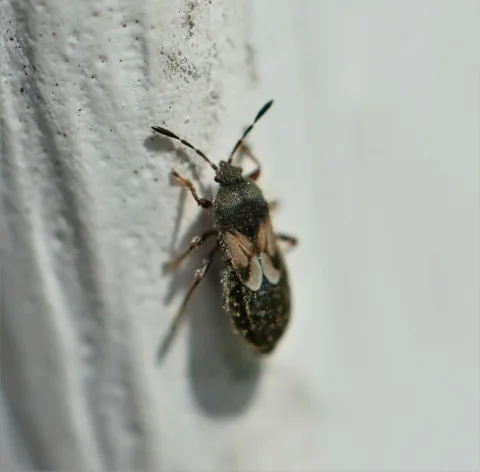 Southern Chinch Bug
Blissus insularis
The southern chinch bug is a tiny sap-sucking bug and the most important insect pest of St. Augustinegrass lawns in the southern United States. Feeding groups kill grass in spreading, irregular patches, often first in hot, dry, sunny spots.
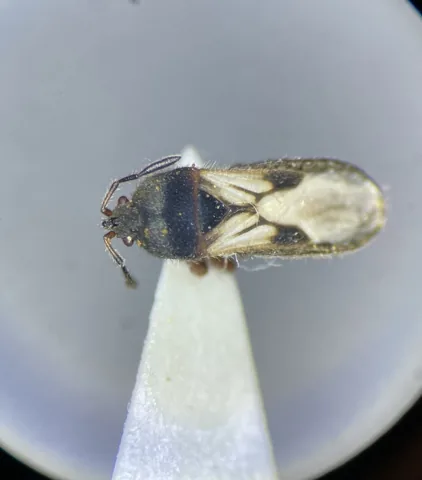 Hairy chinch bug
Blissus leucopterus hirtus
The hairy chinch bug is the chinch bug of northern lawns. Adults and nymphs hide in the thatch and suck sap from grass stems, and the saliva they inject clogs the plant's water-conducting tissue, so patches turn yellow, then brown, and can die in hot, dry weather even when watered.
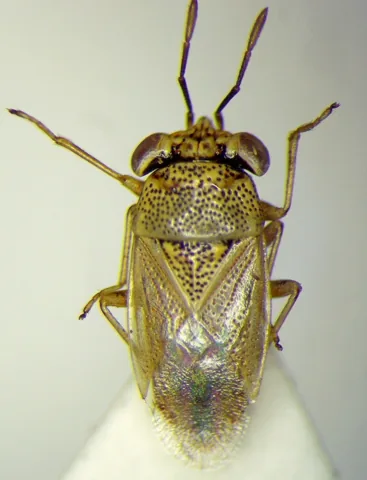 Bigeyed Bugs
Geocoris species (e.g., G. punctipes)
Bigeyed bugs are small true bugs that hunt mites, aphids, whiteflies and insect eggs on low-growing plants. They resemble chinch bugs, and they're sometimes sprayed by mistake.
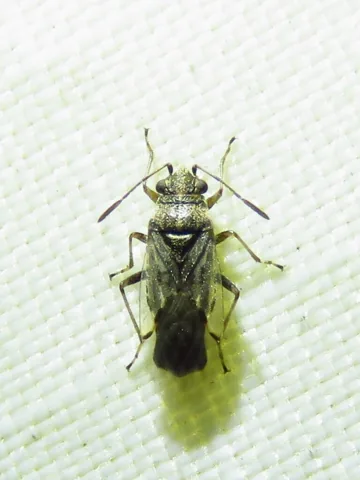 False Chinch Bug
Nysius raphanus
The false chinch bug is a small gray insect that breeds on weeds in fields, pastures and foothills. When those weeds dry up, huge numbers migrate into yards, gardens and homes, sometimes so many that the ground seems to move.
No photo yet
Western chinch bug
Blissus occiduus
The western chinch bug is a small black true bug that has become a serious pest of buffalograss lawns in Nebraska and, more recently, of zoysiagrass. It feeds on sap in the grass crowns, and damage shows up as patches that yellow and then dry to straw brown.
Which chinch bug is in your lawn
Several closely related Blissus species attack turf, and they're very hard to tell apart in the field. Ohio State says most people identify them by where they live and what grass they're on.[2]
- Southern chinch bug (Blissus insularis): the main chinch bug of St. Augustinegrass, which it seriously damages; it also feeds on zoysiagrass, bermudagrass and centipedegrass, and Texas A&M adds bahiagrass. Texas A&M calls it one of the most important insect pests of St. Augustinegrass, and a 2014 study calls it the most destructive.[1][3][7][8][12]
- Hairy chinch bug (Blissus leucopterus hirtus): the most common chinch bug in northern lawns. It prefers Kentucky bluegrass, fine fescues, perennial ryegrass, bentgrass and zoysiagrass, and its range runs through the northeastern states into southern Canada.[2][5]
- Common chinch bug (Blissus leucopterus leucopterus): mainly a pest of sorghum, corn and wheat, found from South Dakota to Virginia and south to about mid-Texas and mid-Georgia. It occasionally damages bermudagrass, fescue, Kentucky bluegrass, ryegrass and zoysiagrass lawns.[2][3]
- Western chinch bug (Blissus occiduus): a pest of buffalograss. In Nebraska greenhouse tests it did little damage to other turfgrasses.[13][11]
What chinch bugs look like
All chinch bugs go through egg, five nymphal stages and adult, and the different species look nearly the same, so an expert is needed to separate them.[2][7]
- Adults: black with white wings that lie flat over the back, each wing with a black triangular mark. Sizes given by extension sources run from about 1/8 inch (UC IPM) to 1/6 to 1/5 inch (Texas A&M, Wisconsin) and 3/16 inch (Washington State); Ohio State gives about 3.5 mm.[3][4][8][6][2]
- Some adults are long-winged and can fly; others are short-winged and can't.[2][3][1][8]
- Young nymphs: wingless, bright orange to red with a white or cream band across the abdomen. They darken with each molt, and the last nymphal stage is black or brownish-black with visible wing pads.[1][2][3][4][7]
- Where they hide: in the thatch and around the base of the grass, so you usually have to part the grass to see them. When numbers are high, adults and large nymphs walk onto sidewalks and climb the sides of light-colored buildings.[2][4][3][7]
Chinch bug damage or drought?
Chinch bugs feed with a needle-like beak and inject saliva that is toxic to the grass. The grass yellows, wilts as if dry and dies. Damage starts as irregular yellow patches that turn brown, keep spreading outward and can merge, often with a ring of yellowing grass around the dead center.[2][1][4][3]
Ohio State and Washington State say the patches keep dying even when the lawn is watered, and Wisconsin says damaged lawns look drought-stressed even with enough soil moisture. The saliva can keep plants wilting and yellowing after the bugs have been killed.[2][6][4]
- Where it shows first: hot, sunny spots such as slopes and grass along driveways, sidewalks and roads. Shaded grass tends to show less damage.[1][4][3][6]
- When: mostly during hot, dry weather. In the North, Ohio State gives June into September and Wisconsin late June until the first frost. UC IPM says southern chinch bugs are active from April through October.[2][4][8]
- Brown patch disease vs. chinch bugs: Texas A&M says brown patch in St. Augustinegrass usually forms circular or half-circle patches, while chinch bug damage forms irregular dead areas.[3]
- No bugs, no chinch bug problem: Texas A&M says dead spots without high chinch bug numbers are probably from something else, such as too little water, white grubs or disease. Finding the bugs is the best proof.[3]
The flotation (coffee-can) test
Parting the grass and looking works when there are lots of bugs, but small nymphs and eggs hide deep in the thatch and are easy to miss. Floating them out is more reliable.[2][1][7][4]
- Make the sampler: cut both ends out of a large can, such as a coffee can or 1-gallon can. Georgia also suggests a 4-inch piece of PVC pipe.[1][2][3][7]
- Pick the spot: sample at the edge of a yellowing patch where green grass meets dying grass, not in the dead center. Take several samples from different parts of the lawn.[1][5][4][3]
- Set it: twist the can through the grass and thatch into the soil. UC IPM says 2 to 3 inches deep, Georgia up to 3 inches. Texas A&M suggests cutting the grass around the rim with a knife if needed.[2][8][7][3]
- Fill and watch: fill the can with water and top it off as it soaks in. Wisconsin suggests stirring the grass with your hand. Clemson says both adults and nymphs should float up within 5 minutes; Ohio State, Texas A&M and New Hampshire count over about 10 minutes.[1][2][4][3][5]
- Check what floats: bigeyed bugs, which eat chinch bugs, often turn up in the same samples. See the look-alike section below before counting.[4][3]
How many is too many
Sources set different action levels, partly because they use different can sizes:[3][8][4][5][7][1][2]
- Texas A&M: more than 2 bugs per sample, on average, in a 4-inch can, or 4 to 5 or more in a 6-inch can. Damage normally appears at about 20 to 25 per square foot.[3]
- UC IPM: an average of at least 3 nymphs and adults per 6-inch coffee can, or 135 per square yard.[8]
- Georgia: more than 3 in a flotation sample. Georgia notes populations can reach over 100 per square foot at the edges of patches.[7]
- Wisconsin: an average of 2 to 3 per test area. New Hampshire: 10 or more in a can means a problem.[4][5]
- Per square foot: Clemson gives 20 to 25, and Ohio State 25 to 30, especially in June and July.[1][2]
Thatch, watering and fertilizer
Lawn care decides how bad chinch bugs get. Texas A&M says good water, fertilizer and thatch management dramatically reduce the need for insecticides.[3][1]
- Thatch: chinch bug numbers rise with thatch. Texas A&M says thatch shelters the bugs and binds many insecticides so they work less well. Mow often enough that you remove no more than 35 to 40% of the blade at a time, and if thatch is more than 1 inch thick, vertical mowing (dethatching) may be needed while the grass is actively growing. Aeration and a thin top dressing of soil or compost also help it break down.[3][7][1][6]
- Fertilizer: chinch bugs favor lush, heavily fertilized grass. Texas A&M suggests no more than 3 to 4 pounds of nitrogen per 1,000 square feet a year on St. Augustinegrass in sun and no more than 2 pounds in shade, with slow-release sources. UC IPM says using the low end of recommended nitrogen slows chinch bug reproduction.[1][3][8][2]
- Mowing height (northern lawns): Wisconsin suggests 2 1/2 to 3 1/2 inches, and New Hampshire no shorter than 3 inches.[4][5]
Should you water more?
Most sources say yes. Chinch bugs do best in hot, dry conditions, and drought-stressed grass suffers more damage. Texas A&M says dry weather helps nymphs and eggs survive by cutting disease in the bugs, and Wisconsin says wet weather slows them and favors a natural fungus disease. Wisconsin and Washington State recommend regular irrigation in hot, dry periods, and UC IPM says adequate moisture helps grass tolerate feeding and promotes the fungus.[3][4][6][8][5]
Water deeply rather than often. Texas A&M says to water St. Augustinegrass when blade edges start to curl, the grass doesn't spring back quickly when walked on, or the lawn turns dull bluish-gray, wetting the soil about 6 inches deep and letting it dry between waterings. Frequent light watering makes shallow roots and raises the risk of injury, and soggy soil slows thatch breakdown.[3]
Ohio State disagrees for hairy chinch bugs in northern lawns. It says newer research found the fungus Beauveria bassiana has more effect when turf goes into summer dormancy, so letting the lawn go dormant in hot, dry weather should reduce hairy chinch bug numbers. Ohio State also says chinch bug damage keeps spreading regardless of irrigation once it starts.[2]
Resistant grasses and endophytes
Endophytes are fungi that live inside some grass plants. Ohio State says perennial ryegrasses, fine fescues and tall fescues with endophytes are highly resistant to hairy chinch bugs, and recommends reseeding damaged lawns with endophyte-enhanced seed. Washington State says the same for ryegrasses and fescues with high endophyte levels.[2][6]
In an Ohio State study, chinch bug damage and numbers in perennial ryegrass fell as the share of endophyte-infected plants rose, even when chinch bugs were very abundant. A Nebraska greenhouse study, though, found endophyte-free and endophyte-enhanced fine fescues both moderately to highly susceptible to hairy chinch bugs.[10][11]
Ohio State says lawns with 50% or more Kentucky bluegrass are the most likely to be attacked. New Hampshire warns that endophyte-enhanced seed can harm livestock, so follow the label on where it can be used.[2][5]
- St. Augustinegrass: 'Floratam' controlled southern chinch bugs in the Southeast from 1973 on, but populations in Florida and Texas have overcome it. Texas A&M says it no longer appears resistant, and Georgia lists it as susceptible along with 'Seville' and 'Raleigh'. Clemson says there are indications chinch bugs are overcoming it in parts of Florida, and UC IPM's guidelines still list it as resistant.[12][3][7][1][8]
- Newer options: Georgia says 'FX-10' and 'Captiva' are resistant based on recent research, and UC IPM lists FX-10 and 'Floralawn'. Common types such as 'Texas common' and 'Raleigh' are highly susceptible.[7][8][3]
Bigeyed bugs: the look-alike to leave alone
Bigeyed bugs (Geocoris species) are predators that kill large numbers of chinch bugs. They're about the same size and shape, so they're often mistaken for chinch bugs in flotation samples.[2][3][4][7]
- Head and eyes: bigeyed bugs have a wide head with large, bulging eyes, and the head is at least as wide as the thorax. Chinch bugs have smaller eyes and a narrower, somewhat triangular head.[9][3][8]
- Body: chinch bugs are more slender for their length; bigeyed bugs are oval.[9][3]
- Wings: bigeyed bugs lack the chinch bug's white wings with black triangular marks.[3]
- False chinch bugs (family Lygaeidae) are another plant-feeding look-alike with small eyes and a slender body.[9]
Natural enemies
Besides bigeyed bugs, chinch bugs are attacked by minute pirate bugs and other predatory bugs, spiders, ants, earwigs and small parasitic wasps that attack the eggs. Texas A&M warns that repeated insecticide sprays can kill these predators and actually increase chinch bug numbers.[3][7][8][2]
Natural enemies have limits. Ohio State says bigeyed bugs usually don't build up until considerable damage has been done, and the egg parasite doesn't build up fast enough to control hairy chinch bugs.[2]
Sources disagree on fungus products. Ohio State says Beauveria bassiana applications won't reduce hairy chinch bugs below damaging levels, and Texas A&M says there are no consistently effective fungal controls and that beneficial nematodes have given inconsistent results. Georgia says Beauveria can be used against southern chinch bugs as long as the thatch and soil stay moist.[2][3][7]
Insecticides: what and when
When chinch bugs are at damaging numbers, an insecticide can stop further injury. Texas A&M lists carbaryl and pyrethroids such as bifenthrin, cyfluthrin, lambda-cyhalothrin and permethrin for home lawns; Wisconsin recommends bifenthrin, carbaryl and cyfluthrin for home use.[3][4]
Ohio State says pyrethroids labeled for chinch bugs give the fastest knockdown, in 3 to 5 days, while most neonicotinoids give satisfactory control within 7 to 10 days. Nebraska researchers note that neonicotinoids are generally not recommended for chinch bugs because of inconsistent control, and Texas A&M's list for professionals includes imidacloprid for suppression only. UC IPM's turf guidelines rank chlorantraniliprole first and say to apply when bugs are first seen and before eggs hatch.[2][13][3][8]
- Liquids: chinch bugs live at the surface and in the thatch, so Ohio State and Texas A&M say not to water in liquid sprays, which would wash the insecticide past them into the soil. Texas A&M says watering before the spray helps it penetrate, and UC IPM says to mow and irrigate before treating, then not mow or irrigate for at least 24 hours.[2][3][8]
- Granules: many need a light watering to release the insecticide. Texas A&M suggests 1/8 to 1/4 inch of water after spreading, and a drop spreader to keep granules off sidewalks and drives; sweep up any that land on pavement.[3][2]
- Even coverage: Texas A&M says hose-end sprayers usually put out 15 to 20 gallons of water per 1,000 square feet and suggests spraying back and forth over the same area. The calibration guide linked below shows how to check what your sprayer or spreader actually puts out.[3]
- Spot treatments: where damage is limited to a few areas, treat the off-color grass and the surrounding infested area rather than the whole lawn, which also spares beneficial insects.[3]
- Preventive sprays: in lawns with a history of chinch bugs, Ohio State and New Hampshire describe early treatments in about April or May to early June, when overwintered adults and young nymphs are active. Wisconsin says a single early May application may give season-long control where chinch bugs return year after year, but not to treat on a routine schedule otherwise. New Hampshire says to sample first.[2][5][4]
- Read the label: make sure chinch bugs and your site are listed, and keep people and pets off until the treated area dries or the label's re-entry time has passed.[3][1]
Insecticide resistance in southern chinch bugs
Southern chinch bugs have a history of beating control methods. Clemson says that in many parts of Florida they resist older organophosphate and carbamate insecticides, and Texas A&M reported bifenthrin resistance in parts of Florida. Georgia's 2026 circular says some populations now resist imidacloprid, bifenthrin, lambda-cyhalothrin and deltamethrin, though it's less likely that all populations do.[1][3][7]
To slow resistance, Georgia recommends rotating treatments and avoiding repeated applications of the same insecticide. UC IPM says to rotate products with different mode-of-action group numbers and not to use the same group more than twice a season.[7][8]
Georgia also notes reports that combining a pyrethroid with a neonicotinoid has managed resistant populations. Using insecticides only when counts call for it also spares the predators that help keep chinch bugs down.[7][3]
Getting the lawn back
Ohio State says lightly damaged turf recovers fairly quickly with light fertilizer and regular watering. Heavily infested lawns can lose a lot of grass and need overseeding, which often happens just as crabgrass and other summer weeds are germinating, so weed control may be needed too.[2]
In the North, reseed with endophyte-enhanced ryegrass or fescue. In the South, consider a resistant St. Augustinegrass cultivar suited to your area.[2][6][7]
Common questions
- How do I know if I have chinch bugs or drought?
- Do a flotation test at the edge of a yellowing patch. Grass damaged by chinch bugs doesn't recover with watering, and the patches keep spreading.[2][6][3]
- How many chinch bugs per coffee can is a problem?
- It depends on the source and can size: more than 2 in a 4-inch can or 4 to 5 in a 6-inch can (Texas A&M), at least 3 per 6-inch can (UC IPM), more than 3 (Georgia), 2 to 3 (Wisconsin) or 10 or more (New Hampshire).[3][8][7][4][5]
- Should I water my lawn to stop chinch bugs?
- Most sources say deep, regular watering in hot, dry spells helps, because dry conditions favor chinch bugs. Ohio State says letting northern lawns go summer-dormant may reduce hairy chinch bugs.[3][4][8][2]
- Is a bug with big eyes in my lawn a chinch bug?
- Probably not. Bigeyed bugs have wide heads and bulging eyes, lack the chinch bug's white wings with black marks, and eat chinch bugs.[9][3]
- Is Floratam St. Augustinegrass still resistant to chinch bugs?
- Not reliably. Populations in Florida and Texas have overcome it, and Georgia lists it as susceptible. Georgia names FX-10 and Captiva as resistant.[12][3][7]
- Should I water in chinch bug insecticide?
- Not liquids; the bugs live at the surface. Many granules need a light watering, about 1/8 to 1/4 inch, to release the insecticide.[2][3]
- When do chinch bugs damage lawns?
- Mostly in hot, dry weather: June into September in the North and from about April through October for southern chinch bugs.[2][4][8]
Photo credits
- Southern Chinch Bug: (c) Barry Cottam, some rights reserved (CC BY) — via iNaturalist, CC BY 4.0
- Hairy chinch bug: (c) Jacob Weston, some rights reserved (CC BY) — via iNaturalist, CC BY 4.0
- Bigeyed Bugs: (c) Konstantin Grebennikov, some rights reserved (CC BY) — via iNaturalist, CC BY 4.0
- False Chinch Bug: (c) Annika Lindqvist, some rights reserved (CC BY) — via iNaturalist, CC BY 4.0
Sources
- Clemson Cooperative Extension Home & Garden Information Center, “Chinch Bugs, HGIC 2487 (C. S. Gorsuch).” hgic.clemson.edu/factsheet/chinch-bugs/ (accessed 2026-11-10)
- Ohio State University Extension, “Chinch Bugs in Turfgrass, HYG-2503 (D. J. Shetlar, J. Andon, 2012).” ohioline.osu.edu/factsheet/HYG-2503-11 (accessed 2026-11-10)
- Texas A&M AgriLife Extension, “Chinch Bugs in St. Augustine Lawns, E-420 (M. E. Merchant, D. A. Mott).” agrilifeextension.tamu.edu/wp-content/uploads/2025/05/Chinch-Bugs-in-San-Augustine-Lawns.pdf (accessed 2026-11-10)
- University of Wisconsin-Extension, “Turfgrass Disorder: Chinch Bug, A3237 (R. C. Williamson, D. L. Mahr, R. Kachadoorian, 2005).” hort.extension.wisc.edu/files/2023/12/A3237-1.pdf (accessed 2026-11-10)
- University of New Hampshire Extension, “Hairy Chinch Bug [fact sheet].” extension.unh.edu/resource/hairy-chinch-bug-fact-sheet (accessed 2026-11-10)
- Washington State University Extension, “Lawn and Turf: Chinch bugs (Hortsense).” hortsense.cahnrs.wsu.edu/fact-sheet/chinch-bugs/ (accessed 2026-11-10)
- University of Georgia Cooperative Extension, “Southern Chinch Bug: Biology and Management in Turfgrass, Circular 1147 (S. V. Joseph, 2026).” fieldreport.caes.uga.edu/publications/C1147/ (accessed 2026-11-10)
- UC Statewide IPM Program, “Southern Chinch Bug, Turfgrass Pest Management Guidelines.” ipm.ucanr.edu/agriculture/turfgrass/southern-chinch-bug/ (accessed 2026-11-10)
- UC Statewide IPM Program, “Bigeyed Bugs, Natural Enemies Gallery.” ipm.ucanr.edu/natural-enemies/bigeyed-bugs/ (accessed 2026-11-10)
- Journal of Economic Entomology (PubMed 10985027), “Richmond DS, Shetlar DJ. Hairy chinch bug damage, population density, and movement in relation to the incidence of perennial ryegrass infected by Neotyphodium endophytes. J Econ Entomol 2000;93(4):1167-72.” pubmed.ncbi.nlm.nih.gov/10985027/ (accessed 2026-11-10)
- Journal of Economic Entomology (PubMed 16573341), “Anderson WG, Heng-Moss TM, Baxendale FP. Evaluation of cool- and warm-season grasses for resistance to multiple chinch bug species. J Econ Entomol 2006;99(1):203-11.” pubmed.ncbi.nlm.nih.gov/16573341/ (accessed 2026-11-10)
- Journal of Economic Entomology (PubMed 25195463), “Youngs KM, Milla-Lewis SR, Brandenburg RL, Cardoza YJ. St. Augustine grass germplasm resistant to Blissus insularis. J Econ Entomol 2014;107(4):1688-94.” pubmed.ncbi.nlm.nih.gov/25195463/ (accessed 2026-11-10)
- Journal of Economic Entomology (PubMed 21404859), “Stamm MD et al. Dose-response relationships of clothianidin, imidacloprid, and thiamethoxam to Blissus occiduus. J Econ Entomol 2011;104(1):205-10.” pubmed.ncbi.nlm.nih.gov/21404859/ (accessed 2026-11-10)