On this page
How to identify it
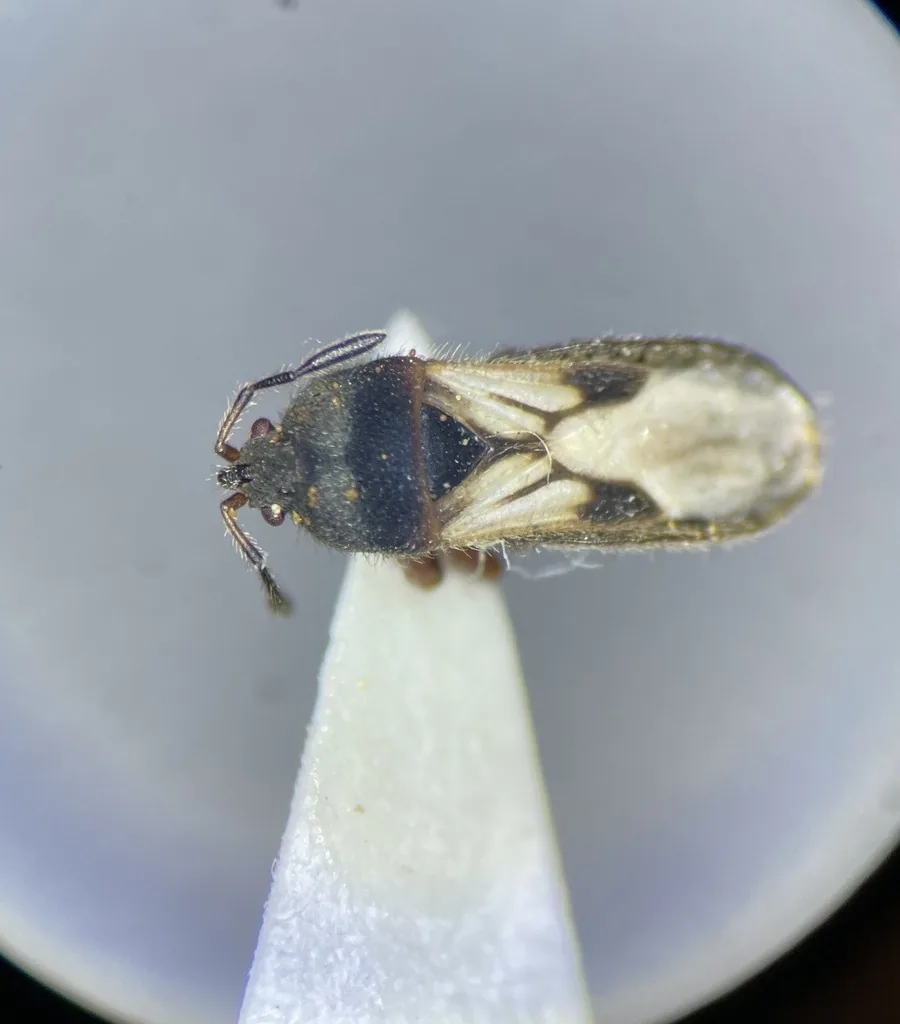
- Adults are about 3.5 mm long (Wisconsin puts it at 1/6 inch) and gray-black, with fine hairs on the body and reddish to burnt-orange legs. The white wings have a black spot at the middle of the front edge and fold over the back in a white triangle.[1][2]
- Some adults are short-winged and some full-winged, and only the full-winged ones can fly.[1]
- Newly hatched nymphs are bright orange to red with a pale band across the body. They darken as they grow (Ohio State describes purple-gray middle stages with two black spots; Wisconsin, red to brown to black), and the fifth and last nymphal stage is black, about 3 mm long, with visible wing pads.[1][2]
- The hairy chinch bug and the common chinch bug look almost identical. Ohio State notes that an expert is needed to separate the species and subspecies, so most people go by location and host plant.[1]
Look-alikes
| Look-alike | How to tell them apart |
|---|---|
| Big-eyed bugs | About the same size and shape as chinch bugs and often mistaken for them, but big-eyed bugs are predators that kill large numbers of chinch bugs. They turn up in flotation tests too, so sort out what floats before deciding to treat.[1][2] |
| Southern chinch bug | Ohio State notes that southern and western chinch bugs live where their names suggest, while the hairy chinch bug is the one in northern turf. All Blissus chinch bugs look very similar, so location is the practical guide.[1] |
Where it lives
The hairy chinch bug occurs throughout the northeastern states and into southern Canada, and it shares part of the northern range of the common chinch bug, which Ohio State maps from South Dakota to Virginia and south to about mid-Texas and mid-Georgia. Wisconsin Extension reports serious chinch bug injury to some Wisconsin lawns every year.[1][2]
Biology and life cycle
The hairy chinch bug prefers Kentucky bluegrass, fescues, perennial ryegrass, bentgrass and zoysiagrass, and Ohio State finds lawns with 50 percent or more bluegrass the most likely to be attacked. In Wisconsin, fescues and bentgrasses are the grasses most often damaged. The closely related common chinch bug prefers grain crops such as corn, sorghum and wheat but can also move into turf.[1][2]
Adults spend the winter in the thatch and at the bases of grass stems, and in tall bunch-type grass. Wisconsin adds plant debris and the ground around house foundations. Nymphs that have not matured by the time cold weather arrives do not survive the winter.[1][2]
Adults become active and mate when temperatures reach about 70°F. Females insert their eggs into the folds of grass blades or into the thatch, mostly from mid-April into June between New York and Illinois, and Ohio State reports that one female may lay up to 200 eggs over 60 to 80 days.[1][2]
The eggs are tiny, about 0.84 mm long, white at first and bright orange just before they hatch. They take 20 to 30 days to hatch below 70°F and as little as a week above 80°F.[1]
Nymphs feed by inserting their mouthparts into grass stems, usually under a leaf sheath, and pass through five stages. They grow slowly in cool spring weather and faster as it warms; Wisconsin gives 4 to 7 weeks from hatching to adult, depending on temperature.[1][2]
The first generation usually matures by mid-July. A second generation develops over the summer and may mature from late August into September, and in a long season adults may start a partial third generation, though most of those late nymphs do not mature before winter. Wisconsin sees two generations a year, or only one in the coolest parts of the state.[1][2]
Warm, dry weather early in the season followed by little rain favors chinch bugs. Wet weather slows their buildup and favors a naturally occurring fungus disease that kills them.[2]
Damage and signs
- Damage first shows as irregular yellow or reddish patches in hot, sunny parts of the lawn, often on slopes and along sidewalks and driveways. The patches turn brown and keep spreading outward, and the grass eventually dies regardless of watering.[1][2]
- As they feed, the bugs inject saliva into the grass. Ohio State explains that it clogs the plant's vascular tissue, giving the grass a purplish tint and keeping water and food from moving, so the leaves wither as if in drought. Wisconsin notes that the toxin keeps plants wilting and yellowing even after the bugs have been controlled.[1][2]
- Injury usually shows in hot, dry weather from June into September. Wisconsin finds it most obvious in late summer and early fall, though it can appear any time from late June until the first frost, and a heavily infested lawn can look brown and droughty with a slight pink cast.[1][2]
- The damage can look like drought stress, other insect injury or a turf disease, which is why both fact sheets rely on finding the bugs themselves before treating.[1][2]
Health risk
A lawn pest. The Ohio State and Wisconsin fact sheets describe damage to grasses only and mention no risk to people or pets.[1][2]
Control
Prevention
Keep the lawn healthy so it can tolerate a small infestation: mow at 2.5 to 3.5 inches, control weeds and diseases, and fertilize properly without overdoing it. Ohio State warns that overfertilized, lush turf only attracts more chinch bugs.[2][1]
Where chinch bugs are a repeat problem, reseed with resistant grass. Ohio State lists perennial ryegrasses, fine fescues and tall fescues with endophytes as highly resistant and recommends reseeding damaged lawns with endophytic turf.[1]
Advice on watering differs. Wisconsin's list of lawn practices includes frequent irrigation during hot, dry periods. Ohio State reports recent research suggesting the Beauveria bassiana fungus hits chinch bugs harder once turf goes summer-dormant, so letting the lawn go dormant in hot, dry weather should reduce hairy chinch bug numbers.[2][1]
Biological control
When they are numerous enough, big-eyed bugs, spiders and other predators do a lot to keep chinch bugs in check. Ohio State adds that big-eyed bugs usually build up only after considerable damage, commercial Beauveria bassiana products did not bring hairy chinch bugs below damaging levels in studies, and the known egg parasitoid does not multiply fast enough to control them.[2][1]
Pesticides
Treat only when sampling shows damaging numbers, not as a routine preventive. Ohio State treats 25 to 30 bugs per square foot as the level that warrants control, especially in June and July, while Wisconsin suggests treatment may be needed at an average of two to three chinch bugs per test area.[2][1]
On lawns where chinch bugs have caused damage year after year, one early-season application can be used instead. Wisconsin mentions a single early May treatment; Ohio State gives April or early May to early June, after adults finish their spring movements and young nymphs become active.[2][1]
Wisconsin's fact sheet lists bifenthrin, carbaryl and cyfluthrin for home use and notes that insecticidal soaps are registered but largely untested. Ohio State reports that pyrethroids labeled for chinch bugs knock populations down fastest, in three to five days, while most neonicotinoids give satisfactory control in seven to ten days. Read and follow the label.[2][1]
Chinch bugs live at the surface and in the thatch, so liquid sprays should not be watered in, which can wash the insecticide into the soil past the bugs. Some granular products do need irrigation to release the insecticide, so check the label instructions.[1]
Checking a lawn with the flotation test
Chinch bugs hide in the thatch, and eggs and small nymphs are easy to miss just by parting the grass. A flotation test is more reliable.[2][1]
Remove both ends of a coffee can or a one-gallon can and twist it through the turf and thatch into the soil. Fill it with water, topping it up as it soaks in, and stir the grass with your hand. Chinch bugs float to the surface; Ohio State counts adults and nymphs over 10 minutes.[2][1]
Test the edges of yellowing or dying patches and several other parts of the lawn, and sort out predators such as big-eyed bugs from the chinch bugs before deciding to treat.[2]
Common questions
- Why are chinch bugs on my sidewalk and house wall?
- When the first generation matures, usually by mid-July, many adults and large nymphs walk across sidewalks and crawl up light-colored buildings. Wisconsin notes that heavy infestations put bugs on building sides and sidewalks, and adults spend the winter in plant debris and around house foundations.[1][2]
- Will a lawn damaged by chinch bugs recover?
- Lightly damaged turf recovers fairly quickly if it is lightly fertilized and watered regularly. A heavily infested lawn can lose many plants and need overseeding, and because that often falls when crabgrass and other summer weeds are sprouting, extra weed control may be needed.[1]
- Is it the hairy chinch bug or the common chinch bug?
- The two can't be told apart without an expert. Ohio State notes the hairy chinch bug is the one usually found in northern lawns, while the common chinch bug mainly attacks grain crops and only sometimes settles in turf.[1]
Sources
- Ohio State University Extension (Ohioline), “Chinch Bugs in Turfgrass, HYG-2503-11 (2012).” ohioline.osu.edu/factsheet/HYG-2503-11 (accessed 2026-11-08)
- University of Wisconsin-Extension, “Turfgrass Disorder: Chinch Bug, A3237 (R.C. Williamson, D.L. Mahr, R. Kachadoorian).” hort.extension.wisc.edu/files/2023/12/A3237-1.pdf (accessed 2026-11-08)
- iNaturalist, “Blissus leucopterus hirtus taxon page (order and family).” www.inaturalist.org/taxa/522602 (accessed 2026-11-08)