The short answer
- Confirm it first. Tug on grass at the edge of a dead patch. If the stems snap off at the crown and are hollow, with fine, sawdust-like frass inside or around the base, it's billbugs. White-grub-damaged turf lifts like a loose carpet instead, and white grubs have six legs while billbug larvae have none.[1][5][8][4]
- Count the adults in spring. Billbugs walk across driveways and sidewalks on warm days. In New England, seeing two or more a minute on pavement next to a bluegrass lawn in late May or early June means damage to that turf is likely.[7][11][8]
- Time any treatment to the adults or the young larvae. Extension timings for bluegrass billbug run from late April to early May (adults, before egg laying) to June (small larvae). Spraying after the larvae are full-grown usually comes too late.[4][9][10][7]
- For the long run, overseed with endophyte-enhanced perennial ryegrass or fescue, or billbug-resistant cultivars, and keep the lawn watered and fed so it can hide light damage. Beneficial nematodes (Steinernema carpocapsae or Heterorhabditis bacteriophora) can suppress the larvae.[1][7][9][5]
Billbug profile
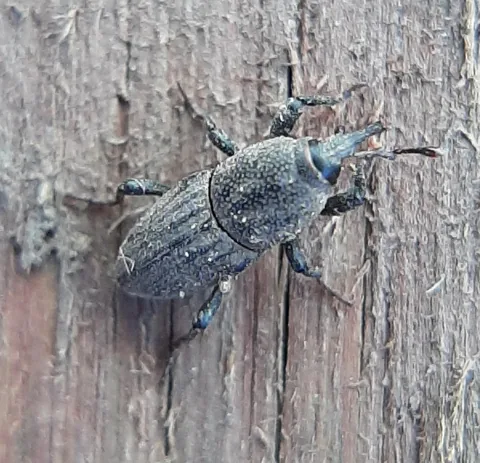
Which billbug is in your lawn
Billbugs are weevils in the genus Sphenophorus. Utah State University Extension says at least 10 species are known turfgrass pests across the United States, in both cool-season and warm-season lawns. The species matters mostly for timing, because their life cycles differ.[5][7]
- Bluegrass billbug (Sphenophorus parvulus): the most common billbug on lawns in Pennsylvania and probably in New England. It prefers Kentucky bluegrass but also attacks perennial ryegrass and fescues. Utah State gives the adult as about 1/4 inch long, black to dark brown, with even pitting on the thorax.[8][7][10][5]
- Hunting billbug (Sphenophorus venatus vestitus): about 1/3 inch (8 to 11 mm) by Utah State's measure, 0.3 to 0.4 inch by NC State's, with a smooth Y-shaped area behind the head and curved marks like parentheses on each side. In California, UC IPM says hunting billbugs prefer zoysiagrass.[5][6][1]
- Phoenix (Phoenician) billbug: Penn State says it is limited to southern California and Arizona, and UC IPM says it is more common in California than the hunting billbug and prefers bermudagrass. On this species the two side marks join into an M.[8][1]
- Rocky Mountain (Denver) billbug: the largest of the group, about 1/2 inch long, per Utah State. Colorado State University Extension says it is far more common in Colorado than the bluegrass billbug, and Penn State gives its range as the Rocky Mountains and northern Great Plains.[5][9][8]
What adults and larvae look like
Adults are hard-bodied weevils with a long, curved snout and elbowed antennae with small clubs at the tips. Colors run from gray and brown to almost black, or red-brown in the hunting billbug, and dried soil can change how they look. They are slow-moving and play dead when disturbed, drawing in their legs and lying still. Utah State notes that adults can't fly but walk a lot, which is why they turn up on sidewalks and short-mown grass on warm days.[5][8][9][10]
Sources give adult lengths from 1/4 inch to 1/2 inch, depending on the species: not quite 1/4 inch for bluegrass billbug in UMass Extension's description, 3/8 inch in Penn State's and New Hampshire's, 3/8 to 1/2 inch in Colorado State's (covering both Colorado species) and about 1/2 inch in Iowa State's.[7][8][11][9][10]
The larvae are the stage that kills grass. They are white or cream-colored, legless and slightly C-shaped, with a hard brown head. The youngest are tiny (about 1/25 inch) and live inside grass stems. Full-grown larvae are 1/4 to 3/8 inch long by Penn State's figures, up to 1/3 inch by Utah State's and 1/3 to 1/2 inch by Colorado State's.[5][1][8][9]
The tug test: billbugs, grubs or drought?
University of Missouri Extension calls billbug damage one of the most commonly misdiagnosed turf problems; it is often mistaken for drought, disease, chinch bugs or white grubs. Iowa State adds sod webworms and plant stress to that list and says to confirm billbugs before applying any treatment.[4][10]
To do the tug test, grab a handful of grass at the edge of a yellow or dead patch and pull gently. Billbug-damaged stems break off at the crown, and they're hollow and packed with fine, sawdust-like frass, which Penn State describes as moist and light brown to straw-brown. UMass Extension calls that sawdusty material positive identification of bluegrass billbug damage.[5][8][7][4]
White grubs feed lower on the roots. UC IPM explains that because billbug larvae feed higher up, billbug-damaged turf breaks at the crown when pulled, but it can't be rolled back like a carpet and the soil doesn't feel spongy underfoot the way it does over a heavy grub infestation. To check the larvae themselves, dig under the thatch: billbug larvae are legless, while white grubs have six legs and curl into a C.[1][2][9]
A soap drench won't show you billbug larvae. UC IPM's soap flush (1 to 2 fluid ounces of dishwashing soap in a gallon of water over a square yard) brings billbug adults, chinch bugs and caterpillars to the surface within 10 minutes, but billbug larvae and white grubs stay put, so you have to dig for them.[2]
Drought and billbugs often go together. Utah State notes that billbugs are more abundant where soil moisture is low and that drought-susceptible Kentucky bluegrass cultivars appear more prone to billbug damage, and Penn State says billbug damage often goes unnoticed during drought.[5][8]
Where and when the damage shows up
Damage starts as scattered, straw-colored or yellow-brown patches and can spread into large dead areas in a heavy infestation. In bluegrass lawns, UMass Extension says it usually appears first along the edges of driveways and sidewalks and can look like salt damage, except that it shows up in July.[8][5][7][9]
Timing of visible damage varies by region: late June through early August in Pennsylvania, late June and early July in Iowa, late July and most of August in New England, late June and July in Colorado, and mid to late summer in Utah.[8][10][7][9][5]
Sources disagree on which lawns are most at risk. Colorado State says billbug injury is most common on new lawns, especially sod lawns. Iowa State says damage rarely occurs in turf less than 3 years old and that lawns with a history of billbug damage are likely to be hit again. UC IPM notes that turf grown on fumigated soil is especially susceptible because natural enemies have been lost, and that drought-stressed turf can be hit hard.[9][10][1]
Counting billbugs: sidewalk counts, pitfall traps and soap flushes
Sidewalk counts are the easiest homeowner check. On sunny days in late May or early June, watch the pavement next to a bluegrass lawn. UMass and New Hampshire Extension both say that seeing two or more adults per minute means damage to the adjacent turf can be expected; UMass gives the example of 12 billbugs in five minutes, followed by visible damage about six weeks later. Iowa State says adults can be spotted on driveways and sidewalks from April through May.[7][11][10]
Pitfall traps catch the walking adults. Utah State describes the simplest version as two nested cups buried to the lip in the soil. Iowa State suggests placing traps at 20-foot intervals where billbugs are suspected and checking them twice a week until the first of June. Penn State considers pitfall trapping impractical for most homeowners and suggests watching sidewalks instead.[5][10][8]
A soap flush can bring adults out of the grass. Iowa State's recipe is 1/4 cup of lemon-scented dish detergent in 2 gallons of water poured over the turf, with any adults surfacing within 15 minutes. Iowa State cites University of Nebraska research that one adult from a soap flush justifies an insecticide.[10]
For larvae, dig. Use a trowel or shovel to cut out a plug in a suspect area and look through the thatch and top few inches of soil. Utah State says billbug larvae usually stay in the top few inches; Iowa State says they usually feed just below the thatch but occasionally 2 to 3 inches down.[5][8][10]
How many is too many
Extension thresholds for billbug larvae vary, and UMass says so directly. UMass suggests 8 to 12 larvae per square foot as a reasonable starting point for moderately maintained lawns in New England. Penn State cites University of Maryland entomologists for an economic threshold of 6 to 8 per square foot. Utah State uses a sampling threshold instead: an average of one or more larvae per cup-cutter plug.[7][8][5]
For adults, the main guides are UMass and New Hampshire's two-per-minute sidewalk count and the University of Nebraska soap-flush figure cited by Iowa State. Below those levels, a well-watered, well-fed lawn can usually tolerate the feeding, according to UC IPM, Utah State and Colorado State.[7][11][10][1][5][9]
Life cycle: why timing is everything
Bluegrass billbugs have one generation a year. Adults spend the winter in leaf litter, thatch, debris near foundations, hedgerows or where turf meets the sidewalk. They become active in spring; Penn State puts this at late April through mid-May once temperatures pass 65°F, New Hampshire at May, and Utah State at March and April, with a peak in early to mid June. Females chew small holes in grass stems and insert eggs.[7][8][9][11][5]
Young larvae feed inside the stem for about two weeks by UMass Extension's account (2 to 3 weeks by Iowa State's), then break out, drop into the thatch and feed on crowns, roots and rhizomes. Penn State says larvae need 5 to 8 weeks to finish growing. They pupate in the soil, and new adults appear from late August into October and move to overwintering sites.[7][10][8][11]
Utah State reports research suggesting a partial second generation in Utah, with some larvae overwintering. Colorado State says most Rocky Mountain billbugs overwinter as larvae and lay eggs through most of the growing season, peaking in June and July.[5][9]
Hunting billbugs in the South run on a longer schedule. NC State says they overwinter as adults or partly grown larvae, lay eggs from May into September, and that larvae are most common from May to October. In California, UC IPM says adults can be found all year and generations overlap, which makes billbugs hard to control with insecticides there.[6][1]
Penn State summarizes a growing degree day model for bluegrass billbug developed by David Shetlar of Ohio State (base 50°F, counted from March 1): first adult activity at 280 to 350 degree days, 30 percent of adults active at 560 to 624, larvae leaving the stems at 925 to 1,035, and severe visible damage at 1,330 to 1,485. Utah State runs its own degree-day model on a different starting date and temperature base, so local numbers differ.[8][5]
When to treat: adults in spring or young larvae
The spring adult window. Missouri, Iowa State and Colorado State recommend treating bluegrass billbug adults in late April to early May, before egg laying. Colorado State moves this to early to mid June for the Rocky Mountain billbug. For hunting billbugs, NC State says to treat when adults leave their overwintering sites but before they lay eggs, and no later than 3 weeks after adults become active.[4][10][9][6]
The young-larva window. UMass Extension says the adults are vulnerable for only about seven to ten days, which makes adult sprays easy to mistime, and that June applications aimed at small larvae are the most reliable timing in New England; New Hampshire gives the same June advice. Colorado State targets early-stage larvae in late spring (bluegrass) to early summer (Rocky Mountain). NC State says to treat hunting billbug larvae about 6 weeks after adults become active, when they've reached the root zone.[7][11][9][6]
Late summer is usually too late. UMass says that once the larvae reach their largest stage it is too late for acceptable control, UC IPM calls curative treatment of billbug grubs difficult, and Penn State says summer rescue applications are usually less effective than spring ones because damage may already be done.[7][1][8]
Treat only where it's needed. NC State says spring preventive applications should be made only on sites with a history of hunting billbugs, and Iowa State says to confirm billbugs are present before treating.[6][10]
Insecticides: which type for which stage
Contact insecticides kill adults on the surface. Pyrethroids such as bifenthrin and lambda-cyhalothrin can control spring adults before they lay eggs, but Colorado State says they don't move into the soil and won't control larvae. Utah State adds that adults keep moving in, so short-lived contact sprays can't stop a later influx.[9][5][6]
Systemic insecticides target larvae inside the plant. The neonicotinoids imidacloprid, clothianidin and thiamethoxam and the diamide chlorantraniliprole are taken up by the grass. UC IPM and Utah State say they work best when applied before eggs hatch, so the insecticide has spread through the plant before the larvae start feeding. Colorado State notes chlorantraniliprole is slow to act (a couple of weeks) and rates it very low hazard to people, pets and bees.[1][5][6][9]
Water it in. UC IPM and NC State both say to irrigate after applying a soil insecticide or nematodes so the material moves through the thatch into the zone where the larvae feed. UC IPM also says not to apply imidacloprid when the turf is waterlogged.[1][6]
Protect bees and slow resistance. UC IPM rates imidacloprid and thiamethoxam highly toxic to bees and clothianidin toxic to bees, and says not to let them drift onto blooming plants where bees are foraging. Colorado State advises mowing off dandelion, clover and other blooms before treating a lawn. Rotate products with different mode-of-action group numbers. Follow the label for rates; this page doesn't give them.[1][9][5]
Resistant grasses and endophytes
Endophytes are beneficial fungi that grow inside some perennial ryegrass and fescue cultivars and make them unpalatable to billbugs and other surface-feeding insects. UMass, Penn State, UC IPM and Colorado State all list endophyte-enhanced ryegrass or fescue as a billbug-resistant choice; UC IPM suggests endophyte-enhanced perennial ryegrass for fall overseeding.[7][8][1][9]
Kentucky bluegrass has no endophytes, but some cultivars resist or tolerate billbugs. Colorado State says resistance comes with fine stems and leaves and tougher plant tissue, and Utah State says drought-resistant bluegrass cultivars suffer less damage. Utah State also reports evidence that mixing bluegrass with endophyte-enhanced grasses helps, and Colorado State says serious billbug problems should largely be avoidable when about a third or more of the plants in a lawn have good resistance. For bermudagrass and zoysiagrass lawns, UC IPM recommends resistant varieties where possible.[7][9][5][1]
When you renovate after billbug damage, Iowa State says to use a blend of grasses known to resist the pest, and Colorado State notes that cultivars that spread more aggressively let damaged areas fill in faster. Ask a seed or sod supplier which cultivars are endophyte-enhanced. Penn State and New Hampshire caution that endophyte-enhanced grass can harm livestock, so follow the seed label about where to use it.[10][9][5][8][11]
Beneficial nematodes and other natural enemies
Insect-parasitic nematodes are the main biological option. UC IPM says commercially available Steinernema carpocapsae or Heterorhabditis bacteriophora often control billbug larvae, especially where the soil has been fumigated, and Colorado State says both can work on larvae and adults. Note the difference from white grubs: Colorado State says Steinernema carpocapsae doesn't control white grubs, so it's a billbug and caterpillar nematode, not a grub one.[1][9][3]
Timing and handling matter. UMass Extension says to time nematodes to the emergence of small larvae, usually late June or early July, and warns that Steinernema carpocapsae dries out easily, so don't apply at midday in midsummer, in low humidity or wind, and water immediately afterward. Utah State says to water before and after, check the expiration date, and expect that several applications may be needed.[7][5][8]
Results are mixed. UMass says field trials in the Northeast have been limited, with somewhat more promising trials in Alabama and Ohio, and Utah State calls the use of insect-killing nematodes and fungi against billbugs limited. Penn State says the naturally occurring fungus Beauveria bassiana, which covers infected billbugs in white, cottony growth, rarely kills enough of them to keep numbers below damaging levels.[7][5][8]
Ground beetles, rove beetles, ants and spiders live in lawns and eat turf pests. Utah State says they eat few billbug adults but may change billbug behavior in ways that shrink the population, and suggests conserving them by planting flowering perennials near the lawn and using fewer or more selective insecticides.[5]
Watering, feeding and recovery
A healthy, well-watered lawn can hide light to moderate billbug damage. UC IPM, Utah State and Colorado State all say good watering, fertilizing and mowing let turf tolerate low billbug numbers and help it repair. Utah State suggests checking that sprinklers work and cover the whole lawn, since billbugs are more abundant in dry areas and dry, drought-stressed spots are more likely to suffer serious damage.[1][5][9]
Penn State notes that fertilizer and water can mask damage but that heavier inputs may not fit a low-input lawn program, which is another reason to lean on resistant grasses over time. When you reseed dead patches, use a blend of billbug-resistant grasses.[8][10]
Common questions
- How do I know if I have billbugs or grubs?
- Pull on the damaged grass. Billbug-damaged stems snap off at the crown and are hollow with sawdust-like frass, but the turf doesn't roll back like a carpet. Grub-damaged sod lifts away, and the grubs underneath have six legs; billbug larvae have none.[1][5][8]
- When is the best time to treat for billbugs?
- Either in spring, against adults before they lay eggs (late April to early May for bluegrass billbug in Missouri, Iowa and Colorado), or against small larvae in June (UMass and New Hampshire). Treatments after the larvae are full-grown in mid to late summer rarely work well.[4][10][9][7][11]
- What do billbugs look like?
- Adults are small gray, brown or black weevils, about 1/4 to 1/2 inch long, with a long curved snout. They often walk across sidewalks in spring and play dead when touched. Larvae are white, legless grubs with a brown head.[5][9][10]
- Do beneficial nematodes kill billbugs?
- They can. UC IPM says Steinernema carpocapsae or Heterorhabditis bacteriophora often control billbug larvae. Apply them to moist turf when small larvae are present, avoid hot, dry or windy weather, and water right away. Field results have been mixed.[1][7][5]
- Will watering get rid of billbugs?
- No, but it helps the lawn hide and outgrow light damage, and billbugs tend to be more abundant where soil moisture is low. Good watering, fertilizing and mowing let turf tolerate low numbers.[5][1][9]
- What grass resists billbugs?
- Endophyte-enhanced perennial ryegrass and fescues, plus some Kentucky bluegrass cultivars with fine, tough leaves or good drought tolerance. Colorado State says problems are largely avoidable when a third or more of the lawn has good resistance.[7][9][5]
Photo credits
- Billbugs: (c) Will Linnard, some rights reserved (CC BY) — via iNaturalist, CC BY 4.0
Sources
- University of California Statewide IPM Program, “Billbugs (Turfgrass Pest Management Guidelines, UC ANR Publication 3365-T).” ipm.ucanr.edu/agriculture/turfgrass/billbugs/ (accessed 2026-11-10)
- University of California Statewide IPM Program, “Monitoring and Treating Insects and Mites (Turfgrass Pest Management Guidelines).” ipm.ucanr.edu/agriculture/turfgrass/monitoring-and-treating-insects-and-mites/ (accessed 2026-11-10)
- University of California Statewide IPM Program, “The UC Guide to Healthy Lawns: Beneficial nematodes.” ipm.ucanr.edu/TOOLS/TURF/PESTS/innem.html (accessed 2026-11-10)
- University of Missouri Extension, “Turfgrass Insects, IPM1020, page 3: Other subsurface-feeding insects (Billbugs).” extension.missouri.edu/publications/ipm1020/3 (accessed 2026-11-10)
- Utah State University Extension, “Billbugs in Turfgrass (D. Wickwar and R. Ramirez, March 2022).” extension.usu.edu/planthealth/research/billbugs (accessed 2026-11-10)
- NC State Extension (TurfFiles), “Hunting Billbugs in Turf (R. Brandenburg and T. Billeisen).” content.ces.ncsu.edu/hunting-billbugs-in-turf (accessed 2026-11-10)
- UMass Amherst Center for Agriculture, Food, and the Environment, “Billbugs in Lawns (P. Vittum).” www.umass.edu/agriculture-food-environment/home-lawn-garden/fact-sheets/billbugs-in-lawns (accessed 2026-11-10)
- Penn State Extension, “Billbugs in Home Lawns (P. Heller).” extension.psu.edu/billbugs-in-home-lawns (accessed 2026-11-10)
- Colorado State University Extension, “Billbug and White Grub Management in Lawns, Fact Sheet 5.516.” extension.colostate.edu/resource/billbug-and-white-grub-management-in-lawns/ (accessed 2026-11-10)
- Iowa State University Extension and Outreach, Yard and Garden, “Bluegrass Billbug (M. Shour and R. Pope).” yardandgarden.extension.iastate.edu/encyclopedia/bluegrass-billbug (accessed 2026-11-10)
- University of New Hampshire Cooperative Extension, “Bluegrass Billbug [fact sheet] (R. Maccini).” extension.unh.edu/resource/bluegrass-billbug-fact-sheet (accessed 2026-11-10)