The short answer
- Trap first. Find a straight, active tunnel by tamping down short sections of ridge and checking which ones are raised again, and set the trap at least 18 inches from a mound.[1][2][6]
- Don't count on grub control. Moles eat earthworms and other soil animals as well as grubs, a grub-free lawn can still have moles, and moles may dig more while searching for food.[1][2][7][6]
- Castor oil repellents have shown some effect on eastern moles, but a repelled mole simply moves on, often to the neighbor's yard. Washington's wildlife agency goes further and says no repellent now available reliably protects lawns from moles.[1][2][7]
- Vibrating, sonic and pinwheel devices, and home remedies such as gum, broken glass or mothballs in tunnels, have not been shown to work.[1][2][6][7]
- Check your state's rules before you buy a trap. In Washington, for example, the state wildlife agency says the traditional mole traps are no longer legal because they grip the body, with no exception for emergencies and no special permits for them, and a 2002 Attorney General opinion reached the same conclusion for traps that pierce the mole's body.[7][4][5]
Tunnelers to tell apart
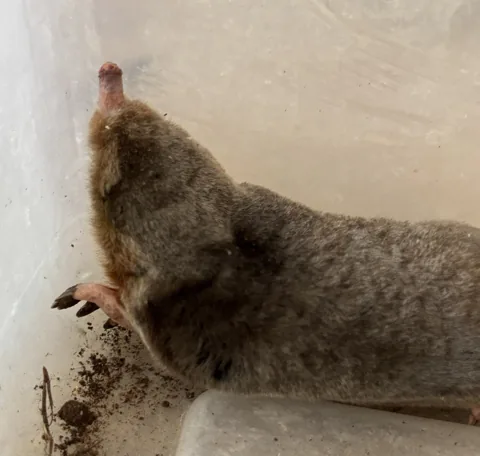 Moles
Talpidae (shown: eastern mole, Scalopus aquaticus; Scapanus species in the West)
Moles are small insect-eating mammals related to shrews, not rodents. They spend almost their whole lives underground hunting earthworms and insects, and their tunneling leaves raised ridges and mounds that disfigure lawns and gardens.
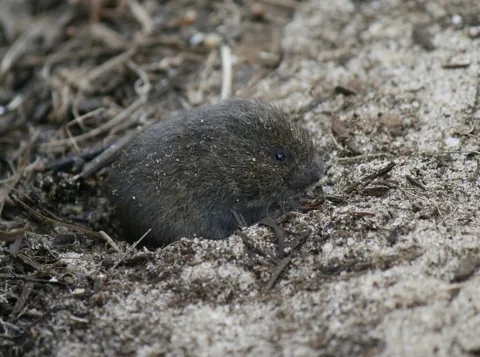 Voles (meadow mice)
Microtus species (shown: meadow vole, M. pennsylvanicus)
Voles, often called meadow mice, are small burrowing rodents that live in dense grass and ground cover. Their clearest sign is a maze of narrow surface runways, and they damage lawns, garden plants and the bark of young trees.
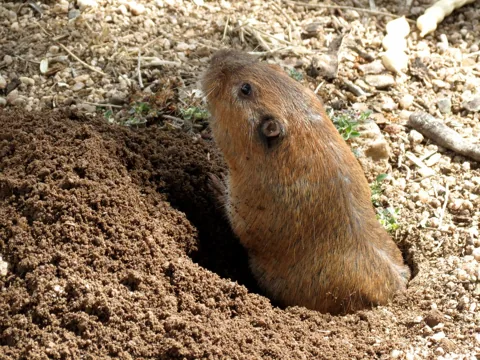 Pocket gophers
Thomomys and Geomys species (shown: Botta's pocket gopher, Thomomys bottae, listed by iNaturalist as Megascapheus bottae)
Pocket gophers are burrowing rodents named for the fur-lined cheek pouches they use to carry food. They rarely come above ground, but a single gopher can ruin a garden quickly by eating roots and pulling plants into its tunnels.
Make sure it's moles
Mole mounds tend to be circular, often with the soil in small chunks, and they often run in a line over the tunnel that connects them. Pocket gopher mounds tend to be crescent-shaped. Moles also push up surface ridges as they tunnel just under the ground. Washington's wildlife agency describes molehills as roughly circular piles 6 to 24 inches across and 2 to 8 inches high, with the plugged burrow opening near the center.[1][7][6]
If roots or bulbs are being chewed, look for a rodent. Moles occasionally eat plant material, but UC IPM says pocket gophers, meadow voles and deer mice are almost always the cause of that kind of damage. Moles and voles often live in the same yard and their damage is often confused, and the controls are different. Penn State says voles and mice often travel through mole runways and do the gnawing, while moles may damage plants by disrupting the roots as they tunnel underneath.[1][2][6][7]
- Moles live almost entirely underground. Shallow feeding tunnels run just below the surface, and the more permanent tunnels are about 2 inches across and 8 to 12 inches deep. Other sources measure differently: Penn State puts the deep runways 12 to 18 inches down, and Washington's wildlife agency says 3 to 12 inches, occasionally as deep as 40, with surface tunnels 1 to 4 inches below ground.[1][6][7]
- They're active all year, though surface activity slows or stops during extreme cold, heat or drought. Activity usually peaks after rain or watering, when digging is easiest. Sources differ on the busy season: Penn State says moles are busiest during rainy periods in summer, while Washington's wildlife agency says digging there is heaviest in fall and winter, when the soil is moist.[1][6][7]
- Moles are territorial, so you'll usually find only one mole per tunnel outside the breeding season, which runs from late winter through early spring. They typically have one litter of three or four young a year. Penn State and Washington's wildlife agency both put litters at three to five young; Penn State says they're born in March or early April.[1][6][7]
- You probably have fewer moles than you think. Penn State says two or three per acre is about the most you'll have and that three to five per acre counts as a high population. Washington's wildlife agency says the average city lot rarely holds more than one male or two female moles.[6][7]
- Washington's moles eat more plant material than most. The state wildlife agency says Washington species are somewhat omnivorous and cites stomach samples from Oregon in which earthworms made up 70 to 90 percent of the Townsend mole's diet, along with grass roots, vegetable roots, bulbs and seeds.[7]
Why killing grubs won't reliably get rid of moles
Moles feed on earthworms, insects and other small soil animals. ICWDM says moles do eat grubs, but they also eat worms and ants, and a lawn can be free of grubs and still have moles. Washington's wildlife agency adds that grubs are only part of the diet and that moles often visit well-watered lawns in dry spells just for the moisture.[1][2][7]
Insecticides often don't reduce mole damage. If the soil insects drop, moles may dig more while they hunt for food, which can mean more damage to turf and gardens, not less. Penn State says any effect on moles usually takes several weeks, and both Penn State and Washington's wildlife agency warn that soil insecticides can harm songbirds or other ground-feeding birds and wildlife; the Washington agency adds that they can kill beneficial soil animals and may poison groundwater.[2][6][7]
UC IPM allows that fewer white grubs may make turf less attractive to moles but says research hasn't confirmed it.[1]
Not every source is as doubtful. Penn State says that if the food supply is removed, moles will be forced to leave, and that milky spore disease can control certain white grubs but may take several years to become established. Washington's wildlife agency says moles may move on only if repeated insecticide use wipes out the earthworms, grubs and other soil animals, and it calls that approach expensive, with no immediate reduction in damage and little chance of long-term control.[6][7]
Finding a tunnel worth trapping
A trap only works where a mole is traveling. Moles dig deep tunnels that they reuse almost permanently, plus a network of surface feeding runs, some of them only temporary, so trap sets in the deeper tunnels are more likely to catch.[1][6]
- Tamp down short sections of surface ridges and mounds, check them every day, and retamp any that are raised again, noting where activity is. Penn State suggests mashing several tunnels down with your foot and checking the next day for the ones that have been repaired.[1][6]
- Choose a straight section with fresh activity. Avoid twisting ridges, and don't set traps on top of mounds; UC IPM says to stay at least 18 inches from a mound.[2][1][6]
- To find a deep tunnel, probe between or next to fresh mounds with a pointed stick, slender metal rod or gopher probe. When the soil suddenly gives way, you've probably hit the burrow.[1]
- Moles can be trapped at any time of year, since they're active year-round. Washington's wildlife agency says it's best to concentrate control efforts in late winter and early spring, before the young are born.[1][7]
Setting the main trap types
When a mole's snout meets a strange object in its tunnel, it tends to plug that section off and dig around or under it. It doesn't avoid loose soil, which it meets naturally from cave-ins, so it digs straight through and springs the trap when its body or the soil pushes on the trigger. That's why traps straddle the tunnel, encircle it or hang above it. Penn State puts it this way: the mole springs the trap following its instinct to reopen a blocked passage.[1][6][7]
Mole traps differ from gopher traps, and very few work on both. Follow the maker's instructions carefully.[1]
- Scissor-jaw traps go in the main tunnel, usually 8 to 12 inches down. Remove a section of soil slightly larger than the trap's width, about 6 inches, and build a plug of moist soil in the middle of the opened tunnel. With the safety catch on, set the trap and wedge it into the burrow with the trigger resting snugly on the plug, scatter loose soil over it to about the top of the tunnel to keep light out, then release the safety catch.[1]
- ICWDM and Penn State describe a different scissor-jaw set, over a straight surface runway rather than in the deep tunnel, with the jaws straddling the run and in line with it; Penn State sets the points of the jaws about 1 inch below the runway. In heavy clay, both say to cut a path for the jaws so they close quickly; ICWDM does it by dry-firing the trap. Cover the set with loose soil or grass so the tunnel stays dark, and mark it with a flag so nobody runs it over with a mower.[2][6]
- Harpoon traps can be set on a soil plug in a deeper tunnel or on the surface over an active ridge. For a surface set, press the ridge down with your thumbs, the width of the trigger, until the trigger sits squarely on the depression, and push the trap's legs into the ground on either side of the run. Don't step on other parts of the run.[1][2][6]
- Pincer-style mole traps are set like pocket gopher traps but are smaller. Probe for a permanent tunnel, dig down to it, place traps deep into each tunnel so no part sticks out, stake it with a wire flag, and cover the hole with loose soil, canvas or plywood to keep out light and air.[1]
- Choker loop traps: Penn State says to dig a hole across the tunnel a little deeper than the tunnel and just the width of the trap, set the trap so its loop circles the run, block the opening with loose, damp soil cleared of gravel, pack soil under the trigger pan so it rests snugly, then fill in with loose soil to the level of the pan to shut out all light.[6]
- Traps set inside the tunnel take less skill and can be hidden from view, but they take more time to check.[2]
Checking traps, and when to move them
- Be patient. It can take several days for a mole to reach a trap, and more traps in more parts of the tunnel system speed things up. Penn State's advice is the same: keep moving the traps until you succeed.[1][6]
- If a trap hasn't caught anything after 2 or 3 days, the mole may have changed its route or the trap may be set wrong. Move it to fresh activity. If the mole dug around the trap, the trap blocked the run; reset it in another part of the tunnel. Penn State says to move a trap after two days, and adds that the runway may have been disturbed too much or the mole may have detected the trap.[2][6]
- Spring a trap before you pull it up, and wear glasses or goggles against flying soil. Don't yank a sprung trap straight out of the ground: check the jaws or tines with a trowel, because the mole may not be caught securely or dead.[2]
- With harpoon traps, leave the tips of the tines in the soil to lower the risk of someone being impaled, and cover the trap with a 5-gallon bucket for extra safety.[2]
- Once the damage stops, keep watching for new mounds. ICWDM warns that where habitat is good and nearby mole numbers are high, other moles often move into areas that have just been emptied. Washington's wildlife agency says moles from nearby readily take over the tunnels left behind, and suggests leveling all the old mounds so fresh ones stand out.[1][2][7]
Barriers for beds, bulbs and raised beds
- To protect an existing planting, bury hardware cloth or 1/4-inch wire mesh in a trench 6 inches wide and at least 2 feet deep, with a 6-inch lip bent at a right angle away from the plants and about 6 inches left above the ground. Galvanized or stainless steel lasts longer.[1]
- For a small area such as a seed bed, ICWDM describes a fence of 24-inch sheet metal or hardware cloth buried at least a foot deep and bent at a 90-degree angle. Penn State gives a similar design: bend 24-inch sheet metal or hardware cloth lengthwise into an L with two 12-inch sides, bury it completely in a trench 12 inches deep and 12 inches wide, and point the foot of the L away from the area you're protecting. That's shallower than the 2-foot trench UC IPM recommends.[2][6][1]
- Barriers give temporary relief, since persistent moles can eventually dig around them. Wire-mesh baskets stop moles from heaving planted bulbs out of the ground, and a wire-mesh bottom on a raised bed keeps moles out completely. Washington's wildlife agency calls underground barriers labor-intensive and costly and recommends them only for exceptional situations.[1][7]
- Packing the soil with a roller, drying it out, or working in heavy clay and rocks makes ground less inviting to moles, but ICWDM notes these changes also hurt the plants, so most people won't accept them.[2]
Repellents, baits and fumigants
- Castor oil repellents: research shows some effect on eastern moles, and none has been published for western species. ICWDM says the product must be watered thoroughly into the lawn (½ inch of water before applying and at least 1 inch after), heavily irrigated areas lose it quickly, the whole area should be treated because moles can tunnel under a perimeter band, and granular castor oil products did less well than liquids in early studies. Follow the label.[1][2]
- Even when a repellent works, it only pushes moles out of the treated area, so in a neighborhood they keep digging next door. Washington's wildlife agency notes that a mole may work one part of its tunnel system, which can run for several hundred feet, for a few days and then move to another part, so a repellent often gets credit for a move the mole was making anyway; when it comes back a week or two later, people assume it's a new mole.[1][7]
- Not everyone accepts castor oil. Penn State's fact sheet says no chemical repellents are currently registered for moles and that one product's registration was canceled in 2005, and Washington's wildlife agency says no repellent now available reliably protects lawns or plantings.[6][7]
- Grain baits rarely work, because moles eat worms and insects; ICWDM says moles may just push grain bait to the surface. Worm-shaped gel baits containing bromethalin, placed in the tunnel, did better than grain baits in limited studies. Follow the label exactly; it's the law.[1][2]
- Penn State says the grain or pelleted baits sold for moles usually carry zinc phosphide, which is highly poisonous to all wildlife, works only when placed in active burrows, must never be broadcast, and in many products is restricted to certified applicators; even then, poisoning usually works less well than trapping. Washington's wildlife agency says poisoned baits have proven ineffective on moles and that a newer gel bait hasn't been on the market long enough to judge for Washington's species.[6][7]
- Burrow fumigation isn't often used for moles, because their burrows are fairly shallow. Aluminum phosphide is a Restricted Use Pesticide that requires a fumigant management plan, and fumigants usually fail in porous, dry soil or where moles use many shallow feeding tunnels. ICWDM notes that aluminum phosphide and charcoal-based gas cartridges are registered against moles in most states, but Penn State says moles can detect the gas and quickly wall off treated tunnels, and Washington's wildlife agency calls gas cartridges and smoke bombs unreliable. Penn State also warns that fumigants can cause severe burns and ignite dry grass and leaves.[1][2][6][7]
What doesn't work
- Frightening devices: mole wheels, pinwheels, vibrating windmills, whistling bottles, and electronic, sonic, magnetic or vibrating stakes haven't been proven to drive moles away. Washington's wildlife agency suggests why: moles are used to the noise and vibration of sprinklers, people walking about and lawnmowers.[1][2][6][7]
- Things pushed into tunnels: broken glass, razor blades, rose thorns, chewing gum, used cat litter, bleach, lye, mothballs, gasoline, ammonia and human hair have proved ineffective, and some are hazardous to the environment. Washington's wildlife agency says moles simply wall off the object and dig around it, and that some of these items are more dangerous to the gardener than to the mole.[1][2][6][7]
- The mole plant, or gopher purge (Euphorbia lathyris): its effect is questionable, it's poisonous to people, and it can become a weed. ICWDM doesn't recommend it. Penn State says the same of the castor bean plant, and adds that marigold borders haven't been scientifically tested.[2][6][1]
- Flooding tunnels: it usually fails and wastes a lot of water, because mole tunnel systems are extensive. Washington's wildlife agency is less dismissive: it says flooding sometimes forces moles out, but only if the whole tunnel system is flooded quickly, and it works best where moles have just moved in. It warns against flooding near a building, which can damage the foundation or flood a basement or crawl space.[1][7][6]
- Cats and dogs: they occasionally kill a mole, but their effect on mole numbers is limited. Washington's wildlife agency says dogs and cats kill moles but rarely eat them, and that barn owls and other raptors, which take young moles as they disperse, may help in rural areas.[1][7]
- Pit traps: they can catch moles, but ICWDM says the time and effort make them impractical.[2]
- Shooting: ICWDM calls it impractical, and Washington's wildlife agency says it's generally limited to rural places and too hazardous in populated areas, even where it's legal.[2][7]
Check the law where you live
- In California, moles are classified as nongame mammals, and an owner or tenant whose property is threatened may control them by any legal means.[1]
- In Pennsylvania, moles are classified as nongame mammals and are protected, but they can be controlled when they're causing damage. Penn State advises checking local laws on which traps, toxicants and other methods are allowed.[6]
- Washington's trapping initiative, I-713, defines a body-gripping trap as any trap that grips an animal's body or part of it, and says cage and box traps, suitcase-type live beaver traps and common rat and mouse traps are not body-gripping traps.[3]
- A 2002 Washington Attorney General opinion concluded that mole traps that pierce the mole's body with a spring mechanism are body-gripping traps and that the initiative prohibits them.[4]
- Washington's Department of Fish and Wildlife can issue a special permit for nuisance animals only for a submerged Conibear-type trap, a padded foothold trap or a non-strangling foot snare, and only after non-lethal methods have failed or can't reasonably be used. The agency's mole page says there are no special permits or verbal approvals for mole traps.[5][7]
- Washington's wildlife agency says moles are unclassified there and that people may trap or kill moles on their own property when they're damaging crops, domestic animals or property, but that since I-713 the traditionally used mole traps, because of their body-gripping design, are no longer legal, with no exceptions for emergencies.[7]
If you can live with them
Moles do some good. Penn State says their tunneling aerates the soil and helps organic matter move deeper, and both Penn State and Washington's wildlife agency note that moles eat lawn and garden pests; the Washington agency names crane fly larvae and slugs. If a mole isn't really causing a problem, both suggest leaving it be.[6][7]
- Rake or shovel molehills away as they appear or before mowing, and reseed large bare spots; Washington's wildlife agency says the rainy months are the time to spread seed.[7]
- Fill sunken runs with sand or screened soil and reseed.[7]
- Check small plants that a mole has heaved up or buried with a mound, and reset or uncover them.[7]
- Letting the grass grow a bit taller, or planting shrubs into old mounds, makes mole activity less noticeable, according to the Washington agency.[7]
Common questions
- Will treating my lawn for grubs get rid of moles?
- Not reliably. Moles also eat earthworms and other soil animals, a lawn with no grubs can still have moles, and moles may dig more while searching for food after the insects are gone.[1][2][7]
- Do castor oil mole repellents work?
- They've shown some effect on eastern moles; nothing has been published for western species. They only move moles out of the treated area, and they need to be watered in well. Penn State and Washington's wildlife agency are more skeptical of repellents in general.[1][2][6][7]
- How long does it take to trap a mole?
- Often several days. If a trap catches nothing in 2 or 3 days, move it to a run with fresh activity, and use more traps to speed things up. Penn State says to move it after two days.[1][2][6]
- Do sonic or vibrating mole stakes work?
- No. Research doesn't support electronic, sonic, magnetic or vibrating devices for moles.[1][2][6][7]
- Are mole traps legal in Washington?
- Washington's wildlife agency says the traditionally used mole traps are no longer legal there because they grip the body, and that no special permits are issued for them. The agency says people may still kill moles that are damaging their property, just not with those traps.[7][4]
- How many moles are in my yard?
- Usually fewer than the damage suggests. Penn State says two or three per acre is about the most you'll have, and Washington's wildlife agency says a typical city lot rarely holds more than one male or two female moles.[6][7]
Photo credits
- Moles: (c) Sam Kieschnick, some rights reserved (CC BY) — via iNaturalist, CC BY 4.0
- Voles (meadow mice): (c) David LaMagna, some rights reserved (CC BY) — via iNaturalist, CC BY 4.0
- Pocket gophers: (c) Katja Schulz, some rights reserved (CC BY) — via iNaturalist, CC BY 4.0
Sources
- University of California Statewide IPM Program, “Pest Notes: Moles.” ipm.ucanr.edu/home-and-landscape/moles/ (accessed 2026-11-10)
- Internet Center for Wildlife Damage Management, “Mole Damage Prevention and Control Methods.” icwdm.org/species/mammals/moles/mole-damage-prevention-and-control-methods/ (accessed 2026-11-10)
- Washington State Legislature, “RCW 77.15.192: Definitions (Initiative Measure No. 713).” app.leg.wa.gov/RCW/default.aspx?cite=77.15.192 (accessed 2026-11-10)
- Washington State Office of the Attorney General, “AGO 2002 No. 3: Applicability of statutory prohibition against 'body-gripping traps' to certain mole traps (June 11, 2002).” www.atg.wa.gov/ago-opinions/applicability-statutory-prohibition-against-body-gripping-traps-certain-mole-traps (accessed 2026-11-10)
- Washington Department of Fish and Wildlife, “How to apply for a special permit to use body-gripping traps.” wdfw.wa.gov/node/21856 (accessed 2026-11-10)
- Penn State Extension, “Moles.” extension.psu.edu/moles (accessed 2026-11-10)
- Washington Department of Fish and Wildlife, “Living with wildlife: Moles.” wdfw.wa.gov/species-habitats/living/species-facts/moles (accessed 2026-11-10)