The short answer
- Confirm it's a gopher: gopher mounds are crescent- or fan-shaped with a plugged hole off to one side. Mole mounds are round, volcano-shaped and plugged in the middle, and ground squirrel holes are open with no mound.[1][4]
- Find the main tunnel with a probe or long screwdriver on the plug side of a fresh mound. When the probe breaks into the tunnel it drops suddenly, about 2 inches per UC IPM.[1][7]
- Trap in the main tunnel with pincer or box traps set in pairs, staked with wire so they can't be dragged off. No bait is needed. Move traps that catch nothing in 1 to 2 days.[1][7]
- Protect beds and new plantings with wire: line raised beds with hardware cloth or 3/4-inch-mesh wire, and plant shrubs and trees in wire baskets.[1][8]
- Skip the gadgets. Vibrating stakes, ultrasonic devices, pinwheels, gopher purge and castor bean plants, chewing gum, and smoke or gas cartridges don't work, per UC IPM and ICWDM.[1][7]
- If you use a toxic bait, put it only inside the main tunnel, never on the surface, and keep it out of food gardens. Dogs, cats and other predators can be poisoned by eating gophers that ate bait, according to one EPA-registered zinc phosphide label.[1][10]
- In western Washington, check first: the Mazama pocket gopher is protected, and lethal control isn't allowed where it lives.[8]
Gopher, mole and vole profiles
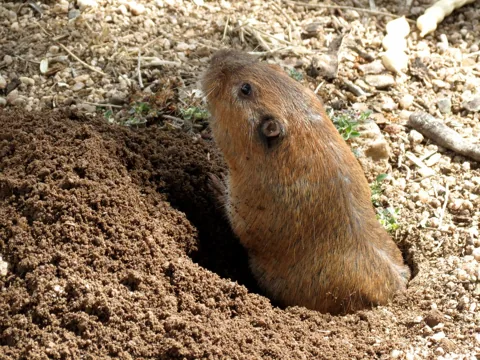 Pocket gophers
Thomomys and Geomys species (shown: Botta's pocket gopher, Thomomys bottae, listed by iNaturalist as Megascapheus bottae)
Pocket gophers are burrowing rodents named for the fur-lined cheek pouches they use to carry food. They rarely come above ground, but a single gopher can ruin a garden quickly by eating roots and pulling plants into its tunnels.
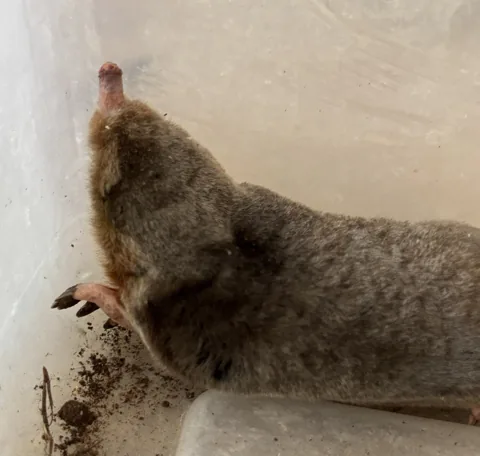 Moles
Talpidae (shown: eastern mole, Scalopus aquaticus; Scapanus species in the West)
Moles are small insect-eating mammals related to shrews, not rodents. They spend almost their whole lives underground hunting earthworms and insects, and their tunneling leaves raised ridges and mounds that disfigure lawns and gardens.
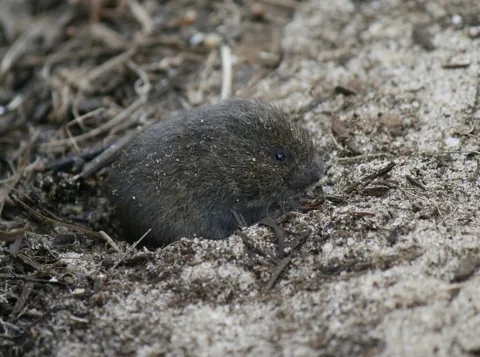 Voles (meadow mice)
Microtus species (shown: meadow vole, M. pennsylvanicus)
Voles, often called meadow mice, are small burrowing rodents that live in dense grass and ground cover. Their clearest sign is a maze of narrow surface runways, and they damage lawns, garden plants and the bark of young trees.
Is it a gopher, a mole or a vole?
The three animals leave different signs, and the fix differs for each. Moles are not rodents and eat mostly worms, insects and other invertebrates, while gophers eat only plants. Voles are mouselike rodents that travel along runways above ground.[2][8][3]
- Pocket gopher mound: crescent-, horseshoe- or fan-shaped from above, with the hole off to one side and usually plugged. ICWDM explains the shape: gophers come up to the surface at a 45° angle, so the mound ends up shaped like a teardrop.[1][4]
- Mole mound: more circular, volcano-shaped in profile, with a plug in the middle that may be hard to see. Moles also push up raised ridges just under the surface as they hunt; gophers don't make these.[1][2][4]
- Vole signs: well-traveled runways above ground, usually hidden under grass or other cover, connecting burrow openings. Voles gnaw bark in irregular patches, with marks about 1/8 inch wide and 3/8 inch long.[3]
- Ground squirrel holes: open, unplugged burrow entrances without a mound.[1]
- Gopher feed holes: an opening with no dirt mound and a circle of clipped plants around it, where a gopher fed a body length or so from its tunnel.[1]
- Soil plugs: WDFW describes a 1- to 3-inch circle of disturbed soil or a small depression where a gopher came out and then plugged the hole behind it.[8]
- Winter casts: in snowy areas, gophers tunnel through the snow and pack the tunnels with soil. After the snow melts, these show up as long ropes of soil on the surface.[1][4][8]
What you're dealing with
Pocket gophers are named for the fur-lined cheek pouches on the outside of the face, which they use to carry food. They have small eyes and ears, large-clawed front feet, and big front teeth they use for digging. Lips that close behind the incisors keep dirt out of their mouths.[1][4][8]
- Size: UC IPM gives 6 to 10 inches long including the short tail for California's species. ICWDM gives 5 to 14 inches across US species, with males larger than females.[1][4]
- Species: ICWDM counts 14 species in 3 genera in the US. Botta's pocket gopher covers most of the southern half of the western US, the northern pocket gopher most of the Northwest, and the plains pocket gopher the central plains from Canada to Texas and Louisiana. The southeastern pocket gopher lives in Florida, southern Georgia and southeastern Alabama, where gophers are sometimes called 'salamanders' and 'gopher' means a tortoise.[4]
- Burrows: a system can cover 200 to 2,000 square feet, per UC IPM. Feeding tunnels run about 6 to 12 inches deep, and the nest and food chamber can be as deep as 6 feet. WDFW gives tunnel diameters of 1¾ to 3½ inches depending on the gopher's size.[1][8]
- Activity: gophers don't hibernate and can be active at any hour, even when you see no new mounds. They usually live alone, one to a burrow system, except for mothers with young and during breeding season.[1][8]
- Breeding: in nonirrigated areas there is usually 1 litter a year, but in irrigated sites UC IPM says gophers can have up to 3, averaging 5 to 6 young. WDFW gives one litter of three to seven young for Washington's gophers.[1][8]
- Lifespan: up to 3 years per UC IPM; WDFW says one to two years.[1][8]
- Health risk: ICWDM and WDFW say gophers aren't a significant disease threat to people or pets, but they bite hard. Wear gloves when handling traps and trapped gophers.[6][8]
What gophers damage
- Garden crops, bulbs and ornamentals: a single gopher moving along a garden row can pull whole plants into its tunnel from below in a short time.[1][8]
- Trees and shrubs: gophers girdle stems, clip and prune roots, and under snow may clip trees and shrubs near ground level or gnaw bark several feet up. Plants with one large taproot suffer most.[6][1][8]
- Irrigation and cables: they gnaw flexible plastic water lines, especially drip tubing, and buried utility cables. Their tunnels can also divert irrigation water and cause erosion.[1][6]
- Lawns: mounds smother grass, get in the way of mowing and spoil the look of turf.[1][6]
Step 1: Find the main tunnel
Trapping and baiting both depend on finding the main burrow. Lateral tunnels lead from the main tunnel up to each mound, and a gopher may not come back to a lateral, so traps and bait there work less well.[1]
Sources differ on how far from the mound to probe: UC IPM says about 4 to 12 inches from the plug side of the mound, and ICWDM says the main burrow is generally 12 to 18 inches from the plug. Start close and work outward.[1][7]
- Pick fresh mounds of dark, moist soil. ICWDM adds that new mounds are darker and taller and their soil doesn't clump.[1][7]
- Use a gopher probe or a long screwdriver. UC IPM says the main burrow is usually 4 to 12 inches deep, and a probe with a tip wider than its shaft makes tunnels easier to feel.[1]
- Feel for the drop: resistance falls suddenly when the probe enters the tunnel.[1][7][9]
- Expect to probe several times. A tunnel the gopher has back-filled with loose soil can feel like an open one, and UC IPM suggests new users dig down to check until they can tell the difference.[1]
- Probing gets easier with practice, and UC IPM says your skill will improve with experience.[1]
Step 2: Trap in the main tunnel
UC IPM calls trapping a safe and effective way to control pocket gophers. ICWDM says all the common gopher traps work and the choice comes down to the size of your gophers and personal preference.[1][7]
- Pincer traps: two-pronged traps the gopher sets off by pushing against a flat pan or wire. Most experienced trappers find them easier to set, and they need less digging. UC IPM says one pincer design can catch larger, mature gophers better than another.[1]
- Box (choker) traps: some beginners find them easier, but setting them in the main tunnel takes more digging, which matters in a lawn.[1]
- Newer insert-style traps go directly into the burrow; UC IPM says little is known yet about how well they work.[1]
- Cage traps: ICWDM describes PVC-tube cage traps at least 12 inches long, darkened except at the bait end. In Washington, live traps are the only traps that don't need a special permit (see state rules below).[7][8]
- Setting: open the main tunnel with a trowel, shovel or hori hori knife and set traps in every tunnel that leads off the opening, since you don't know which part the gopher is in.[1]
- Bait and scent: UC Davis researchers found no benefit from putting food behind the trap and no effect of human scent, though ICWDM notes some trappers use lettuce or alfalfa.[1][7]
- Anchor every trap to a stake with wire or chain so you can pull it out and scavengers can't drag it off. ICWDM warns against string or rope, which gophers chew through.[1][7]
- Covered or open: UC IPM sees little advantage in covering trap sets, and ICWDM says research found no difference between open and closed sets. Cover sets anywhere people or pets go, and cover box traps, because a gopher will often plug the tunnel before hitting the trigger wire of an uncovered box trap. A sheet of 1/2-inch plywood with soil sifted around the edges keeps the hole dark and keeps feet out.[1][7]
- Check and move: check traps often. If nothing is caught within 1 to 2 days (48 hours per ICWDM), reset the traps somewhere else. Keep trapping until no new mounds appear.[1][7]
- Timing: ICWDM says burrowing picks up in spring and fall, that trapping works best in spring and fall, when gophers are pushing up new mounds, and that trapping in winter where possible lowers the spring breeding population. In irrigated lawns and gardens, UC IPM and WDFW say mounds can appear any time of year.[7][5][1][8]
Step 3: Protect plants with wire baskets and underground fencing
Barriers take work and money, but WDFW recommends them for small areas and valuable plants. UC IPM and WDFW warn that no barrier is permanent: gophers can dig under it, and WDFW notes they can dig much deeper than 24 inches.[8][1]
- Raised beds and flower beds: screen the bottom and sides with hardware cloth or 3/4-inch-mesh poultry wire before you fill them. Raised beds with solid sides need only the bottom covered.[1][8]
- Wire baskets for shrubs and trees: install them at planting time and make them big enough for several years of root growth. UC IPM suggests light-gauge 3/4-inch non-galvanized wire, which rusts away after several years so it won't strangle roots; WDFW suggests a double layer of 1-inch chicken wire.[1][8]
- Bulbs and plants that need long-term protection: WDFW suggests baskets of 1/2-inch hardware cloth.[8]
- Fencing around a garden or valuable trees: bury the wire at least 2 feet deep with a 6-inch skirt bent outward at a right angle, and run it at least 1 foot above ground to stop gophers moving overland. UC IPM calls for 1/2- to 3/4-inch mesh, ICWDM for 1/4- or 1/2-inch hardware cloth. Galvanized or stainless wire lasts longer, and WDFW suggests two coats of rustproof paint. Check for utility lines before you dig.[1][7][8]
- Fencing has a cost for trees: UC IPM notes the wire can restrict and damage tree roots.[1]
- Drip lines and cables: surround them with 6 to 8 inches of coarse gravel, 1 inch or more across, which gophers burrow around. ICWDM adds that gophers can't open their jaws wide enough to damage a pipe more than 3 inches in outside diameter.[1][7][8]
- Seedlings: plastic tubes, netting or one-gallon containers protect the above-ground parts of small new plants.[7][8]
Toxic baits: placement rules and secondary poisoning
UC IPM warns that toxic baits can be a threat to wildlife, pets and children, especially in backyards. If you use one, the label is the law, and every gopher bait label we checked limits use to placement inside the burrow system.[1][10][9]
- Underground only: put bait in the main tunnel, never the laterals, and never on the surface. UC IPM says surface application is illegal and ineffective. Use a long-handled spoon kept only for bait (a funnel helps), clean up any spills, and cover the probe hole so light is blocked but no dirt falls on the bait.[1][7][9]
- Not in food gardens: the zinc phosphide label says not to apply where food or feed may be contaminated, and UC IPM says not to bait in gardens with root vegetables.[10][1]
- Secondary poisoning: that same label says wildlife eating the bait may be killed, and that dogs, cats and other predatory and scavenging birds and mammals might be poisoned if they eat animals that ate the bait. It requires barrier laminate gloves for anyone picking up carcasses or leftover bait.[10]
- Spilled bait: ICWDM says bait placed underground poses minimal hazard to non-target wildlife, but bait spilled on the surface can poison ground-feeding birds such as mourning doves.[7]
- Strychnine: UC IPM says strychnine baits, usually 0.5%, are the most effective gopher baits and kill with a single feeding, and a UC Davis field trial found 100% efficacy after two treatments. That study also notes strychnine's use is now limited in the United States. One EPA-stamped 0.5% strychnine gopher bait is a Restricted Use Pesticide sold only to certified applicators, labeled 'Convulsive Poison' and toxic to fish, birds and other wildlife.[1][12][9]
- Zinc phosphide: 2% baits also kill with a single feeding, per UC IPM. ICWDM notes grain baits break down quickly in damp burrows, so avoid baiting when rain is forecast.[1][7][10]
- Anticoagulants: ICWDM lists chlorophacinone and diphacinone as registered for pocket gophers, but UC IPM says they are no longer legal for residential use in California and old products should go to a household hazardous waste facility. In the UC Davis trial, newer cholecalciferol-plus-anticoagulant baits reached 75% to 85% efficacy, compared with 100% for strychnine.[7][1][12]
- Check for results: tamp down or clear mounds before baiting. If new mounds appear more than 2 days after a strychnine or zinc phosphide treatment, UC IPM says to rebait or switch to trapping.[1]
- Endangered species: the strychnine label warns that killing an endangered species during baiting can bring a federal fine, and it excludes the Mazama pocket gopher in Thurston and Pierce counties, Washington.[9]
Fumigation: why smoke bombs fail and phosphides are off-limits at home
- Smoke and gas cartridges: UC IPM says they usually don't work because gophers quickly seal off the burrow when they sense smoke or gas. ICWDM adds that gopher tunnels are too extensive for the gas to spread well.[1][7]
- Aluminum and magnesium phosphide: these release highly toxic phosphine gas, are restricted to certified applicators, and are banned around all residential areas, including homes, nursing homes, schools (except athletic fields), day care facilities and hospitals. EPA also bars use in any burrow within 100 feet of a building that people or domestic animals may occupy.[11][1]
- UC IPM says aluminum phosphide does control gophers, but because of those rules it likely won't be available on most home properties; a licensed professional can use it where it's allowed, such as parks and athletic fields.[1][11]
- Pressurized exhaust machines inject carbon monoxide-rich exhaust into the burrow. UC IPM reports removal rates over 70% in some settings for one machine, but they are expensive and mostly practical for large-scale gopher control.[1]
- Propane-oxygen explosive devices are only somewhat effective, loud, and carry risks of injury, fires in dry areas and torn-up turf; UC IPM says they are unsuitable in residential areas.[1]
What doesn't work
- Repellents: UC IPM says no repellents currently sold protect plants from gophers. ICWDM says high concentrations of capsaicin reduced gnawing in tests, but field effectiveness hasn't been shown and no products are registered.[1][7]
- A USDA field trial of capsicum oleoresin applied to the soil found gophers moved away from treated plots for 3 days or less, which the researchers judged a likely disturbance effect rather than true repellency.[13]
- Repellent plants: gopher purge, castor bean and garlic haven't been shown to keep gophers away. ICWDM recommends against planting gopher purge and castor bean because they may be invasive and some are poisonous to people and pets.[1][7]
- Vibrating stakes, ultrasonic devices and wind-powered pinwheels: ineffective in research trials. UC IPM suggests gophers get used to noise and vibration from sprinklers, mowers and traffic.[1][7]
- Chewing gum or laxatives in the burrow don't kill gophers.[1]
- Garden watering doesn't drown them; gophers easily withstand normal irrigation. Flooding a burrow sometimes forces a gopher out where it can be killed.[1][7]
- Owl boxes and other predators: barn owls do eat gophers, but they hunt over large areas, often far from their boxes. UC IPM says owls are unreliable for protecting a single yard.[1]
- Shooting isn't practical for pocket gophers, per ICWDM.[7]
Legal status and state rules
ICWDM says pocket gophers generally aren't protected by federal or state law, and in California UC IPM says they are nongame mammals that can be controlled at any time in any legal manner without a trapping license. Washington is the main exception among the sources we checked.[4][1]
- Washington, protected gophers: the Mazama pocket gopher in Thurston, Pierce, Clark and Mason counties is state threatened, and its subspecies in Thurston and Pierce counties have been listed as threatened under the federal Endangered Species Act since April 2014. WDFW says lethal control isn't permitted in those areas and asks people to contact a local WDFW office before any control.[8]
- Washington, traps: elsewhere in the state gophers may be trapped or killed, but WDFW says a written special trapping permit is required for every trap except live traps, with no exceptions for emergencies.[8]
- Washington, release: it's unlawful to release a pocket gopher anywhere but the property where it was legally trapped without a permit.[8]
- Pesticide labels: one zinc phosphide gopher and mole bait label states it is not for use against pocket gophers in North Carolina. Read the label for your state before buying.[10]
After the gophers are gone
Level all old mounds and clear weeds and debris so you can spot new mounds easily, then check the area regularly. Gophers move in from neighboring land, and if you border wildlands or vacant lots, UC IPM says to expect regular reinvasion. Catching one or two newcomers right away is easier and cheaper than waiting.[1]
- A weedy strip next to a yard or garden feeds gophers. Where it's practical, clear it to make a buffer of poor habitat.[1]
- Gophers aren't all bad. WDFW says a typical gopher moves about a ton of soil to the surface each year, loosening compacted ground and burying plant matter, and their burrows shelter other animals. Where gophers aren't numerous enough to cause heavy damage, WDFW says they should be considered neutral.[8]
Common questions
- What's the fastest way to get rid of a gopher?
- Trapping in the main tunnel. Find the tunnel with a probe on the plug side of a fresh mound, set traps in pairs in the tunnels leading off the opening, stake them, and check them often. UC IPM says to move traps that haven't caught anything in 1 to 2 days.[1]
- How can I tell a gopher mound from a mole hill?
- Look at the shape. A gopher mound is fan- or crescent-shaped with the plugged hole off to one side. A mole hill is round and volcano-shaped with the plug in the center, and moles also leave raised ridges just under the surface.[1][4][2]
- Do gopher smoke bombs work?
- Usually not. UC IPM and ICWDM say gophers seal off their burrows quickly when they detect smoke or gas, and the tunnel systems are too large for the gas to reach them.[1][7]
- Is gopher bait safe for dogs and cats?
- Not entirely. Baits must go underground, where ICWDM says the risk to wildlife is low, but a zinc phosphide label warns that dogs, cats and other predators can be poisoned by eating poisoned gophers. Pets and children can also reach spilled bait. UC IPM recommends trapping and fencing as the main tools around homes.[7][10][1]
- Do vibrating stakes or ultrasonic repellers keep gophers away?
- No. UC IPM says vibrating stakes, ultrasonic devices and pinwheels haven't been effective in research trials, and ICWDM knows of no frightening device that works on pocket gophers.[1][7]
- Will one gopher really ruin a garden?
- It can. UC IPM says a single gopher can create several mounds a day and inflict considerable damage on a garden row in a short time by pulling plants down into its tunnel.[1]
Photo credits
- Pocket gophers: (c) Katja Schulz, some rights reserved (CC BY) — via iNaturalist, CC BY 4.0
- Moles: (c) Sam Kieschnick, some rights reserved (CC BY) — via iNaturalist, CC BY 4.0
- Voles (meadow mice): (c) David LaMagna, some rights reserved (CC BY) — via iNaturalist, CC BY 4.0
Sources
- University of California Statewide IPM Program, “Pest Notes: Pocket Gophers.” ipm.ucanr.edu/home-and-landscape/pocket-gophers/ (accessed 2026-11-10)
- University of California Statewide IPM Program, “Pest Notes: Moles.” ipm.ucanr.edu/home-and-landscape/moles/ (accessed 2026-11-10)
- University of California Statewide IPM Program, “Pest Notes: Voles (Meadow Mice).” ipm.ucanr.edu/home-and-landscape/voles/ (accessed 2026-11-10)
- Internet Center for Wildlife Damage Management, “Pocket Gophers: Identification.” icwdm.org/species/rodents/pocket-gophers/ (accessed 2026-11-10)
- Internet Center for Wildlife Damage Management, “Pocket Gopher Biology.” icwdm.org/species/rodents/pocket-gophers/pocket-gopher-biology/ (accessed 2026-11-10)
- Internet Center for Wildlife Damage Management, “Pocket Gopher Damage Identification.” icwdm.org/species/rodents/pocket-gophers/pocket-gopher-damage-identification/ (accessed 2026-11-10)
- Internet Center for Wildlife Damage Management, “Pocket Gopher Damage Prevention and Control Methods.” icwdm.org/species/rodents/pocket-gophers/pocket-gopher-damage-prevention-and-control-methods/ (accessed 2026-11-10)
- Washington Department of Fish & Wildlife, “Living with wildlife: Pocket gophers.” wdfw.wa.gov/species-habitats/living/species-facts/pocket-gophers (accessed 2026-11-10)
- U.S. Environmental Protection Agency, Pesticide Product Label System, “Pocket Gopher Bait Containing Strychnine (EPA Reg. No. 4271-17), EPA-stamped label 2022-08-30.” www3.epa.gov/pesticides/chem_search/ppls/004271-00017-20220830.pdf (accessed 2026-11-10)
- U.S. Environmental Protection Agency, Pesticide Product Label System, “Zinc Phosphide Rodent Pellets (EPA Reg. No. 61282-50), EPA-stamped label 2024-04-29.” www3.epa.gov/pesticides/chem_search/ppls/061282-00050-20240429.pdf (accessed 2026-11-10)
- U.S. Environmental Protection Agency, “Expanding Label Restrictions to Reduce Risks of Aluminum and Magnesium Phosphide.” archive.epa.gov/pesticides/reregistration/web/html/aluminum-magnsm-phos-fs.html (accessed 2026-11-10)
- Pest Management Science, abstract via PubMed, “Baldwin, Meinerz and Witmer 2017, Novel and current rodenticides for pocket gopher Thomomys spp. management in vineyards: what works?.” pubmed.ncbi.nlm.nih.gov/27138063/ (accessed 2026-11-10)
- Pest Management Science, abstract via PubMed, “Sterner et al. 2005, Capsicum oleoresin: development of an in-soil repellent for pocket gophers.” pubmed.ncbi.nlm.nih.gov/16200503/ (accessed 2026-11-10)