The short answer
- Confirm it's voles: look for surface runways 1 to 2 inches wide through the grass with small open burrow holes, clipped grass and rice-shaped green or brown droppings in the runways.[6][8][1]
- Take away their cover: mow regularly, clear weeds and litter, and pull mulch back from tree trunks (2 to 3 feet or more, depending on the source). Voles avoid feeding in the open.[8][10][7][1]
- Protect what matters with 1/4-inch hardware cloth: cylinders around young tree trunks and low fences around beds, with the bottom edge buried several inches.[1][8][10]
- Trap them in the runways with ordinary mouse snap traps set at right angles to the runway, trigger end in the runway, covered so birds can't reach them. Trapping works on small areas, not big acreages.[1][8][7]
- Skip ultrasonic devices, gas cartridges and mothballs, which don't work on voles. Repellents have little evidence behind them, and vole poison baits are mostly restricted-use products that are dangerous to pets, children and wildlife.[1][8][10][9]
Related profiles
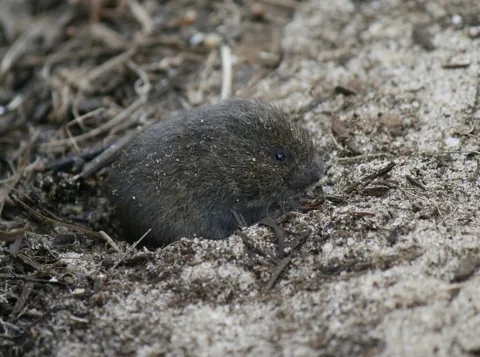 Voles (meadow mice)
Microtus species (shown: meadow vole, M. pennsylvanicus)
Voles, often called meadow mice, are small burrowing rodents that live in dense grass and ground cover. Their clearest sign is a maze of narrow surface runways, and they damage lawns, garden plants and the bark of young trees.
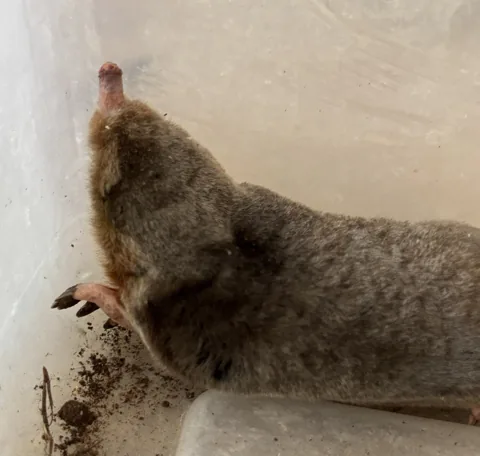 Moles
Talpidae (shown: eastern mole, Scalopus aquaticus; Scapanus species in the West)
Moles are small insect-eating mammals related to shrews, not rodents. They spend almost their whole lives underground hunting earthworms and insects, and their tunneling leaves raised ridges and mounds that disfigure lawns and gardens.
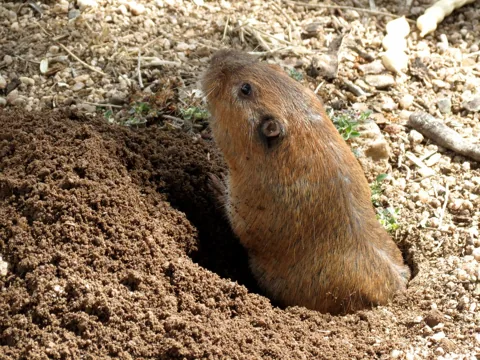 Pocket gophers
Thomomys and Geomys species (shown: Botta's pocket gopher, Thomomys bottae, listed by iNaturalist as Megascapheus bottae)
Pocket gophers are burrowing rodents named for the fur-lined cheek pouches they use to carry food. They rarely come above ground, but a single gopher can ruin a garden quickly by eating roots and pulling plants into its tunnels.
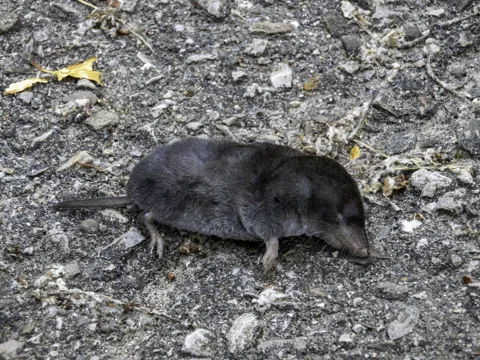 Shrews (northern short-tailed shrew)
Soricidae (e.g., Blarina brevicauda)
Shrews are small insect-eating mammals with long, pointed snouts and tiny eyes. They are mouselike but not mice, and the wildlife damage handbook notes that most species have no significant negative impact and aren't abundant enough to be pests. They eat large numbers of insects, including lawn and crop pests. This page uses the common northern short-tailed shrew as its main example.
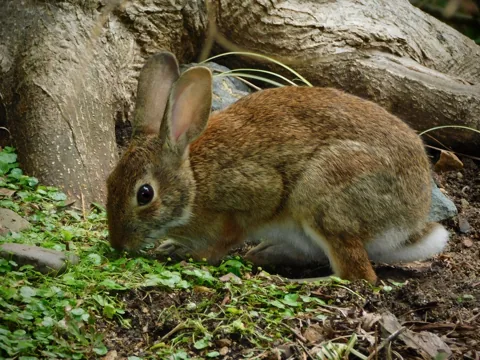 Rabbits (cottontails; eastern cottontail shown)
Sylvilagus species (shown: eastern cottontail, S. floridanus)
Cottontail rabbits are common in yards with brush and dense landscaping. They clip vegetables and flowers in spring and summer and gnaw the bark of young trees and shrubs in fall and winter.
Vole, mole, shrew, mouse or gopher?
Voles are often confused with other small animals that tunnel in yards, and the fixes differ, so identify the animal before you start. Penn State notes that methods that work on one species may be useless on another.[8]
Voles have stocky bodies, short legs, short tails, small eyes and ears that barely show through the fur. Most are brown or gray. Penn State gives 5 to 7 inches long for mature voles, UC IPM 5 to 8 inches including the tail; ICWDM lists 4 to 6 inches total for the pine (woodland) vole and up to 8 1/2 inches for California and montane voles.[8][1][4]
- Voles vs. moles: moles have greatly enlarged front feet with big digging claws, no external ears and very small eyes. They are not rodents and live on earthworms, insects and other invertebrates. Their sign is raised ridges and roughly circular mounds with the plug in the middle; voles leave runways and open holes instead.[8][10][2][3]
- Voles vs. shrews: shrews are smaller, with long pointed snouts and pointed front teeth, and they eat insects and little plant material. Voles have blunt, rounded snouts and chisel-shaped front teeth.[8][10][11]
- Voles vs. mice: the easiest tell is the tail. A mouse's tail is long, nearly half its body length; a vole's is short, about 1 inch in Nebraska's voles. Voles rarely come into houses.[8][9][1]
- Voles vs. pocket gophers: gophers push up crescent- or horseshoe-shaped mounds of loose soil with a plugged hole off to one side. Vole burrow openings are left open, without a mound. Both girdle trees, but vole girdling is generally above ground and gopher girdling below ground.[3][1]
- Damage blamed on moles is often voles: voles use mole tunnels to reach bulbs and plant roots, while moles rarely eat plants. UC IPM says chewing damage to roots and bulbs is almost always caused by rodents such as gophers and voles rather than moles.[9][11][2]
Signs of voles in the yard
You may see a vole dart across the grass, but most of the time they stay hidden in their burrows, so look for what they leave behind.[1]
- Runways: a network of surface paths about 1 to 2 inches wide, kept clear and often hidden under grass or ground cover, with grass along them clipped close to the ground. Pull back overhanging cover to find them.[6][8][1]
- Burrow holes: many openings along the runways, each about 1-1/2 to 2 inches across, per UC IPM.[1]
- Droppings and clippings: rice-shaped droppings, green when fresh and turning brown or gray, plus bits of freshly cut grass in the runways. Penn State says vegetation, small roots or mold growing in a path mean voles no longer use it.[1][8]
- Lawn trails after snowmelt: meadow voles travel under snow into open lawn, and the criss-cross network shows up in spring. Penn State and Nebraska say this lawn damage is usually temporary and the grass recovers.[8][9]
- Pine (woodland) voles: they don't use surface runways. They tunnel underground, push up small conical piles of soil, and eat roots, so injured trees just grow slowly and look off-color or sickly.[8][9][6]
- Gnawed bark: irregular patches of gnaw marks at various angles near the base of the trunk. UC IPM and Penn State give marks about 1/8 inch wide and 3/8 inch long; Nebraska gives individual tooth marks about 1/16 inch wide. Rabbit marks are larger and more regular, and rabbits clip branches with a clean, angled cut. Under snow, vole gnawing can reach a foot or more up the trunk.[1][8][9][6]
Why vole numbers explode
Voles are active day and night all year and don't hibernate. They can breed any time of year, with peaks in spring (and fall, in Nebraska). Females mature in 35 to 40 days, gestation is about 21 days, and litters average 3 to 6 young (3 to 5 in Nebraska). Litters per year vary by source and species: 1 to 5 (Penn State, ICWDM) or 5 to 10 (UC IPM; Nebraska for prairie and meadow voles).[1][8][5][9]
Populations rise and crash in cycles: UC IPM gives peaks every 3 to 6 years, Penn State and ICWDM every 2 to 5 years, and the cycles aren't predictable. During outbreaks densities have reached thousands per acre; ICWDM cites 4,000 voles per acre.[1][8][5]
Most voles live less than a year. Hawks, owls, snakes, foxes, weasels, cats and other predators eat them, but voles breed faster than predators can catch them.[1][9][8]
What voles damage
Voles eat grasses, other plants, bulbs and tubers, and in fall and winter they eat bark and roots. UC IPM lists vegetables such as beet, cabbage, carrot, lettuce, spinach, sweet potato and tomato, plus lilies and other landscape plants, and fruit trees including apple, cherry, citrus and olive.[1][5]
If they chew all the way around a trunk or root, the tree is girdled and can die. Partial girdling shows up as poor vigor and yellowish leaves. Damage under snow often goes unnoticed until it's too late, and Nebraska says bark damage is costliest in winter, when other food is short. Voles can also chew holes in irrigation lines.[1][9]
Check the rules first
Voles are classed as nongame mammals in California and Pennsylvania, and in both states they can be controlled when they are causing damage. Missouri's Wildlife Code allows damage-causing voles to be trapped or shot (3 CSR 10-4.130). ICWDM advises checking with your state wildlife agency for local rules, and Nebraska Extension notes that propane-oxygen exploding devices are illegal in Nebraska.[1][8][10][4][9]
Step 1: Remove cover and food
Voles need dense cover. Weeds, heavy mulch and thick ground cover give them food and protection from predators, and when that cover goes their numbers drop. Removing cover also makes it easier to spot new activity.[1][8]
- Mow lawns and grassy areas regularly. Penn State suggests keeping ground cover at 3 to 6 inches.[8][10][7]
- Clear mulch back from tree trunks: 2 feet or more per Penn State, 3 feet or more per the Missouri Department of Conservation and ICWDM. UC IPM suggests a vegetation-free circle 4 feet across around young trees or vines, since voles prefer not to feed in the open.[8][10][7][1]
- A layer of crushed stone or gravel 3 to 4 inches deep around the trunk also makes a vegetation-free zone. Don't let prunings, leaves or other debris pile up at the base of trees.[8][7]
- Watch plastic weed barriers: Nebraska Extension notes voles often thrive under them around shrubs and trees.[9]
- Remove bird feeders or cut down on spilled seed.[7][9]
- Mow, till or otherwise manage weedy edges, ditch banks and field borders next to the garden; these are where invading voles come from. Nebraska says voles are less likely to cross weed-free zones 15 feet wide, though snow cover can still let them in.[1][9]
Step 2: Hardware cloth guards and fences
Exclusion protects the plants you care most about: young trees, shrubs, flower beds and gardens. Use hardware cloth or wire mesh with openings of 1/4 inch or smaller.[1][8][9][10]
- Tree guards: wrap young trunks in hardware cloth, sheet metal or heavy plastic cylinders, buried 4 to 6 inches into the soil (UC IPM, Penn State) or 6 inches (Missouri Department of Conservation, ICWDM) so voles can't dig under. Penn State suggests cylinders 18 to 24 inches high, and where snow falls they need to stand taller than the expected snow depth, drifts included.[1][8][10][7][9]
- Leave room for growth, since galvanized hardware cloth lasts about five years; Penn State says to size guards for 5 years of growth. Overlap the edges at least 1 inch and fasten them, cover the tops so cavity-nesting birds don't get trapped, and brace guards so they don't press against the trunk. Check them often for voles that dug under or are hiding inside.[9][8][1]
- Garden fences: UC IPM and Nebraska suggest fencing about 12 inches high around beds or gardens. UC IPM buries the bottom edge 6 to 10 inches; Nebraska buries it 2 to 3 inches, or about 6 inches where pine voles are the problem. A weed-free strip outside the fence helps.[1][9]
- Penn State says large-scale fencing is probably not cost-effective, so save fences for small, valuable areas.[8]
Step 3: Trap voles in their runways
Trapping works when vole numbers are low or concentrated in a small area. Nebraska puts the limit at less than an acre, and ICWDM says trapping is not cost-effective over more than 1 acre because of the time and labor costs. Penn State calls it the safest way to remove voles from home grounds.[1][9][7][8]
- Use plenty of traps: UC IPM says a dozen is probably the minimum for a small garden, and Nebraska suggests two to three per runway or hole. Ordinary mouse snap traps work; multiple-catch mouse traps also catch voles, especially meadow and prairie voles.[1][9][7]
- Set each trap at right angles to the runway with the trigger end in the runway. Bait is optional because voles run across the trap; if you bait, use a peanut butter and oatmeal mix or apple slices.[1][9][8]
- Cover the traps with a box, a piece of gutter or a board with 1-inch openings, so birds and squirrels can't reach them, especially baited ones. Leave room for the trap to snap.[1][7][8]
- Penn State finds voles easiest to trap in fall and late winter, and ICWDM says many species are more vulnerable in fall and winter when food is limited.[8][7]
- Check traps daily (Penn State says morning and evening). When a spot stops producing, move the traps 15 to 20 feet away; if you catch nothing after two nights of fair weather, move them. Afterward, break up old runways and burrows with a shovel or tiller.[1][8][9]
- Wear rubber gloves or use a plastic bag over your hand to handle dead voles, then bury them or bag them for the trash. Voles can carry pathogens and parasites, and Nebraska lists tularemia among the diseases they have been linked to. Keep children and pets away from trap sets.[1][9]
Monitor so you catch the next outbreak early
Because vole numbers can climb fast, keep watching after you get control. ICWDM suggests apple slices under an upside-down box with 1-inch half-moon holes cut in the edges, or under a 1-foot square of asphalt roofing shingle; voles that find them show you where they are active. Look regularly for fresh runways, droppings and clippings, especially next to heavily vegetated areas.[7][1][9]
Repellents, predators and gadgets: what the evidence says
Plenty of products and home remedies are sold for voles. Here is how the extension and wildlife sources rate them.[1][8][9]
- Taste and odor repellents: products with capsaicin, castor oil or thiram are sold for voles, but UC IPM calls their efficacy questionable and Penn State says little data exists; the Missouri Department of Conservation says no repellents are known to be effective. Don't make them your only method. They must go on before damage starts, need reapplying after rain or new growth, and are hard to apply at or below the soil line where voles feed. Don't use them on food plants unless the label allows it.[1][8][10][9]
- Predator urine: ICWDM reports that bobcat, coyote and fox urine has been shown to reduce vole numbers and damage, and Nebraska says coyote and fox urine may disperse voles and reduce their breeding. Wear waterproof gloves, since the urine may not be sterile, don't use liquid urine on food plants, and use care because it can burn plants.[7][9]
- Ultrasonic and electromagnetic devices: UC IPM calls them ineffective against voles, Penn State says frightening devices don't reduce damage, and Nebraska says there's no evidence they work.[1][8][9]
- Mothballs: not effective, and the naphthalene in them is toxic and the vapor harmful to people, per the Missouri Department of Conservation. Nebraska also advises against unregistered products.[10][9]
- Gas cartridges and fumigants: vole burrows are shallow, complex and full of open holes, so the gas escapes. Flooding doesn't work either.[1][8][10][9]
- Owls, hawks and cats: many predators eat voles but can't keep numbers below damaging levels. Owl boxes and raptor perches have mixed or unproven results for voles; they may help keep numbers low after you have knocked a population down, and Penn State advises against them where poison baits are used heavily.[1][7][8]
Poison baits: who can use them and the risks
Sources describe toxic baits mainly for large populations and large areas such as orchards and Christmas tree plantations. Sources describe zinc phosphide, a single-dose bait with no antidote, and anticoagulant baits that need several feedings and take 5 to 15 days to work.[8][7][1]
Access depends on the product and your state. Penn State says zinc phosphide and anticoagulant vole baits are restricted-use pesticides that only certified applicators (or people they directly supervise) may use. UC IPM says zinc phosphide is the only toxicant for voles in residential settings in California, is restricted use, and may only be used in non-residential lawns, ornamentals, golf courses and parks. Nebraska's 2011 guide separates general-use from restricted-use vole baits, so read the label and check with your extension office.[8][1][9]
All vole baits are poisonous to pets, children, birds and other wildlife, and animals can be poisoned by eating poisoned voles. Zinc phosphide is a particular hazard to ground-feeding birds. Bait goes in burrow openings, runways or bait stations, never in piles or on bare soil, and only where the label allows.[8][7][9][10]
When to call a professional
If voles are damaging a large planting or you'd rather not trap or handle baits, Penn State points homeowners to wildlife pest control operators and the local extension office. In most backyards, though, Nebraska says vole problems involve small populations that habitat changes, fencing, trapping and repellents can handle.[8][9]
Common questions
- How do I know if I have voles or moles?
- Voles leave runways about 1 to 2 inches wide on the surface with open holes, clipped grass and droppings, and they chew plants and bark. Moles push up raised ridges and roughly circular mounds and eat earthworms and insects, not plants.[6][2][8]
- What is the fastest way to get rid of voles?
- In a yard or garden, mouse snap traps set across active runways, a dozen or more for a small garden, combined with removing cover so new voles don't move in. Toxic baits are faster over large areas but are mostly restricted-use and risky around pets and wildlife.[1][8][9]
- Will my lawn recover from vole damage?
- Usually. The runways that show up after snow melts are typically a temporary problem, and the lawn recovers quickly once the voles leave.[8][9]
- Do castor oil or other repellents get rid of voles?
- The evidence is weak. UC IPM calls vole repellents, including castor oil and capsaicin products, questionable and often impractical, and Penn State says they shouldn't be the only method used.[1][8]
- Do voles come into the house?
- Rarely. Voles are poor climbers and usually don't enter buildings. If one does, mouse snap traps or live traps set as for house mice will catch it.[1][8][7]
- When do voles do the most damage to trees?
- Mostly in fall and winter, when other food is short, and often under snow, where it goes unnoticed until spring.[5][8][1][9]
Photo credits
- Voles (meadow mice): (c) David LaMagna, some rights reserved (CC BY) — via iNaturalist, CC BY 4.0
- Moles: (c) Sam Kieschnick, some rights reserved (CC BY) — via iNaturalist, CC BY 4.0
- Pocket gophers: (c) Katja Schulz, some rights reserved (CC BY) — via iNaturalist, CC BY 4.0
- Shrews (northern short-tailed shrew): (c) Shaun Coleman, some rights reserved (CC BY) — via iNaturalist, CC BY 4.0
- Rabbits (cottontails; eastern cottontail shown): (c) Michael J. Papay, some rights reserved (CC BY) — via iNaturalist, CC BY 4.0
Sources
- University of California Statewide IPM Program, “Voles (Meadow Mice) (Pest Notes, Home and Landscape).” ipm.ucanr.edu/home-and-landscape/voles/ (accessed 2026-11-10)
- University of California Statewide IPM Program, “Moles (Pest Notes, Home and Landscape).” ipm.ucanr.edu/home-and-landscape/moles/ (accessed 2026-11-10)
- University of California Statewide IPM Program, “Pocket Gophers (Pest Notes, Home and Landscape).” ipm.ucanr.edu/home-and-landscape/pocket-gophers/ (accessed 2026-11-10)
- Internet Center for Wildlife Damage Management, “Voles: Identification.” icwdm.org/species/rodents/voles/ (accessed 2026-11-10). Run by university wildlife damage specialists; species modules are based on Prevention and Control of Wildlife Damage (University of Nebraska Cooperative Extension, 1994).
- Internet Center for Wildlife Damage Management, “Vole Biology.” icwdm.org/species/rodents/voles/vole-biology/ (accessed 2026-11-10). Run by university wildlife damage specialists; species modules are based on Prevention and Control of Wildlife Damage (University of Nebraska Cooperative Extension, 1994).
- Internet Center for Wildlife Damage Management, “Vole Damage.” icwdm.org/species/rodents/voles/vole-damage/ (accessed 2026-11-10). Run by university wildlife damage specialists; species modules are based on Prevention and Control of Wildlife Damage (University of Nebraska Cooperative Extension, 1994).
- Internet Center for Wildlife Damage Management, “Vole Damage Prevention and Control Methods.” icwdm.org/species/rodents/voles/vole-damage-prevention-and-control-methods/ (accessed 2026-11-10). Run by university wildlife damage specialists; species modules are based on Prevention and Control of Wildlife Damage (University of Nebraska Cooperative Extension, 1994).
- Penn State Extension, “Voles (S. T. Falker, M. C. Brittingham, L. Williams).” extension.psu.edu/voles (accessed 2026-11-10)
- University of Nebraska-Lincoln Extension, “Controlling Vole Damage (G887, revised 2011; S. M. Vantassel, D. M. Ferraro).” cms.unl.edu/ianr/extension/wildlife/sites/unl.edu.ianr.extension.wildlife/files/media/file/controlling-vole-damage.pdf (accessed 2026-11-10)
- Missouri Department of Conservation, “Vole Control.” mdc.mo.gov/node/136 (accessed 2026-11-10)
- University of Missouri Extension, “Controlling Nuisance Moles (G9440).” extension.missouri.edu/publications/g9440 (accessed 2026-11-10)