The short answer
- Make sure it's a chipmunk: a small striped squirrel that runs with its tail held straight up, and a neat burrow hole about 2 inches across with no pile of dirt around it.[1][2][6][7]
- Take away food and cover: keep birdseed off the ground or move feeders 15 to 30 feet from the house, store pet food and seed in rodent-proof containers, keep firewood and debris away from walls, and don't let shrubs and ground cover run in a continuous line from woods to the foundation.[5][4][3]
- Block entry with 1/4-inch hardware cloth or caulk over openings, screen low dryer vents and downspouts, and lay hardware cloth under the soil over bulbs, extending at least a foot past the bed.[4][5][6][7]
- Trap in an area under an acre: prebait live traps or rat-sized snap traps with peanut butter, nuts or seeds for 2 to 3 days, then set them along travel routes. Cover snap traps with a box so birds and pets can't reach them.[5][4][7][6]
- Check your state's rules first. Chipmunks aren't protected by federal law, but states set the rules for killing or relocating them. There are no toxic baits registered for chipmunks, and repellents give only partial protection.[1][5][6][7]
Related profiles
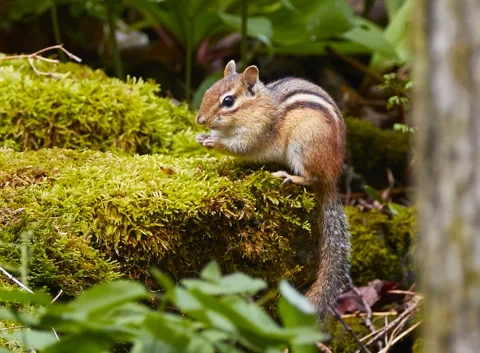 Eastern chipmunk
Tamias striatus
The eastern chipmunk is a small, striped ground squirrel that lives in woodland edges and around homes. Most problems are a nuisance, but many chipmunks burrowing near a house can undermine patios, stairs, retaining walls and foundations.
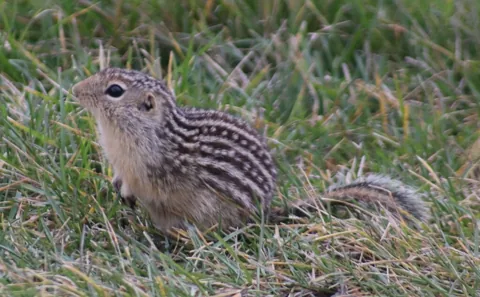 Thirteen-lined Ground Squirrel
Ictidomys tridecemlineatus (formerly Spermophilus tridecemlineatus)
The thirteen-lined ground squirrel is a small, striped ground squirrel of the Midwest and Great Plains that favors short-mown grass. It digs up newly planted seeds and raids vegetable gardens, but it also eats many crop-damaging insects.
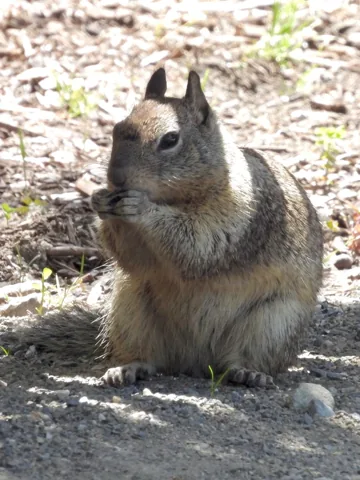 Ground Squirrels
Otospermophilus beecheyi and O. douglasii (California ground squirrel)
Ground squirrels are burrowing rodents that forage above ground near their tunnels. The California ground squirrel is the most common species around homes and gardens in the West, where its digging and feeding can do considerable damage. Los Angeles County's agricultural commissioner calls it the ground squirrel most likely to be met there; it is also known as the Beechey ground squirrel.
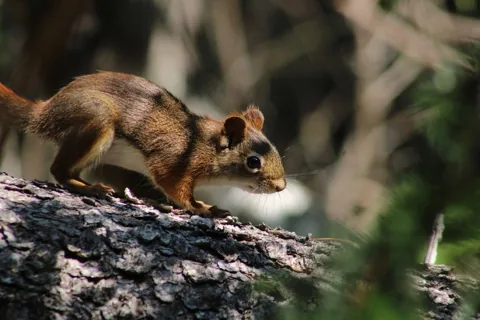 American red squirrel (pine squirrel)
Tamiasciurus hudsonicus
The American red squirrel is a small, rusty-red tree squirrel of conifer and mixed forests across the North and the mountains. It is noisy and territorial, and it can move into attics and other parts of buildings, sometimes filling them with stored pine cones.
Chipmunk, ground squirrel or red squirrel?
The eastern chipmunk is a small, brown, ground-dwelling squirrel. ICWDM and Penn State give 5 to 6 inches of body plus a 3- to 4-inch hairy but not bushy tail and a weight of about 3 ounces; North Carolina, Georgia and Missouri sources give a total length, tail included, of 8 to 10 inches (8 to 12 in the Missouri field guide).[1][5][9][6][7][8]
Look for stripes on the face as well as the back. Eastern chipmunks have dark stripes running from the shoulders to a reddish rump with tan or buff bands between them, and two tan and two brown stripes on each side of the face. They carry food in furred cheek pouches and often sit up to eat.[1][5][8][7]
North America has fifteen native chipmunk species in the genus Eutamias plus the eastern chipmunk in the genus Tamias. The eastern chipmunk covers most of the eastern US except the southeastern coast and Florida, and the smaller least chipmunk (3 to 4 1/2 inches) ranges across much of Canada, the Rocky Mountains, the Great Basin and parts of the upper Midwest. ICWDM says their behavior and damage are similar, so control is the same.[1]
- Thirteen-lined ground squirrel: 13 alternating light and dark stripes from head to rump, the dark ones broken by rows of light spots. When startled, a ground squirrel carries its tail level along the ground; a chipmunk holds its tail upright.[8][1]
- California ground squirrel (West): much bigger, 14 to 20 inches including the tail and 21 to 30 ounces, with mottled brown fur, a white ring around each eye and a somewhat bushy tail. It lives in colonies with burrows about 4 inches across.[10]
- Red squirrel: larger than a chipmunk, with a bushier tail, no lengthwise stripes and a high-pitched chatter; it spends much of its time in trees, while chipmunks stay mostly on the ground.[1][5]
- Tree squirrels flee up a tree or structure and never use a burrow; ground squirrels and chipmunks run to a burrow.[10]
Burrows and signs
Chipmunks are active by day, mostly in the early morning and late afternoon, so you usually see them. Tracks are rarely found.[5][1][9]
- Burrow entrance: about 2 inches across (2 to 3 inches per Missouri Extension), cut neatly through the turf and dropping almost straight down, with no mound of soil. Chipmunks carry the dirt away in their cheek pouches and scatter it.[2][5][7]
- Where: often hidden next to stumps, wood or brush piles, rock walls, basements, garages, patios and foundations, at the base of fallen logs or beside large stones.[2][5][6][7]
- Underground: the main tunnel is usually 20 to 30 feet long (30 feet or more per Georgia Extension), with a nest chamber, one or two food storage chambers, side pockets and separate escape tunnels. Burrows get more complex where cover is sparse.[2][5][6][7]
- Sound: a sharp 'chuck-chuck-chuck' call, and a high-pitched warning call when danger approaches.[1][5]
- Feeding sign: dug-up bulbs and seeds, nibbled seedlings, and gnawed bags of dog food or birdseed.[6][5][3]
How much damage do chipmunks do?
Usually not much. ICWDM says most chipmunk damage involves minimal economic loss and that most conflicts are nuisance problems. Missouri Extension says chipmunks seldom cause economic damage, and Georgia Extension says they rarely become abundant enough to do a lot of damage, though an urban yard can hold as many as 20.[4][3][7][6]
The damage claims about structures come with a qualifier. Penn State says chipmunks in large numbers can cause structural damage by burrowing under patios, stairs, retaining walls or foundations. ICWDM says homeowners report chipmunks are destructive when they burrow around structures, that this warrants control to protect stairs, patios and foundations, and that digging may undermine retaining walls and cause collapse.[5][4][3]
Other damage the sources list: burrows that damage pool liners, clogged downspouts that back water up along foundation walls and soffits, entry into buildings along the sill plate, through dryer vents, along the roof line and under siding, gnawed shrub bark, and, in New England, chewed maple sap tubing. Chipmunks do little damage to lawns.[3][6]
Health risk is low. ICWDM says chipmunks generally don't pose a direct threat to people or pets, usually flee when approached and aren't significant carriers of diseases harmful to humans. Western ground squirrels are different: UC IPM warns that their fleas can carry plague and that you should report unusual numbers of dead squirrels to public health officials and not handle them.[3][10]
Chipmunk habits that matter for control
Eastern chipmunks are mostly solitary and territorial, so a yard usually holds a few separate animals, each with its own burrow.[2][8]
- Territory: a home range may reach half an acre, but an adult defends only about 50 feet around its burrow. Two to 4 chipmunks per acre is typical, up to 10 per acre with enough food and cover.[2][5][7]
- Young: two litters a year, born after a 31-day gestation, in spring (April to May) and again in late summer (August to October in Pennsylvania). Litters are 2 to 5 young (1 to 8 in Missouri's field guide), and the young start exploring above ground at 5 or 6 weeks.[2][5][7][8]
- Winter: chipmunks go inactive from late fall and live on food stored in the burrow rather than hibernating deeply. Some come out on warm winter days, and most are back above ground by early March.[2][5]
- Food: nuts, seeds, grains, berries, mushrooms, insects and carrion, plus bird eggs and nestlings. They cache food all year; a storage chamber can hold up to half a bushel of nuts and seeds.[2][5][8][7]
- Lifespan: up to 3 years in the wild according to Penn State and Missouri Extension, up to 5 according to the Missouri Department of Conservation.[5][7][8]
Bird feeders, firewood and landscaping
Spilled birdseed keeps chipmunks fed right next to the house. Penn State recommends putting bird feeders at least 15 to 30 feet from buildings, and ICWDM recommends feeders that keep rodents out and catch fallen seed before it hits the ground.[5][4]
Cover is the other half. Burrows next to a foundation are hard to find when wood piles, debris or ground cover plantings shelter them, so don't stack firewood against buildings and keep the grass short along the edges of the house.[5][4]
Break the green corridor. Penn State and ICWDM advise against planting ground cover, trees and shrubs in a continuous line that connects wooded areas to the foundation. ICWDM also suggests removing or mortaring stone walls.[5][4]
Missouri Extension notes that wooded lots, thick ornamental shrubbery and dry rock walls draw chipmunks, and that because most people don't want drastic landscape changes, some simply decide to tolerate them.[7]
Hardware cloth and exclusion
Close openings into buildings with 1/4-inch hardware cloth, caulk or similar materials. Georgia Extension lists the places to check: where gas lines, cooling lines, electric cables, dryer vents and cable TV lines enter the house.[5][4][6][7]
Screen a low dryer vent (ICWDM advises a professionally made vent screen because of the fire hazard), and cover downspouts with wire mesh or use gutter guards. Mesh downspout covers need regular cleaning if you don't have gutter guards.[6][4]
To protect bulbs and seeds, lay 1/4-inch hardware cloth over the planting, cover it with soil, and extend it at least 1 foot past every edge of the bed.[5][4][7]
For an active burrow, ICWDM's advice is to wait until the animals are out, fill the hole with soil and cover it with a rock or other heavy object.[4]
Penn State and Missouri Extension say that where chipmunks are numerous, exclusion often costs less than trapping in the long run. ICWDM calls exclusion expensive and practical only in limited situations.[5][7][4]
- Buried mesh barrier: ICWDM's design for fenced sites such as electrical substations is a trench 18 inches wide and 18 inches deep along the fence, with galvanized hardware cloth of 1/2-inch or smaller mesh (6 feet wide) laid across the trench bottom and up the side, continuing 3 feet up the fence, then backfilled, with 2 to 3 feet of sheet metal above it and gates within 1/2 inch of the ground.[4]
- None of the sources here gives a chipmunk-specific buried footer for patios, stoops or slabs. The bulb-bed method and the trench design above are what they describe, so treat any patio footer as an adaptation of those.[4][5]
Trapping chipmunks
Trapping is the most practical way to remove chipmunks in most home situations, and ICWDM calls it practical for areas under 1 acre. Expect follow-up trapping, because new chipmunks move in from surrounding areas.[5][7][6][4]
How many traps: ICWDM suggests counting the chipmunks you see and multiplying by 3.[4]
Bait with peanut butter (alone or mixed with oats), nut meats, sunflower or pumpkin seeds, raisins or breakfast cereal grains. Prebait for 2 to 3 days with live-trap doors wired open, or snap traps unset, until the chipmunks feed on the bait, then set the traps.[5][7][6][4]
Place traps where chipmunks travel or feed, next to active burrows or along walls. Anchor them so they don't move when an animal steps in.[5][7][4][6]
- Live traps: at least 3 x 3 x 10 inches with 1/4-inch mesh, per ICWDM. Cover half of the trap for shelter and to hide the bait from birds and tree squirrels, and put bait at the back. Georgia Extension names the No. 0 and No. 102 sizes of two common live-trap brands.[4][6]
- Snap traps: use rat-sized snap traps, which are bigger than mouse traps. Tie or glue bait to the trigger, set traps perpendicular to the travel route or in pairs with triggers facing away from each other, and anchor them.[5][7][4][6]
- Protect birds and pets: set snap traps under a box or inverted wooden box with a 2-inch hole at each end, or inside a rat-sized bait station. This reduces catches somewhat but keeps songbirds out. Penn State says snap traps should only be used where children, pets and wildlife can't get to them.[4][5]
- Check traps at least once a day, preferably at dusk, and rebait. If 2 or 3 days pass with nothing caught, move the trap. If bait disappears without the trap firing, try mouse-sized snap traps, since young chipmunks may be too light to spring a rat trap.[4]
- Don't handle trapped chipmunks directly, and release any non-target animal right away.[5]
State rules and releasing chipmunks
Chipmunks are not protected by federal law, but states regulate them. ICWDM says most states let landowners or tenants take chipmunks causing or about to cause damage, while some, such as Georgia and Arkansas, require a permit to kill non-game animals. Check with your state wildlife agency before you start.[1][6]
Examples: Pennsylvania protects chipmunks through the Game Commission but lets landowners take ones causing or about to cause damage. Missouri lists them as protected under the Wildlife Code but allows control when they cause damage. North Carolina classes the eastern chipmunk as nongame with no hunting or trapping season. Georgia protects all non-game wildlife and allows homeowners to protect property within state and local law.[5][7][9][6]
Releasing a live-trapped chipmunk is where sources disagree. Penn State says to release it several miles away where it won't bother anyone, and Missouri Extension says at least a mile away. Georgia Extension doesn't recommend releasing animals into unfamiliar territory because most die, notes you can't release them on someone else's property, and says releasing on county, state or federal land is illegal in most states. California makes relocating wildlife without a permit illegal.[5][7][6][10]
If you shoot chipmunks, check state rules and local ordinances first; firing a gun inside city limits is often illegal.[4][6]
Repellents: what the evidence says
Expect partial protection at best. ICWDM says repellents are expensive, usually don't stop all damage and that most commercial repellents haven't been adequately tested. Penn State says they don't give complete damage reduction, and Georgia Extension says there are no repellents registered for chipmunks.[4][5][6]
Taste repellents containing Bitrex, thiram, capsaicin or ammonium soaps of higher fatty acids can protect bulbs, seeds and foliage, and need repeated applications. Penn State limits them to plants not grown for food and notes the products are labeled for squirrels.[4][5][6]
Predator urine products (fox or coyote) are registered for repelling animals from lawns and gardens and are applied as a barrier according to the label. ICWDM's caution that most commercial repellents haven't been adequately tested applies to them too.[4]
Mothballs are out: naphthalene products aren't labeled for mammals, and Georgia Extension says using them that way violates pesticide law.[6]
Frightening devices: ICWDM says none are effective against chipmunks.[4]
Poisons and fumigants
Homeowners have no registered chipmunk poison. Penn State and Georgia Extension say no toxic baits or fumigants are registered for chipmunks, and Missouri Extension says no commercial toxic baits control them. Mouse and rat baits will kill chipmunks, but they aren't labeled for that use and Missouri Extension doesn't recommend them.[5][6][7]
Georgia Extension adds that because chipmunks carry food to their burrows, any bait is taken underground and you won't see results quickly, and that baits should only go outdoors where children and pets can't reach them. It points to the state pesticide product database for what's registered in Georgia.[6]
Sources differ on fumigants. ICWDM says burrow fumigants are effective for chipmunks in small areas. Aluminum phosphide is highly regulated, labeled for agricultural and non-cropland sites, and requires a written fumigation plan; gas cartridges are a fire hazard near buildings and in dry weather. Fumigants should never be used in or around buildings or where people, pets or livestock could contact the gas. Read the label and your state's registration before considering either.[4][5]
A plan for the yard
Start with food, cover and openings, then trap the chipmunks that stay. Follow-up trapping is often needed, because chipmunks from the surrounding area move in, and a yard that still offers seed and shelter keeps drawing them.[4][5][7]
- Week 1: find the burrows (look by stumps, walls, steps and the foundation), move or fix bird feeders, store seed and pet food in closed containers, and pull firewood and debris away from the house.[2][5][4]
- Same week: screen dryer vents and downspouts and seal utility openings with 1/4-inch hardware cloth or caulk. Put hardware cloth over new bulb plantings.[6][4][5]
- Prebait traps for 2 to 3 days, then set them. Count the chipmunks you see and use about 3 traps per animal.[5][4]
- Before you release or kill anything, confirm your state's rules.[1][6]
- After trapping, fill emptied burrows with soil and cap them with a rock, and keep watching: chipmunks from nearby areas will move into empty territory.[4]
Common questions
- Do chipmunks damage foundations?
- They can, but it's not usual. Penn State says chipmunks in large numbers can cause structural damage by burrowing under patios, stairs, retaining walls or foundations, and ICWDM says digging may undermine retaining walls. ICWDM says most chipmunk damage involves minimal economic loss.[5][3][4]
- How can I tell a chipmunk hole from other burrows?
- A chipmunk hole is about 2 inches across, neatly cut and drops almost straight down with no dirt pile. Western ground squirrel burrows are about 4 inches across and are often in colonies.[2][7][10]
- What is the best bait for a chipmunk trap?
- Peanut butter is hard to steal without springing the trap. Nut meats, sunflower or pumpkin seeds, raisins and cereal grains also work. Prebait for 2 to 3 days first.[4][5][7]
- Can I relocate a chipmunk I caught?
- It depends on your state. Penn State and Missouri Extension describe releasing chipmunks a mile or more away, while Georgia Extension says released animals usually die and releasing on public land is illegal in most states. California requires a permit to relocate wildlife.[5][7][6][10]
- Do mothballs or ultrasonic devices keep chipmunks away?
- No. Mothballs aren't labeled for use against mammals, so using them that way breaks pesticide law, and ICWDM says no frightening devices work on chipmunks.[6][4]
- Are chipmunks dangerous?
- Not usually. They flee when approached and aren't significant carriers of diseases harmful to people, according to ICWDM. Don't handle trapped animals with bare hands.[3][5]
- When do chipmunks have babies?
- Twice a year, in spring and late summer or early fall, after a 31-day gestation. The young start exploring above ground at 5 or 6 weeks.[2][5][8]
Photo credits
- Eastern chipmunk: David Bird, public domain (CC0), via iNaturalist
- Thirteen-lined Ground Squirrel: (c) Sean Frey, some rights reserved (CC BY) — via iNaturalist, CC BY 4.0
- Ground Squirrels: (c) Rudyard, some rights reserved (CC BY) — via iNaturalist, CC BY 4.0
- American red squirrel (pine squirrel): (c) oksanaetal, some rights reserved (CC BY) — via iNaturalist, CC BY 4.0
Sources
- Internet Center for Wildlife Damage Management, “Chipmunks: identification and legal status.” icwdm.org/species/rodents/chipmunks/ (accessed 2026-11-10). Run by university wildlife damage specialists; the chipmunk module is based on the chipmunk chapter in Prevention and Control of Wildlife Damage (Hygnstrom, Timm, Larson, eds., 1994).
- Internet Center for Wildlife Damage Management, “Chipmunk Biology.” icwdm.org/species/rodents/chipmunks/chipmunk-biology/ (accessed 2026-11-10). Run by university wildlife damage specialists; the chipmunk module is based on the chipmunk chapter in Prevention and Control of Wildlife Damage (Hygnstrom, Timm, Larson, eds., 1994).
- Internet Center for Wildlife Damage Management, “Chipmunk Damage Identification.” icwdm.org/species/rodents/chipmunks/chipmunk-damage-identification/ (accessed 2026-11-10). Run by university wildlife damage specialists; the chipmunk module is based on the chipmunk chapter in Prevention and Control of Wildlife Damage (Hygnstrom, Timm, Larson, eds., 1994).
- Internet Center for Wildlife Damage Management, “Chipmunk Damage Prevention and Control Methods.” icwdm.org/species/rodents/chipmunks/chipmunk-damage-prevention-and-control-methods/ (accessed 2026-11-10). Run by university wildlife damage specialists; the chipmunk module is based on the chipmunk chapter in Prevention and Control of Wildlife Damage (Hygnstrom, Timm, Larson, eds., 1994).
- Penn State Extension, “Chipmunks (S.T. Falker, M.C. Brittingham).” extension.psu.edu/chipmunks (accessed 2026-11-10)
- University of Georgia Cooperative Extension, “Chipmunk Control, Circular 910 (M.T. Mengak; reviewed December 2022).” fieldreport.caes.uga.edu/wp-content/uploads/2025/08/C-910_3.pdf (accessed 2026-11-10)
- University of Missouri Extension, “Controlling Nuisance Chipmunks, G9527 (R.A. Pierce II).” extension.missouri.edu/media/wysiwyg/Extensiondata/Pub/pdf/agguides/wildlife/g09527.pdf (accessed 2026-11-10)
- Missouri Department of Conservation, “Eastern Chipmunk (field guide).” mdc.mo.gov/discover-nature/field-guide/eastern-chipmunk (accessed 2026-11-10)
- North Carolina Wildlife Resources Commission, “Eastern Chipmunk.” www.ncwildlife.gov/species/eastern-chipmunk (accessed 2026-11-10)
- UC Statewide IPM Program, “Pest Notes: Ground Squirrel (UC ANR Publication 7438; N.M. Quinn, M.J. Dimson, R.A. Baldwin; revised June 2025).” ipm.ucanr.edu/legacy_assets/PDF/PESTNOTES/pngroundsquirrel.pdf (accessed 2026-11-10)