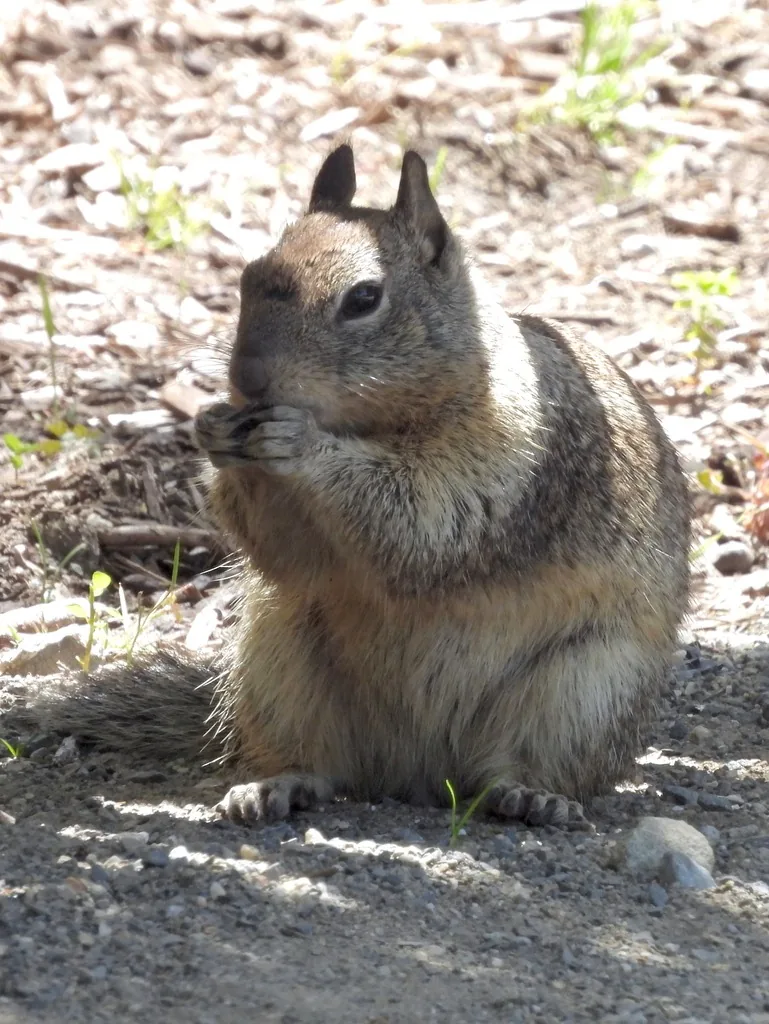
How to identify it
- Body and tail together measure 14 to 20 inches, and adults weigh about 21 to 30 ounces; males are a bit larger than females.[1]
- Fur is mottled brown with white and gray flecks on the back, and lighter browns, grays and white underneath.[1]
- A white ring circles each eye, the ears stand up, and the tail is somewhat bushy but less full than a tree squirrel's.[1]
- Burrow openings are about 4 inches across, and older entrances can be larger.[1]
Look-alikes
| Look-alike | How to tell them apart |
|---|---|
| Tree squirrels | A startled tree squirrel runs up a tree and almost never uses a burrow, while a frightened ground squirrel dives into its burrow.[1][3] |
| Pocket gophers | Gopher tunnels are closed and plugged, with crescent-shaped mounds; feeding holes are about 2 inches wide, smaller than ground squirrel openings.[3] |
| Voles | Vole burrow openings are only 1.5 to 2 inches across, usually in dense vegetation, with surface runways linking them.[3] |
| Moles | Moles leave closed tunnels, raised ridges and cone-shaped mounds rather than open burrow entrances.[3] |
Where it lives
The California ground squirrel lives throughout most of California and into northwestern Baja California, western Nevada, western Oregon and south central Washington.[1][2]
Biology and life cycle
They live in colonies of burrows, usually 5 to 30 feet long and within 2 to 3 feet of the surface, used for sleeping, raising young and storing food.[1]
They are active by day, mostly from midmorning through late afternoon, and usually forage within about 75 yards of the burrow.[1]
Most hibernate in winter, and many adults go inactive for days or more during the hottest weather, plugging the burrow with soil near the nest.[1]
Females have one litter a year, averaging 5 to 8 young, which first leave the burrow at about 6 weeks old.[1]
They eat green grasses and leafy plants in spring, then switch to seeds, grains and nuts and start storing food as plants dry out.[1]
Damage and signs
- They feed on grains and on nut and fruit trees such as almond, apple, apricot, avocado, orange, peach and walnut.[1]
- In gardens they eat vegetable seedlings and can kill young trees, vines and shrubs by gnawing or girdling bark.[1]
- They gnaw plastic sprinkler heads, irrigation lines and boxes.[1]
- Burrows make mowing hard, create tripping hazards, dry out tree roots, and can undermine buildings badly enough to need repair.[1]
Health risk
Ground squirrels can host fleas that spread plague to people and pets. If you find several dead squirrels for no clear reason, don't touch them and notify public health officials.[1][4]
Control
Prevention
Remove brush piles and debris; this takes away cover and makes squirrels and burrows easier to spot.[1]
Ground squirrels dislike dense vegetation, so letting grass grow taller can discourage them, though it may favor voles.[1]
Traps and physical control
Traps work when squirrel numbers are low to moderate; inspect them at least daily and keep children and pets away.[1]
Place box-type kill traps inside a covered box with a 3-inch entrance near active burrows to protect pets, children and other wildlife.[1]
Pesticides
Gas cartridges for burrow fumigation work best in spring when soil is moist; never fumigate in dry soil or during hibernation, and follow the label closely.[1]
Only fumigate active ground squirrel burrows, and skip any burrow that might hold kit foxes, burrowing owls or other nontarget animals.[1]
When to call a professional
Aluminum phosphide fumigant and zinc phosphide grain baits are restricted to licensed pest management professionals in California.[1]
Timing matters
Fumigating in spring is most effective because moist soil holds the gas in and squirrels die before they breed.[1]
Treated grain baits work better in summer and fall, when squirrels are eating mostly seeds.[1]
Filling burrows with soil doesn't stop reinvasion, since new squirrels quickly find and reopen old tunnels.[1]
What doesn't work
No frightening device or repellent has been shown to drive ground squirrels out of their burrows or away from an area.[1]
Burrow exploders aren't recommended for urban use and haven't proven effective.[1]
Hawks, coyotes and other predators eat ground squirrels but usually can't keep numbers low enough for a home gardener.[1]
Legal status
California classifies ground squirrels as nongame mammals that owners or tenants may control legally when they damage crops or property.[1]
Relocating wildlife in California requires a permit, so live-caught squirrels must be released on site or humanely euthanized.[1]
The smaller Mohave ground squirrel and San Joaquin antelope squirrel are listed as threatened, and their ranges may overlap, so confirm the species before acting.[1]
Common questions
- Is it a ground squirrel or a gopher in my yard?
- If you see the animal above ground and open 4-inch holes, it's likely a ground squirrel; gophers stay underground and plug their tunnels.[1][3]
- Can I use rat poison on ground squirrels?
- No. Products labeled for rats and mice should never be used on ground squirrels unless the label lists them as a target species.[1]
- Why do ground squirrels keep coming back?
- Squirrels from nearby land move into empty burrows, so homes next to open land need ongoing monitoring and quick action when new burrows appear.[1]
Sources
- University of California Statewide IPM Program, “Pest Notes: Ground Squirrel, Publication 7438 (revised June 2025).” ipm.ucanr.edu/legacy_assets/PDF/PESTNOTES/pngroundsquirrel.pdf (accessed 2026-10-06)
- University of California Cooperative Extension, Orange County (Ground Squirrel Best Management Practices), “Range and Habitat.” www.groundsquirrelbmp.com/range.html (accessed 2026-10-06). UC peer-reviewed publication supported by the Vertebrate Pest Control Research Advisory Committee.
- University of California Cooperative Extension, Orange County (Ground Squirrel Best Management Practices), “Look-Alike Pests and Damage.” www.groundsquirrelbmp.com/lookalikes.html (accessed 2026-10-06). UC peer-reviewed publication supported by the Vertebrate Pest Control Research Advisory Committee.
- University of California Cooperative Extension, Orange County (Ground Squirrel Best Management Practices), “Disease.” www.groundsquirrelbmp.com/disease.html (accessed 2026-10-06). UC peer-reviewed publication supported by the Vertebrate Pest Control Research Advisory Committee.
- iNaturalist, “Otospermophilus beecheyi taxon page (order and family).” www.inaturalist.org/taxa/180007 (accessed 2026-10-06)